“Feel Good Inaction”

This blog is a follow on from “Conspiracy of Silence” (click on the ARCHIVE, 18th May 2012).

Having remained silent for months on the deepening crisis in elderly care, there is a sudden outcry after the local elections have taken place.  All over the country Social Services are having to increase charges for domiciliary care, reduce grants to the voluntary sector and severely ration funds for residential care.

With completely inept timing, a few days after the elections are over, 78 charities, including Age UK, SAGA and the Local Government Association, publish an open letter to the Prime Minister, aimed at putting pressure on the Government to transform care of the elderly.  The self-appointed newspaper champion of the elderly – The Daily Mail – gave it front page coverage under the banner of its “Dignity for the Elderly” campaign.

This must be one of the longest and least listened to campaigns in recent history but it is no doubt, good for circulation and more stair lift advertising revenue.  Meanwhile, the politicians are too full of self-pity about their loss of support in the local elections to concern themselves about the plight of older people.

The charities undoubtedly feel good about belatedly raising the profile of the issue but they offer no new solutions.  They just keep banging on the drum for money, when they must know that in this time of Government austerity, there is little chance of success.  Their wholehearted support for the recommendations of the Dilnot report, requires an additional £1.7 billion of state funding and flies in the face of all the recent Government pronouncements about the economy.

They call on the Prime Minister to show “vision and courage” when they demonstrate none themselves.  They know that the majority of older people are home owners who are sitting in housing assets which are worth trillions of pounds.  These assets could be used to leverage high quality care and support for older people, but first, leaders in the voluntary sector need to be honest with the elderly and tell them they should no longer expect the state to fund their care.  They should also tell them to put their own well-being ahead of leaving a legacy to their grown up children.  This is not a message that the elderly will welcome, but it is the reality of later life, brought about not only by the economic crisis, but also by the ageing population.

Few politicians of any political persuasion, will face up to this unpalatable news, hence the prevarication about the Dilnot report.  That is precisely why the lead had to come from the charity sector and Age UK in particular.  To continue to call for more Government money and to encourage asset wealthy older people to think they can keep all their legacy, will only prolong the current paralysis of policy.

The new vision and radical change of thinking, needs to come from the voluntary sector.  The wealthiest older people paying for themselves will allow the limited Government funding to be used for those with no assets.

This is a tough uncompromising message, but one which this older generation will face up to if only the truth is told.  Giving them false hope that they can hang on to everything is disingenuous, when the demographic facts are plain to see.  It may make the voluntary sector feel good to be constantly campaigning for worthy causes but forthright and honest discussion is better.

Age UK already promotes equity release, they should encourage it as a major strategy for facilitating better lives for older people.  They could also champion long-term care insurance ahead of any decision being made on the Dilnot report.

The Local Government Association could lead a movement at local level for a large expansion of retirement housing by easing planning restrictions.  If the elderly downsize, it releases equity to support better later life and puts family houses back into the market.

Posted in ELDERLY UK POLICY | Tagged | 1 Comment

“Conspiracy of Silence”

The older generation tend to be more conservative both with a small “c” and a capital “C”.  They also tend to turn out to vote more than the younger generation.  Unless they are too frail to do so.

What so many of them fought to protect in the Second World War was the right to vote in a democracy and peacefully make a difference to people’s lives.  Now in recent elections, that right has been removed from them stealthily by their own politicians.  There is little difference between the positions of the three main political parties.  They all trot out platitudes about dignity and respect for older people but none of them do anything constructive about it.

In the run up to the last general election two years ago, there was a raging debate about funding of long-term care which only resulted after the election in the coalition kicking the issue into the long grass of the Dilnot report.  (Click in the TAG CLOUD on “Dilnot Commission” to see earlier blogs on this subject).

By the time the report was published in July 2011, care funding was in even greater crisis – hospital waiting times were increasing, Social Services were under severe pressure and report after report was damning standards of care of older people in the NHS, residential care homes and domiciliary services.

Meanwhile, the Dilnot report gathers dust on a shelf in Whitehall!

In the May 2012 local elections, little, if anything, was said about the crisis in care.  Except the cries from the charity sector for more money, which at a time of austerity, could only fall on deaf ears.

The silence on the issue of social care funding reflects the paralysis in all three political parties.  All of them are reluctant to tell the hard truth which is that there simply is not enough Government funding to properly provide good quality social or health care in later life, given the dramatic increase in longevity and the rise in the older population.  The majority of elderly people are going to have to pay for their own care by cashing in the value they have accumulated in their homes.

Until this issue is out in the open, older people will continue to hold onto their homes.  Equity release products remain tarnished by the poor value reputation of the past and without a decision on the Dilnot report, there is not likely to be an opening up of care insurance solutions.

Sadly, there are no votes in being the bearer of bad news, so the politicians continue to prevaricate.

The crisis in elderly care continues!

Posted in ELDERLY UK POLICY | Tagged | Leave a comment

A Cruel Deception.

I wrote scathingly about the £140 state pension when it was first heralded as a great step forward by Ian Duncan Smith, the Secretary of State for Work and Pensions.  (Click on Pensions under Topics to see more, or find ” the £140 Pension Illusion ” in the TAG CLOUD).

In the Queen’s Speech, at the opening of Parliament on the 9th May 2012, the prospect of this great pot of gold was again held out with an even bigger enticement of £155  per week for a single pensioner and £310 for a married couple.   Well above the current £107.45 basic state pension !

I first heard about this too-good-to-be-true proposal when it was announced by Ian Duncan Smith at the Age UK “Later Life” conference in 2011.   It takes great confidence to pull off a trick like this in front of a live audience, because what he didn’t make clear was that it did not apply to them.   The pensioners in the audience that day were told that it would not be introduced until 2015, but what IDS forgot to mention was that they will not qualify since this big rise will only apply to future retirees.   No doubt at the time he saw this as a rather politically inconvenient detail, which was not worth mentioning.

This callous move — if it ever happens at all — will leave current day pensioners on a lower rate state pension, living alongside newer pensioners who will receive the higher rate.   In carefully crafted words the Liberal Democrat Pensions Minister said “Our plan will radically simplify the state pension system and set it above the level of the means test, providing a fair and sustainable foundation for pension saving for people of working age.”   Presumably that means that it is OK if the system for existing pensioners  remains complex and unfair ?

A simple flat rate pension sounds like a good idea, but paying for it almost certainly means that universal pension benefits, like the winter fuel allowance, will be scrapped.

The old trick of giving in one hand and taking away in the other.

Posted in Pensions | Tagged , | Leave a comment

Elusive Cherry Blossom

This is the last of a series of posts which cover my visit to Japan in the spring of 2012.   For earlier posts click on “Japanese Odyssey” in the TAG CLOUD.  It ends with a  cartoon by Tom, who accompanied me on the trip, and fittingly  illustrates this land of art and technology.        We had a truly great time !

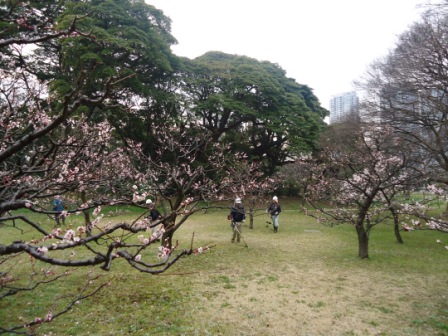
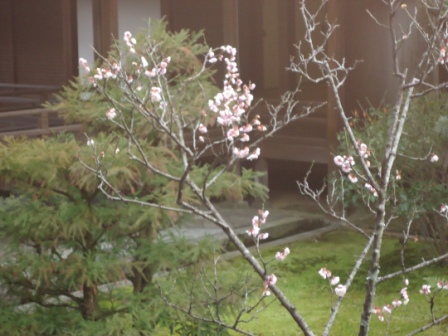
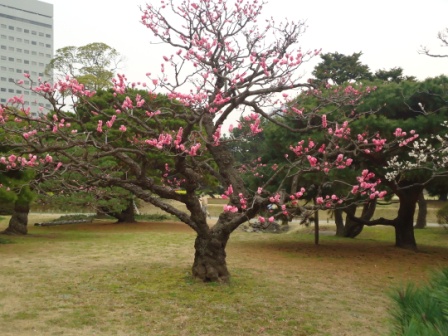
Japan is a land of stark contrasts , none more so than when the cherry trees come into bloom.  They draw out hoards of people in admiration.  It was one of the things we went to see and the reason that determined the timing of our trip.  Except, nature is not that predictable, and does not chime to the tune of travel agents holiday schedules.

When we arrived in Tokyo on the  20th March, the blossom had not yet come out.   The black barked branches were naked and uninviting  —  promise as yet unfulfilled.   Just a few early-bird trees tinged with red blossom buds.     Holding out the prospect of a more beautiful tomorrow.    [  A week later, we travelled further south to Kyoto, alas there the trees had bloomed and the elusive flowers had already blown away. ]


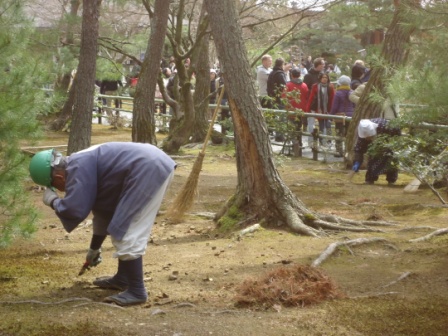
Beneath the expectant trees, a  broom of attendant gardeners busily tidy and titivate.  Ensuring their charges look their best when the blossom finally arrives.   The trees like brides exercising their privilege to be late on their wedding day.

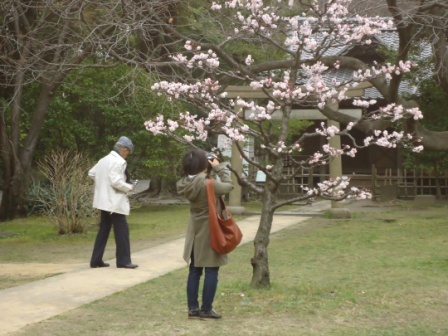
Even  with only the earliest signs of a flower, the photographers are in attendance. Admiring arborial paperatzzi waiting to snap a front page photo.

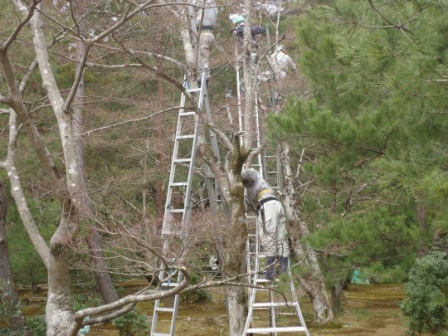
Gardeners on their knees and up in the trees.  Ladders reaching up to every branch.         All the  parks and green spaces have to be spring cleaned.   Weeding, pruning, clipping and tidying every last detail.     Nothing can be out of place when the wedding ceremony starts.

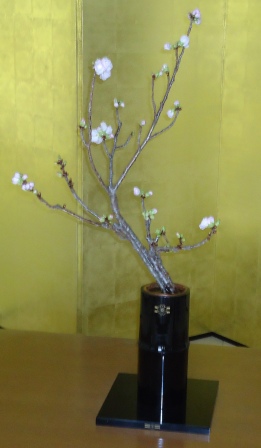
The art of ikebana  draws inspiration from the simplicity of nature, and brings the outside garden into the home.

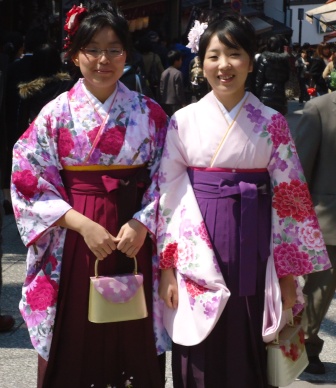
The cherry blosson decorates every thing in Japan at this time of the year not just the gardens.   These two young girls are on a special day out, celebrating their graduation in cherry flower kimonos and cherry blossom in their hair.

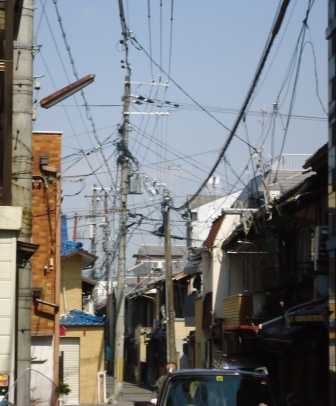
The back streets, in stark contrast to nature, pay tribute only to the virtues of electricity.  The spiders web of wires tells another storey of a country that has decorated the world with its technology.

Tom’s cartoon sums it up  in a single frame.

Posted in SMILES | Tagged | 1 Comment

“The Pill Go Round”

A recent report by Professor Sarah Harper of the Oxford Institute of Population Ageing, highlights the fact that we are too quick to use pills to solve our medical problems rather than making lifestyle changes.

I have written about this in my Pilly Galore blogs (click in the TAG CLOUD on “PILLS” to find them).

A follow-up article in the Daily Telegraph dated 19th March 2012, gives an excellent perspective on this, from a GP’s point of view – it’s written by Max Pemberton.   He outlines some of the issues as:-

  • “Patients want to feel their problem has been listened to and feel shortchanged if they don’t get a prescription”
  • “There are a growing number of drugs for everyday conditions such as high blood pressure or high cholesterol and consequently these get used as treatment”
  • Taking one drug can lead to having to take another and another”

Doctor Pemberton illustrates his point using his experience with an 80-year-old patient who was rather like Pilly Galore in her implicit faith in doctors.  I’ll call her “Unlucky Mabel” and you will see why as her story unfolds.

Unlucky Mabel had trouble sleeping, so she went to her GP and was given a sleeping pill.  It should have been called a “sleeper pill” because it had lots of unintended consequences:-

  • One side effect was incontinence so Unlucky Mabel got a pill for that too;
  • Another problem was constipation and Unlucky Mabel got two more drugs for that;
  • Blurred vision was a third added benefit of the sleeping pill but not to worry, Unlucky Mabel got eye drops for that.

Then Unlucky Mabel got really unlucky, when she was drowsy from her sleeping pills, she had a fall and broke her hip.   After the operation to mend her fracture, Unlucky Mabel got pills to strengthen her bones and more pills for the heartburn those pills caused.

You could not make this story up if you tried so I am grateful to Doctor Pemberton for telling it.

There again, from my own experience, this story is not so unusual.  Many older people take a cocktail of pills every day.   In our quick-fix go-away Health Service, a pill is the every day answer to a thousand problems.   I am sure every GP’s practice has its “Unlucky Mabel” stories.

Look on the good side, although Unlucky Mabel had a bad year, her treatment kept a great many health professionals employed :-

  • Researching the drugs to cure Unlucky Mabel’s sleeping problem,  and her incontinence,  and her constipation,  and her blurred vision,  and later on her weak bones  and her heartburn.
  • Marketing of the drugs to doctors who have to travel to far off medical centres of excellence like Mauritius or Honolulu, where they are told of the virtues of all these new drugs and that occasionally, they have a few side effects.
  • Dispensing the pills through GP’s, practice nurses, locum doctors and all the people employed in high street chemists.
  • And if all else fails, the NHS and all its consultants, registrars, junior doctors, nurses, auxiliaries and managers are all there to pick Unlucky Mabel up.
  • Finally, there are the researchers in universities who are able, with great hindsight and more distant objectivity, to see what those more wrapped up in Unlucky Mabel treatment can’t.

What a pity no-one asked Unlucky Mabel!

WHY CAN’T YOU SLEEP ?

Posted in N.H.S. | Tagged | 1 Comment

“Shinkansen Bullet Train”

This is one of a series of blogs which describe my trip to Japan in April 2012.  To see earlier blogs in the series, click on “Japan Odyssey” in the Tag Cloud.

Half-way through our holiday we travel from Tokyo to Kyoto on the renowned the bullet train.   Our luggage had been sent ahead the previous day  —  there is no room, or more especially, boarding time for messing around with luggage on the Shinkansen !   After our first day encounter with the super efficiency of Japanese Railways ( See the blog by clicking on the Archive  dated April 5 2012 ) we did not dare be late for the train.   So we set off  to Shinagawa station at 9.30am to catch the 11.56 am train   —   Hakari Express116 coach 12 seats 6A and 6C  —  with Mr J.R.’s instructions still ringing in our ears from 5 days before.   There was no-way we were going to let him down by missing the train. 

  The station is vast and the Shinkensen has it’s own set of platforms.   So we start by heading for the Information Office, for some easy turn-left, turn-right, up-the-escalator, turn-right, turn-left directions.   I think we got lost after the second turn-right, still we retraced our steps and they seemed  pleased to see us at the Information Office again 🙂    Next time we listen more carefully and do exactly as we were told.   Then we arrive at the ticket barrier and remembering  Mr JR’s instructions,  ” men are better than machines”, we don’t use the ticket machines.

In spite of our muddled wanderings, the station is organised, spotlessly clean and well provided with food shops offering a huge variety of boxed take-away suchi snacks.   The newsagents are full of manga comics and sudoku puzzles, but no English newspapers.  Nearer the platform, each coach has it’s own waiting room including a Starbucks and a row of computer terminals.

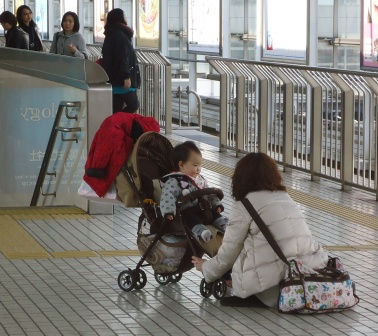
The platform has clear signs  —-  all in Japanese.   Once again they are sparkle- clean, to the point where you can sit on the floor  without getting your coat dirty.   This young mother wth her baby had no problem finding a space to sit, although seats might be a good inovation for old men with dogy western knees.

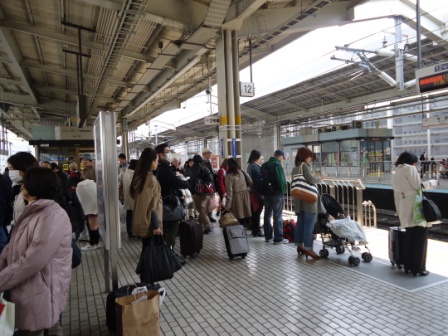
Trains arrive and depart every few minutes from each platform.  A few minutes before your train is due to arrive —  but not too soon in case you get swept off to Okinawa — you line up in a little marked box.   The train stops exactly at your marked carriage point.   All the train doors open automatically.     A quick ‘squirt’ of passengers spill from Coach 12, then with a short intake of breath the train ‘sucks’ on-board the line-up of new passengers in the box marked 12, which includes me and Tom.    A guards whistle and off we go, in less than two minutes, —-but it didn’t feel rushed.

The carriage is five seats wide with a larger than UK style central aisle.   So the trains must be wider than the UK.   All the seats are reserved in advance.   Soon up to 200 miles an hour, we speed through lots of tunnels and built up areas, almost all the way from Tokyo to Kyoto.   Small two storey detached houses interspersed with office blocks and industry.   A flat plain, bordered on one side with a range of heavily forested mountains,  the coast line is never far away on the other side.   Certainly you get the sense that this is a nation squeezed into a very small island.   Building space is in short supply.

 Add the jam-packed trains and crowded Tokyo streets, and just maybe you can begin understand the masks ???????

Sony, Panasonic, Suzuki, Toshiba, Nikon, Mitsubishi – flash by the window like railway ticker tape.     Global Japanese names dotted about in relatively small factories and office buildings.

First stop after an hour at Tokyo Hashi.   At the sound of a “bing bong”, a few people get up and put on their coats,  all are standing in the aisle when the train arrives.   All off in a 20 second ‘squirt’.   All new passengers on in another 20 second ‘suck’.   Train leaves in one minute 40 seconds.

Quarter of an hour later, next stop Nagoya.      Another one minute 40 second stop.

One unusual thing is that every member of the train staff, from the coffee lady to the ticket collector, as they walk through the carriage , stop as they exit the coach, turn around to face the passengers and bow their head – even if no one is looking.

Our final stop, all passengers due to get off are already in the aisle again.   No rocking about on this train, or abrupt stops.   After an announcement in excellent English, Tom and I are duely ‘squirted off’ at Kyoto.

Posted in SMILES | Tagged | 1 Comment

“Green T Makes U P”

As I start to think about packing for a long-awaited trip to Japan, I came across an interesting study by Tokyo University.  Their researchers followed the health care of 14,000 elderly people and related it to their diets over a three-year period.

We have all heard how much longer Japanese people live and the assumption that this may be linked to how much fish they eat.  So I am looking forward to consuming lots of sushi while I am there.

This new study picked up on a new issue – Green Tea.  They found that those who drank at least 5 cups of green tea a day, were more physically active and 33% less likely to develop a disability.

I have been a lifetime tea drinker, but I only started drinking Green Tea a year ago when I met a delegation from the Chinese Government who brought with them their own consignment of Green Tea.  I was instantly converted and have only drunk Lapsang Souchong Tea ever since.

I can honestly say I am a lot more mobile, I am running back and forth to the loo all day.

Indeed, if the Chinese talked to the Japanese, they could perhaps explain the reason behind the Tokyo University research findings.

GREEN TEA MAKES U P

Posted in SMILES | 2 Comments

“Living in the Present”

The growing number of older people with dementia is making societies all over the world reach for straws of solutions   —–    in health care services that are drowning under the pressure of struggling to cope with ageing populations.

Over the past two years, I have written about the pills and potions that lay claim to helping slow down the relentless advance of the disease (click on dementia under TOPICS for previous posts).

The NHS has almost completely given up on long-term care of dementia patients and by default handed the task over to the private sector.   Residential care homes have become the out of sight, out of mind warehouses for the majority of elderly people with the later stages of dementia.   Numerous reports testify to the low quality of care that is provided to most residents by a largely untrained and low paid workforce (click on “NEGLECT SHAMES BRITAIN” in the TAG CLOUD).

As a society, we have a  ‘hopeless’  view of dementia.   This desolate outlook  negatively colours our whole view of the ageing population.

                 It is essential that we turn this unspoken grumble into a smile.

Therefore, any attempt to do so should be looked on positively.    That is why when I recently wrote about a new project in Switzerland, which is a planned village for people with dementia, I wished them well.  (See “Living in the Past” in the ARCHIVE 16 February 2012).

Collectively we need all the help we can get to find better ways of providing for the challenge this difficult disease presents to ageing societies.    Therefore it was particularly interesting to read in The Times,  31st March 2012, of a village in Holland which inspired the Swiss project.   The project is in Hogeweg, which was opened in 2009 and accommodates 152 residents with dementia, who live communally in small group homes.   It has a range of facilities which include a restaurant, a shop and traffic free village streets.   More importantly they have a host of trained staff and volunteers.   The village cost £16m of mainly state funded money to build and it then  around £50,000 a year to look after each resident.   So this option is certainly not cheap and probably therefore cannot be easily replicated.    However, the most important question is “does it improve the lives of the residents?”   To this the answer would seem to be yes – certainly if you judge it by the demand for places – although this may well come from relatives looking for respite for themselves as much as for the residents.

The reported response from Jeremy Hughes, the Chief Executive of the UK Alzheimer’s Society, was understandably cautious and disapointingly sceptical.   He focussed on the need not to deceive dementia patients.    I think that is a somewhat simplistic view.   We subject dementia sufferers to huge indignities in the care we currently provide for them, which go well beyond a few little white lies.

Perhaps the lesson to be drawn out of all of this is that for residents with dementia and their relatives to have better lives, they need more support from properly trained staff and an active life in familiar surroundings.

To this end, taking residents to an artificial environment and grouping them with other confused residents may not be the most obvious thing to do.    Though it may be the only answer for some residents who live alone or are in in the later stages of dementia.

I wonder are we confusing dementia sufferers by taking them away from a world in which they had anchor points in an earlier life ?    Is that is why they so easily lapse back into the past ?    Surely it is better to continue to look forward, by building on a lifetime of their own experience and skills.

Then allow people with dementia to live in the present.

Posted in Dementia | 2 Comments

“Move to the Country” 3

Two years ago I wrote a blog recommending you move to Dorset if you want to live longer.    See May 28 2010, in the Archive.

I must apologise to anyone who took me seriously and moved.   A more upto date study by actuaries Towers Watson has now suggested that Hinton St. George in Somerset is the best place to live if you want the longest life expectancy.  A man of  65 could expect to live until 88.7 and his wife of the same age will live on until she is 91.6.

The downside is that you will be living among lots of barristers, teachers and vicars, who all seem to enjoy long lives.  Still the pub quizes should be good.

Isn’t it amazing how statistics can be so useful in helping us live our lives.  I am sorry though if you have to move again, but it may give you a few more years.

For anyone reading this who lives in Bootle, you are predicted to live 5.5 years less.   So if you can afford the move to Somerset and are good at pub quizes, I should get on with it without delay.

Posted in SMILES | Tagged | 1 Comment

“A Shopping Experience”

This is one of a series of blogs which describe my trip to Japan in April 2012.  To see earlier blogs in the series, click on “Japan Odyssey” in the Tag Cloud.

Takashimaya is an upmarket department store in Kyoto.   We went there to see a Marc Chagall exhibition.   Not exactly the normal way to use valuable retail floor space !    Since we were directed to the “exhibition hall” it is evidently in frequent use for this cultural purpose.   The gallery was well attended and not full of shopping bag carrying temporarily diverted customers.

As lunchtime was approaching, we went to the food department with counter after counter of unrecognisable delicacies.   As you pass by each section, the assistants shout a high-pitched “welcome” at you, like fruit and veg market stall holders in the UK.   Walking by the fresh delicatessen counter which had about ten assistants, set them all off in unison.  Clucking like a coup of squawking chickens.

We finally found the Sushi bar and expected to go in and be able to select one or two samples of food for a light lunch.   First problem was the door again – we could not see in, so when we entered we were surprised to find ourselves in a tiny room with a counter only big enough for a dozen seats —  with a white aproned chef and only one waitress.   Next problem – the menu was all in Japanese – no pictures and no English speakers.    So we pointed at the mid priced set meal and hoped for the best.    We were not disappointed – individual bowl after bowl of food was placed before us.

It was all interesting, although we had no idea what most of it was.    After about an hour and ten courses, we were presented with a plate with one real chilled strawberry and a quarter of grapefruit which turned out to be delicious jelly.    This looked like the last course, but we were only certain when the people at the end of the counter got up and left.

Another surprise experience behind a closed-door.

Next some gift shopping.    I went to browse in the homeware department.    I obviously looked lost after ten minutes of aimless wandering and an assistant approached and offered to help.     When it was apparent I could not speak Japanese, she apologised and fetched someone who spoke fluent English and proceeded to be my personal shopper.  Each time I selected something, she picked up the plastic label off the display and someone else came and took it them away.    When I had finished my selection, she ushered me to sit down at a table.   All my selections were already waiting neatly laid out in front of me.    I was asked to check these were the correct items and then to choose a wrapping paper and colour of ribbon.    I was just wondering how I would keep track of what was in each box, when I was asked to put the name of the intended recipient on a strip of paper.  Then all the presents were taken away.    Within five minutes they were all returned wrapped, ribboned and protected with bubble wrap with the small paper name-tag labels attached.

  A brilliant lesson in customer service !

As I left, I passed another exhibition in the store.   This time a big room sparsely filled with displays of ikebana flower arrangements.   The attendants were all ladies in Kimonos.

I could even get to like shopping if it was all done in this way 🙂

                                    THANKFULLY IT WON’T BE

Posted in SMILES | Tagged | Leave a comment