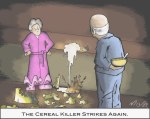
Tommy Graham’s Blogtoons on Packaging

This slideshow requires JavaScript.

Since the GrumbleSmiles blog was started, we have been illustrating some of the posts with cartoons.  This is the third post in building a gallery of all the blogtoons.

I’ve written a series of posts on my struggles with packaging which seemed to have inspired some of Tom’s best cartoons.  You can find the blogs in the TAG CLOUD by clicking on Packaging.

1 Comment

“Princethorpe Court 5”

For earlier stories on this subject, click on   “PRINCETHORPE COURT STORY”   in the TAG CLOUD.

Now we come to the final and most important chapter of the story.   All the effort, time and money would count for nothing if we had not achieved  “Better Lives for Older People”.

Anne Miller bought into the concept of promoting residents’ independence and choice completely.   In no time at all she involved them in all decisions about how Princethorpe Court was managed.

The Residents

Princethorpe Court was designed with activity in mind, so the communal areas were a platform for enhancing your lifestyle.

The restaurant was not a fast food outlet, it was a place you could come each day and socialise.   Everyone had a kitchen in their flat where they or the staff could prepare breakfast or tea, but lunchtime was a popular ‘communal event’ with the majority of residents.  Couples tended to be more self-sufficient, but the majority of residents lived on their own, so lunch was an opportunity for a natter.

There was a hairdressing room which was another popular place for a chat and a sure way of looking your best and lifting your spirits.  The communal laundry was another good place for catching up on all the latest gossip.

Dotted around the scheme, one in each street, were four small sitting rooms.   With Anne Miller’s encouragement, these were taken over by the residents and gradually established their own individual identity.   One as a library full of donated books and jigsaws, one was a spiritual room for quiet contemplation.  Others were used for knitting,   card making,   darts,   quizzes,   poetry reading,   costume making,   exercise  — the list became endless.   Many of these activities were organised and run by the residents themselves.

Anne saw every resident as a potential volunteer.   It was her way of ensuring everyone’s talents and abilities were recognised and utilised for the communal benefit.   After our initial concern about the size of the scheme, we often continued to discuss whether the scheme was too big – there were 48 flats but around 60 residents altogether.  The Social Service view was that anything over 35 flats would become institutional.   Anne’s perspective was that as long as each resident had a ‘role’, they would not get ‘lost’ in the size of the scheme.   Her idea of a ‘role’ was beyond any formal definition of a volunteer — Nora was a very quiet lady who liked to stay in her flat most of the time and just look out of her lounge window, which overlooked the car park — she always knew who had visited the scheme each day and became the scheme’s self-appointed security guard.

The residents at Princethorpe Court would not mind me saying they were “unremarkable”, they were no different to the residents in any of our later extracare schemes.   They had the usual range of frailties that you would expect in an age group that ranged from 60 to 100.  Their average age was late 70’s.   Most were women (80%), mostly widowed before they moved in, almost all came from the local area.   About a quarter had mobility issues and used a wheelchair.

At the same time, the staff ensured that all the residents were treated as individuals, and as their life stories and accomplishments became known, they were made to feel unique.   In that sense they were all “remarkable”.

Here are four people just to illustrate the point:-

TOM was a quiet man, a keen gardener.   He took over the extensive greenhouse and grew salad crops for the restaurant.   His tomatoes were his pride and joy.   Over the years he won medals and certificates galore.   A glass cabinet in the entrance hall of the scheme houses a big silver cup which was awarded to Princethorpe Court at ExtraCare’s first “Garden in Bloom” competition.   In the years to follow we realised that rewarding outstanding talent with small prizes was a way of reinforcing the message that residents had great skill and could still achieve a lot in later life.

JACK AND MABEL looked life in the face and overcame any difficulties they had with a smile.   At well over 70, they regularly flew to Canada to visit their children and grandchildren.   They were the life and soul of any party, in fact I first met Jack when he was bashing himself over the head with a tin tray and singing an old music hall song.   Playing the spoons was another favourite of his.

Jack fell in the empty bath overnight when he had got out of bed to go to the toilet.  He couldn’t get back out and Mabel could not hear him shouting for help, so he spent the rest of the night sleeping in the bath.  Then he got a lecture from Mabel in the morning for being so clumsy.  By the way, Jack had a tin leg, which he wasn’t wearing at the time.

In fact it was his tin leg that brought them together.   In Coventry during the war, they were both running to get into an air raid shelter.   Jack was slow because of his tin leg and when he got to the top of the stairs down into the shelter, he tripped and tumbled down the steps and landed on Mabel.   That’s how they first met – they were married for over fifty years – so Jack said he must have fallen for Mabel in a big way !

JOY KING moved into Princethorpe Court when it opened and still lives there today – over 20 years later.   I first met Joy when we played in a Christmas pantomime together.   She was the Fairy Queen — I think I was the bad guy.   I later found that Joy had come from a theatrical background.   Her father ran a travelling repertory theatre and Joy had to look after her baby sister while her mother and father were performing twice a day in plays.   They lived an itinerant life moving from one theatrical digs to another.   It was a hard life and Joy had a poor education because they never were in one school for more than a few weeks.

Joy joined in all the activities at Princethorpe and one of her proudest days was when she was awarded a degree from the University of ExtraCare for having completed a computer course.

There are hundreds of stories like these which just goes to show that  “Everyone has a Story to Tell”.   This was the title of a book we published to celebrate the lives of our residents after the first five years of ExtraCare.

The hard evidence to show that this model works is only becoming clear nearly 30 years after Princethorpe Court was conceived :-

  • Residents who move into residential care on average only live four more years – in ExtraCare housing the average length of stay is 14 years.
  • The average age of ExtraCare residents is between 75 and 80.  When asked how old they feel, most residents say they feel between 10 and 20 years younger than they actually are.
Posted in RETIREMENT HOUSING | Tagged | Leave a comment

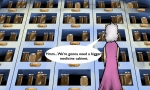
Tommy Graham’s Blogtoons on Pills

This slideshow requires JavaScript.

Since the GrumbleSmiles blog was started, we have been illustrating some of the posts with cartoons.  This is the fourth post in building a gallery of all the blogtoons.

Elderly people and their pills seem to go hand in hand.  So not surprisingly I’ve written a series of blogs on this subject.  Click on Pills in the TAG CLOUD to see the posts.  All the pills blogtoons have a super heroine – Pilly Gallore and her superhero GP Astroglax.


1 Comment

“Dignity Be Damned ” 4

This blog really started two years ago and was revived by the report from the “Commission on Improving Dignity in Care of Older People”.  (Click on “Dignity be Damned” in the TAG CLOUD).

The report was co-authorised by the Local Government Association, the NHS Confederation and AGE UK.  It is well argued and makes a lot of common sense recommendations.

Few would argue with their aspiration to provide better care for the elderly.  However, I am not sure they have fulfilled their stated ambition to “identify the underlying causes of these persistent failings”.  I have commented on what I think should be a more strategic response on my previous blog on this subject.

Meanwhile, here are my comments on their 48 recommendations:-  (Click on the following link www.nhsconfed.org/Documents/Delivering%20Dignity.pdf  if you want to read the full report).

  1. Deliver care at home in the community
    • Absolutely, but you will have to get GPs out and about first, and build shop window style health centres
  2. Make independence at admission and discharge a key measure
    • Good idea – why not pay a bonus for health improvement
  3. Ban patronising language
    • Yes but it’s hardly a top priority so let’s not get all P.C. about it
  4. Comprehensive geriatric assessment
    • It is wishful thinking in these express service NHS days
  5. Nutritional needs
    • A critical failing that will only be solved with more staff, volunteers and relatives
  6. Families, friends and carers
    • Agreed and see above
  7. ‘This is me record’
    • Nice idea so long as it is not turned into a blizzard of paper
  8. Feedback
    • Needs to be monitored by a panel of independent elderly people with a direct reporting line to health boards
  9. Staff take personal responsibility
    • A platitude
  10. Practiced based development
    • Should lead to a new NVQ/Nurse for the elderly qualification
  11. Recruit compassionate staff
    • Another platitude.  Most staff are compassionate, it is the system that needs changing
  12. Dementia training
    • This is essential, there should be dementia nurses at ward sister level on all elderly wards
  13. Devolved leadership
    • This will never happen inside the NHS.  It is a command and control model and probably should stay that way for short-term acute care
  14. Board leadership
    • It is called “walking the floor” but right now they could well get lynched if they ventured onto elderly wards
  15. Ward leadership
    • Will only happen if you reduce paperwork, give them enough staff and empower them to discipline poor performance
  16. Patient/family feedback
    • Who can disagree
  17. Staff reflection time
    • Ditto
  18. Professional duty of care
    • Motherhood and apple pie
  19. Protection of vulnerable adults
    • A toothless, ineffective process that has nothing to do with leadership
  20. Discharge from hospital
    • Should be controlled by community based staff, otherwise the rush to empty beds takes priority
  21. Care home values
    • Not at all clear what this is about
  22. Care Quality Forum
    • If the Nursing Quality Forum has not worked for older people, why would another forum for care work?
  23. A rating scheme for care homes
    • CQC has only just abandoned one
  24. My home life
    • A good process that should be used more widely
  25. Care plans
    • This is already mandatory but too often its use is limited to basic care tasks by pressure of time
  26. Buildings fit for purpose
    • There needs to be massive capital investment to build new accommodation and thereby eliminate old out-of-date residential care homes
  27. Family and friends, carers as partners
    • Of course
  28. Volunteers in care homes
    • Residents themselves are the most valuable and reliable volunteers
  29. More use of technology
    • Yes in principle, but it all needs to be more “elder-friendly”.  SKYPE could open a window way beyond contact with relatives, so could web cams and CCTV
  30. 360° staff appraisal
    • If it is done constructively
  31. Personal responsibility
    • Motherhood and apple pie again
  32. Access to medical care
    • Of course but it only works if doctors will come out of their surgeries
  33. End of life care
    • Agreed
  34. Board role
    • See answer 14
  35. Non Executive Directors
    • Agreed.  It should be routine and regular, not just ceremonial
  36. Invest in training
    • 5% of staff time should be spent on training
  37. Residents’ charter
    • Rarely worth the paper it is printed on
  38. Feedback
    • See answer 8 and also consider suggestion schemes, resident forums and comprehensive annual surveys of residents, relatives, volunteers and staff.  The results and improvement plans should be published.
  39. NHS Commissioning
    • Cost drives their decisions.  I have little confidence they can put a price on dignity
  40. Ditto
  41. NICE
    • All hot air
  42. More fine words
  43. Local advocacy groups
    • A good idea in principle but toothless in practice
  44. Health Watch
    • Community health councils did not work so what will change this time
  45. Universities and professional bodies
    • They already have this responsibility but are ineffective at guaranteeing good performance or compassion
  46. Regulation
    • This has singularly failed to deliver better care and I have long argued that the DoH should refocus CQC’s remit to focus on best practice and training for improvement rather than ineffective policing.
  47. Healthcare Assistant
    • I think there should be a new qualification of second level, mainly practice base ‘nurse for the elderly’, as already operated in Holland.
  48. Care Quality Commission
    • See point 45.  They should also conduct regular customer satisfaction surveys with residents and their relatives

As I said at the beginning, there is nothing much to disagree with here.  It is mainly good practice that is already implemented in the best care homes and hospitals.  The key question is why is it not done everywhere and that will not be answered by greater exhortation.

Who was it who said “two priorities are no priority at all”?  48 recommendations may be a direction of travel but they are a long way from a road map.

The second stage of the Commission’s work needs to start further back at the root causes of the problem.

Posted in HEALTH, N.H.S. | Tagged | 4 Comments

“Princethorpe Court 4”

For earlier stories on this subject, click on   “PRINCETHORPE COURT STORY”   in the TAG CLOUD.

The Staff Support Team

From the very outset of developing our new concept, it was not just about bricks and mortar, it was about creating a more fulfilling life for residents.   A life that was able to reach beyond the tasks of daily living  and lift residents above their concerns about increasing frailty.   That said, it was also about maintaining and promoting their independence, by empowering them to build on their valuable skills and considerable life experience.

In other housing and care models, the care element creates dependence and communal living can reinforce the negative images of getting old.   We wanted to reverse that thinking and create positive opportunities for ageing, with support to overcome increasing frailty.

To do this we needed a special staff team, who aspired to do much more than offer comfort and care.   Our first Princethorpe Court Manager was an inspired and inspirational appointment.   Sister Anne Miller was a Franciscan Nun ,with a background of working in the third world.   She did not have the obvious recent experience in care management, we had set out to look for.   I was one of the interview panel and I have to admit before I met her I was very apprehensive.   My Welsh Chapel upbringing made me very nervous about having an overly pious scheme.   I think I expected Anne to come to the interview in a habit and be rather timorous.   I could not have been more wrong.  There was no habit, just a cross on a necklace and timid she was not !   She was very self-assured.   Obviously compassionate about the elderly and quite a feisty lady.   She even argued with me, which was a dangerous step in a job interview, but her conviction ( not the CRB type 🙂 ) made a lasting impression on me.   I still was not 100% sure, but Liz Taylor argued very strongly in favour of Anne, and that swung the day.

We never had reason to regret the decision.  Anne proved to be an exceptional manager who helped improve our vision beyond measure.   She built a strong staff team around her and helped them to understand the difference between the care background most of them had come from, and the supportive environment we wished to create.   We didn’t rush in and do things for people, we wanted to help and encourage them to do things for themselves.   It is about restoring confidence to people.   This takes time and patience, which can easily be squeezed out of a hard pressed staff schedule.   The result is that care hastily delivered can often lead to greater dependency.   This lesson has certainly been lost in the modern-day express style speedy boarding NHS.   It was also seldom seen in minimum staff levelled residential care, where high staff turnover and frequent use of agency staff meant there was little time to really get to know residents’ individual needs.

At Princethorpe Court, Anne’s team developed support plans which embraced the whole of a residents’ life, not just their immediate care needs.   Later this became known as a “Book of Life” and was a written and photographic record of a resident’s past life and future ambitions.

It was testament to Anne Miller’s mentoring skills that her two senior staff, Mary Saint and Ginny Larkin, both went on to become managers of their own schemes in the ExtraCare Charitable Trust.   Many other staff also were promoted to managerial and team leader positions in the following years and transferred the Princethorpe culture to other schemes.

MORE TO COME

Posted in RETIREMENT HOUSING | Tagged | Leave a comment

“More Easy Money”

In my last blog on this subject (click on “Easy Money” in the TAG CLOUD), I was endeavouring to repay my part of the national debt, by securing some newly printed Quantitative Easing money.   To be prudent, which is something we all learned from Gordon Brown, I decided to ask for more than I needed.  Just like all the banks did.

Now I turn to the problem of how I might wisely invest the surplus £960,000 that I would have after the rigorous economic stress testing and one-eye-open, all-you-can-learn-in-a-minute, due diligence.

Perhaps I should start by listening to those helpful, totally independent, banking financial advisors.  They have all sorts of wonderous tax-free, low-risk, high-return, investment plans.  They point out that they may start off with high risks and low returns, but could …… (and they emphasise “COULD” to protect their independence and integrity)…..so could, but probably will ……. (unless there is a financial calamity which is unlikely)….. so will then, have an almost guaranteed high return….by 2020 or sooner.   That’s where the “kick out” clause comes in.   The one where you get kicked out before the investment plan becomes too generous.

Finally, there is the 40-page contract which it took their 400 lawyers 4 years to draw up in order to guarantee their independence, integrity and incomprehensibility.   All you have to do is sign and hand over your hard-earned Quantitative Easings.   Sadly, as my 40 no-win, no-fee lawyers weren’t around to advise me, and I could not understand a word of what had been said.  Even though I accepted their advice was independent, I decided not to pursue this avenue to financial success.

So in the meantime, after I have helped pay off the National debt, I maybe should pour some of my newly printed, newly found wealth into the black hole of borrowings, otherwise known as the British economy. My new found friend, Mr Mervyn King, says that he has been doing it for a while now and its just a matter of time before things come right for Britain.  So below is a cartoon of Mr King and myself discussing our shredded economy.

After all, I am nearly a quantitative eased millionaire so it would be a shame to fritter it all away.

Posted in ELDERLY MARKET, SMILES | Tagged | Leave a comment

“Dignity Be Damned ” 3

Click on this topic in the TAG CLOUD for the earlier blogs on this subject.

The title of this blog was a response two years ago to the Government’s focus on “dignity”.  No-one could possibly disagree that elderly people are entitled to respect and dignity. There is however, a real danger that a focus on this issue will provide the Government with a smoke screen, to obscure much more fundamental problems which the NHS faces with care of the elderly.  Hence my title “Dignity Be Damned”.

The “Delivering Dignity” report reads as though everyone on the Commission Group took it in turns to make a recommendation for improving dignity.  Given it is only a draft report, you could be forgiven for thinking there is nothing wrong with that.  All the recommendations have merit.  Although simply asserting that best practice should be carried out everywhere, fails to address the starting premise of the authors, of trying to understand why things are failing so badly at present.  Without knowing what the problems are, you will never find the right solutions. 

I think it is possible to judge from the report’s paragraph headings, that they see a failing in leadership at Board and Management levels.   Reading between the lines, you can also assume from the weight of words and recommendations, that they feel there is a lack of compassion from front line staff. 

On both counts I think they are in danger of treating the symptoms and not the cause.   I believe that the vast majority of managers and staff in the NHS and residential care have every intention of delivering good care to older people.   It is not an easy area to work in and staff would not stay if they were not fully committed.   I say that, having worked for over 20 years in the ExtraCare Charitable Trust, as a Managing Director who was frequently on the front line with many thousands of care home and former NHS staff.  Most of the Commission’s recommendations are in line with the working practices of ExtraCare Charitable Trust, so  it goes without saying, I am a strong advocate of the proposals.

However, before they hone the details of their recommendations, they must first strategically address the fundamentals.

Over the last two years I have been writing about this issue on my GrumbleSmiles blog and I am sorry I missed the opportunity to submit my comments as evidence to the Commission.  However, I did get the opportunity to speak to Dianne Jeffrey,  after her speach on the report, at the Age UK Life Conference.

The fundamental issue is that the NHS is being overwhelmed by the changing demographics of the elderly population.  The NHS was never designed or resourced to deal with the complex and chronic conditions of so many elderly people.  Fast track acute hospitals are geared for rapid throughput and are the wrong place to attend to long-term care.   This situation is further compounded by the overlay of dementia present in so many elderly people. 

To cope with this tsunami situation, we need nothing short of radical re-engineering of the service, albeit done in an organised transition.   My recommendations  to the Commission are:-

1.  Resources should be transferred out of the NHS into a new “SENIOR HEALTHCARE ENTERPRISE“.  (Similar to the formation of the Housing Corporation, whose funding enabled the expansion of Housing Associations and facilitated the transformation of social housing provision in the latter quarter of the twentieth century.)  This organisation would be responsible for commissioning capital and revenue funded projects in the community, to as far as possible look after the health and social care needs of elderly people in their own homes.  They would also commission a network of HEALTH IMPROVEMENT CENTRES (see my blog on “New Vision of Later Life 2”) which would support community work with specialist clinicians and offer hotel style rehabilitation and respite care.  These would be the hub for telecare and telehealth and also be the coordinating base for domiciliary care.  Resources should be moved from Social Services so that we end up with a fully integrated health and social care system.

This would allow the NHS to concentrate on acute, short-term interventions.

2.  We should develop a new qualification of second level “NURSES FOR THE ELDERLY“.  They would lead all care services for older people.   In addition, all carers should be NVQ Level 2 Qualified in Care including dementia.

3.  In all residential care provision, webcams and Skype should be available to all elderly clients, so that they can open up a visual communication channel to relatives and advocates who can remotely monitor the service they are receiving.  This service could be further developed to include telecare and telehealth (this is an enhancement of the Commission’s recommendation 29).

I’m not suggesting this re-engineering be done quickly.   A rapid change would be too big a shock to the existing system and would likely meet major opposition from interest groups who would prefer to maintain the current situation.   I would start with a pilot programme underpinned with new funds provided by the Senior Healthcare Executive.   Soft loans and grants would be offered to promote innovative services provided by best practice organisations from the public, voluntary and private sectors.   Building on success would allow the gradual expansion and transfer of elderly services away from the acute sector of the NHS and into a re-invigorated and integrated health and social care service.

These ideas are discussed in greater length in my GrumbleSmiles blog in the thread on “New Vision of Later Life”.

Posted in HEALTH, N.H.S. | Tagged | 2 Comments

“Princethorpe Court” 3

For earlier stories on this subject, look up “PRINCETHORPE COURT STORY” in the TAG CLOUD.

The Design

This section is not intended to be a design brief, I just want to illustrate how the concept we were developing permeated through the whole of the design, right down to the smallest detail.  We also wanted to get well away from the institutional feel of residential care which emphasised to residents they were living in someone else’s building, which was no longer their own home.

We were wanting to create an environment where people could live out the rest of their lives and not have to move on.  We also wanted it to be a community where you could enjoy the privacy of your own home but have the company and support of the neighbours around you.

The scheme had 48 flats which was considered large. at a time when 30-35 dwellings was more the norm.  The reason for the bigger project was related to the need for scale to support a care staff team and a restaurant.  The flats themselves were mainly one bedroom, but we insisted on them being 2-person i.e. big enough for a double bed.  This is a forgotten issue these days but one bed, one person was the standard at the time.  The flats were only 35m² which is very small compared to the 50m plus of the current day.  The Princethorpe flats were palaces compared to a 10m² bedroom in residential care!

A key principle was that there was level access throughout the scheme – lifts were provided to the first floor and their were no steps or stairs anywhere in the scheme ( except for fire escape stairs ) — all doors were extra wide to accommodate wheelchairs and fire doors were free-swing or held back on magnetic links and only closed automatically if there was a fire alarm.  These issues are standard today, but at the time they were exceptional and relatively expensive to provide.

Now let’s look at some of the more symbolic details in the scheme which were designed to emphasise the concept:-

  • Individual House Front Doors.

Front doors to flats in residential care and in a lot of Local Authority / Housing Association sheltered housing were generally flush style internal doors, often all gloss painted the same colour to minimise initial and future maintenance costs.  At Princethorpe Court we took the opposite view.  Your front door is a symbol of your home as your castle.  Front doors were panelled external doors with brass door knockers, brass house numbers and letter boxes.  The knocker said to staff, knock and wait before you enter someone’s home – this often was not the practice in residential care.

The letter box was even more contentious, with the fire officer and the Post Office.  Fire officers didn’t want a hole in a fire door, and this debate lasted until we found a compromise, but we kept the letter boxes!  The Post Office just did not want the hassle of delivering post within the scheme, when in a residential care home they could do one delivery to the manager’s office.  This argument raged for many months, but we were adamant that residents had their own address and were entitled to receive their mail through their own individual letter box.  We won in the end but there were some grumpy postmen to start with.

Once we had the letter box, we could also have newspapers delivered and leave people to pay their own bills, which underlined the concept of people living independently in their own homes.

This idea extended to milk deliveries and a shelf was provided outside each front door.

  • Internal Streets.

The internal corridors of most residential care homes were long, straight, bare-walled   and only punctuated by regularly spaced identical front doors.   Small filing cabinet labels were the only way of knowing somebody lived inside the flats.  The easy slip-in and out label was an indication of how long they were expected to stay.

We were building homes for people to live long happy lives and we wanted them to be proud of their new homes.

At this point I must mention the designer of Princethorpe Court.  Ian Hardy was an exceptionally talented architect and he bought into the concept completely.  He also took us literally when we said we wanted an excellent design and that’s what he gave us – but it wasn’t cheap.  Still he gave us design ideas which ExtraCare Charitable Trust is still using to this day.

In the internal corridors, Ian styled them as external streets.  The flats all had kitchen windows looking onto the street.  The walls were constructed with an expensive external rustic brindle brick that matched the outside of the scheme.  External wall lamps illuminated the corridors focussed around the porch of the flats’ front doors.  The corridor floor was a jute matting which was imported from Holland.  It was not only expensive, but we were worried about its durability.  Thirty years later, it is still there and looking good.  The widths of the corridors were relatively wide and at corners were opened out to include planting boxes full of rubber plants, ferns and assorted jungle vegetation.

To finally seal the idea that this was more like an external environment, the first residents to move in were invited to give each corridor a separate “street” name which then became part of their address.

These are only two examples of the many issues we debated over long hours – developing the concept.  We were fortunate to have Ian Hardy’s design flare to interpret them so well.  It is testament to the whole team that many of these themes continue to be used to this day.

MORE TO COME

Posted in RETIREMENT HOUSING | Tagged | 1 Comment

Tommy Blogtoons on the Postal Service

Since the GrumbleSmiles blog was started, we have been illustrating some of the posts with cartoons.  This is the second post in building a gallery of all the blogtoons.

I’ve written a series of posts on the virtues of the UK postal service and its trials and tribulations and here are the cartoons that accompanied them.  You can find the blogs in the TAG CLOUD under the heading of “GRUMBLESMILES POST”.


GRUMBLESMILES POST

This slideshow requires JavaScript.

Posted in ABOUT GRUMBLESMILES | Tagged | 1 Comment

“Dignity Be Damned 2”

TWO YEARS AGO I wrote a blog called “Dignity be Damned” in response to a report extolling the virtues of a then new initiative.   (See it by clicking on the ARCHIVE April 2010).

The trumpeted campaign was led by the Elderly People’s Champion – Michael “here-today-gone-tomorrow” Parkinson.  He called for people to sign up as Dignity Champions and raise the standard of care of the elderly.  The new approach was so instantly successful that Mr Parkinson was able to move on — without any dignity.  He obviously saw the way the market was changing, so now you can see him regularly on TV adverts, championing funeral plans !

Since then there have been numerous reports chronicling the appalling care the elderly receive in the NHS and in residential care.  (See my earlier blogs by clicking on “Neglect Shames Britain” in the TAG CLOUD).

Third world malnutrition and dehydration; willful bedsore neglect; cruel failure to give pain relief and constant misdiagnosis of dementia are everyday occurrences in the NHS.  This needs ruthless elimination !

Somehow the new “Commission on Improving Dignity in Care of Older People” with a large pair of rose-tinted glasses managed to look beyond all of this and completely miss the main issue – MONEY.

I will comment in my next blog on their recommendations.

There is nothing much to argue with in the report, indeed its 30-pages and 48 recommendations are difficult to disagree with.  The problem is that 48 sticking plasters won’t heal a dying patient.  What is needed is major surgery.

The NHS is bereft of leadership at all levels starting at the disempowered paper-not-patient ward sister level.  Rising through the myriad of meddling, muddle-targeted health authority managers; right up to the head in the clouds, never responsible, dithering, withering politicians.

On the social care side of the divide, Social Services are too often focused on political correctness and human rights, while the elderly sit and wait.   Meanwhile residential care operators are starved of resources and have an uninspired vision of a better life for older people.   The Southern Cross example of corporate greed does not suggest that more money in their pockets would be used to improve the situation.

Sadly, although the commission report received front page headlines “Britain is failing the Elderly” in the Daily Telegraph, its serious point was lost in grasping the shallowness of the “dignity” message.   This newspaper article, along with others that followed, were misdirected into condemning on how elderly people are addressed as “DEAR” or “CHUCK”.

I’d have to say that if you were starving me to death in hospital and hadn’t given me a drink in 24 hours.   Then call me anything you like just —-

GIVE ME A DRINK AND FEED ME !

P.s. I will comment on the recommendations next week.

Posted in HEALTH, N.H.S. | Tagged | 3 Comments