“Neglect Shames Britain” 6

I first wrote something on this subject over 10 months ago using a banner headline taken from the front page of The Daily Mail.  It championed a cause led by the Patients Association to do something about the appalling care of elderly people in many NHS hospitals.  The focus of concern was the failure of staff to deliver even the most basic of care – food and drink.  Several other articles followed with more examples of poor treatment.  The outcry was endorsed by a host of celebrities and an appeal to raise £100,000 was launched.  The Health Secretary – Andrew Lansley – promised action and the Care Quality Commission promised to look into the problem.  (See the TAG CLOUD – “NEGLECT SHAMES BRITAIN” for all the earlier posts).

Nearly a year later nothing has changed but we are getting another report from the toothless regulator – CQC – confirming what everyone already knew.  The Commission found HALF of the 100 hospitals inspected were not meeting basic nutrition standards.

Official figures show that more than 800 patients die of dehydration and 300  die malnourished.

In an attempt to get on the right side of the problem, the Health Secretary came up with hollow assurances about dignity and compassion – no assurances about food and drink though – and a wonderful realisation that “we must never lose sight of the fact that the most important people in the NHS are its patients”.  The final, but hardly reassuring promise, is that “in the future new local Health Watch organisations will be able to carry out unannounced independent inspections and hold local services to account” – which sounds like “pass the parcel”.

Reports after reports, promises after promises and still nothing changes.  So what are the fundamental issues which lead to this crisis of neglect? 

  • Firstly, the sheer number of elderly people needing to be admitted to hospital is overwhelming the system.  That causes pressure on beds and in turn the need for early discharge.  Although not fundamental, other changes have added to the pressure:-

The project 2000 training of nurses has led them to take a step back from hands on patient care;                                                                                                                the Health and Safety culture has created a blizzard of over the top risk assessment paperwork;                                                                                                 that in turn set up a platform of liability and fear;                                                    and a pre-occupation with box ticking instead of common sense.

  • Secondly, there simply is not enough public money available to pay for the additional cost required, and this was the case even before the credit crunch of the last few years.  It’s time that all politicians were honest with the public and explained that elderly people are going to have to spend a lot more of their own money on health care in later life.
  • The third fundamental is that the vast majority of people involved in care of the elderly, both inside and outside the NHS, from Government Ministers to the Regulators, NHS Managers, doctors, nurses, carers and relatives, all want to do a good job.  They just need to be released from the tangled web of blame and recrimination that can’t possibly lead us out of this seemingly unsolvable situation.

The inability of our society to escape from this problem is blinded by the mindset that sees the elderly as a burden and increased lifespan as a penance.  This is a view shared by our political leaders, in spite of their public protestations, but it is also a perspective of most members of our society if we judge ourselves by our ability to stand back and watch this neglectful situation develop.  Sadly, it is a belief increasingly held by elderly people themselves as they succumb to all the negative rhetoric of ageism and the increasingly frequent talk of assisted suicide and euthanasia.

The central thing to recognise is that the demographics won’t change at least for several generations.  What we can change, in the flick of a mental switch, is the glass half full view to see the elderly as a pool of wisdom and experience.  To see their added years as a reservoir of volunteers to heal and bind our society – a generation of givers not receivers.

Significantly, many of the UK’s elderly have the accumulated wealth to support themselves, once they let go of the idea that they need to leave a legacy to their offspring.  Cashing in their ‘castle’ will not come easily to many people but it is essential to break the mould of demographics and inadequate public funds.  Once broken it can release a liberating amount of money to pay for improved health care as well as increased later life opportunities.  Ultimately, this is just an acknowledgement that since we, the older home owning generation, did not anticipate living to an even riper old age, we are fortunate to have acquired wealth in housing equity which can now be cashed in.  This line of thinking will undoubtedly stir up a hornets nest of opinion about those who saved and those who didn’t, but that is a fruitless argument and ignores the fact that most of the growth in housing assets has been down to inflation.

Ultimately only individuals, perhaps with the encouragement of their children, can make this mid-set change for themselves.  The Government s likely to continue to sit on its hands rather than admit that it have not got enough money to solve the problem.  All the negative reports about the poor care of the elderly only serve to increase the despair about the situation.  It would be far better for the Government and the CQC to highlight and reward best practice and to support improvements in preventative health care.  Equally, agreeing to the Dilnot Commission report and paving the way to an insurance market for privately funded long-term care would further open up a new way of individuals securing better health care.

Elderly people themselves need to take control of their own futures with all the resources they have at their disposal.
Posted in HEALTH | Tagged , | 1 Comment

“A Pinch of Salt”

Years ago, salt and pepper were on every table and were used freely.  Most people would not start a meal without taking a minute to liberally shake salt all over the food.  The extreme example was – and still is – in every fish and chip shop, where it is still part of the ritual at the counter to flamboyantly sprinkle salt and vinegar over the paper wrapped parcel of calories, fat and delight.   For the older generation, it is a habit that is hard to break.

   Youngsters today, get their daily intake of salt hidden in the burger and fries, as they express their way through McDonald’s, or Burger King.

Every TV chef tops off the ingredients of their latest culinary masterpiece with a pinch or two or three of salt.

Then, we all finish off the day with a packet of ready salted crisps while we relax in front of the tele.    Who remembers Smiths Crisps with a little blue wrap of salt secreted somewhere in the packet?  My Godfather  – Uncle Ken Thomas – was a very creative man and his claim to fame was that he was the man who designed the machine that poured the salt into the blue paper and twisted the bag.

Now, we find all that arm shaking and salt sprinkling was bad for us.  There has long been an understood link between salt intake and high blood pressure and in turn strokes and heart attacks.  Most of us managed to ignore such counselling after years of salt loving indoctrination.

   A study at the University of Toronto claims to have established a link between high salt intake and dementia.  Reasearchers looked at a group of 1,262 healthy men and women aged 67 to 84 and over a three-year period. They found those with a high salt intake had significantly greater memory loss.

   The average British person’s intake of salt is 8.6 grammes per day which is well over the recommended limit of 6 grammes  –  1 teaspoonful.

  So stop eating crisps, go easy on processed foods and say no to salt on the fish and chips.

                                    Unlearn the habit of a lifetime.


Posted in Dementia, HEALTH | 2 Comments

“The Cost of Dementia”

The cost of dementia is worn on the faces of the thousands of sufferers and their relatives.  It is also a worry in the back of most older people’s minds in terms of how they might cope financially if one of their family succumbs to this often long drawn out illness.  Yet in spite of the pandemic scale of this disease – 35 million sufferers world-wide – progress towards a cure is slow and investment in research is low.

In reviewing the latest literature on dementia, perhaps the most useful information I have found is contained in a report by Kings College, London, written for the charity Alzheimer’s Disease International.  It focuses on the cost of treating the illness and the potential savings to the NHS:-

  • Early diagnosis would save £6,175 per sufferer
  • Including all the estimated undiagnosed people, this could save nearly £2.8 billion

Early diagnosis is the key, because this has the potential to prevent sufferers being admitted to hospital.  Hospital admission is especially expensive for elderly dementia patients because they tend to stay longer.  To compound the problem, they often develop other conditions such as incontinence and pressure sores.  This in turn frequently means that when they are discharged, their care needs have increased to the point where they can no longer cope at home.  The next step is a prolonged and expensive stay for the rest of their lives in residential care.

The exposure of the scale of these financial figures may well be the evidence needed to persuade the Government to commit more resources to researching accurate early diagnosis.  This could then enable sufferers and their supporters to adopt better coping strategies in the early stage of the disease.


Posted in Dementia, HEALTH | Tagged | 1 Comment

“The Penny Post”

A good few years ago, I remember being told a story by an elderly gentleman about the wonders of the postal service during the First World War.  He was injured in a battle at the Somme and sent back to Blighty to convalesce at a hospital in Much Wenlock in far off rural Shropshire.  His mother lived in London and used to write to him every day and ask what he had for lunch.  By the morning of the following day, over her breakfast, she had a letter back from her son.  They continued this correspondence every day for two years, while he was in the convalescent home. The postman never failed him or his mother.

                                     This was customer service par excellence !

Somehow things don’t seem to have improved since then 😦

I sent a letter in the post last Monday and on Friday it still had not been delivered.  It was a large letter (A4 size) but light (just four sheets of paper inside),no bricks, no ticking clocks.  I put a first class stamp on the envelope, not because it was urgent, but just in case it was over the standard size. 

None of this is good enough for Royal Mail these days.  There are different charges for every letter,  unless it is ‘standard’ – whatever that means!   So now you can’t just post your letter in the post box,  you have to go to the Post Office,  queue while somebody in front of you collects their pension,  then have your letter weighed and individually stamped.   Every letter seems to cost a different and unfathomable amount, which only the person behind the counter understands.  Then it’s recorded in a book – ???  although that doesn’t mean it is a recorded letter – so I don’t know what that’s about;  maybe it is an MI5 thing in these heightened security days.

Finally,  you get to post your letter after 10 minutes in the counter queue, 10 minutes walking to the post office. Then another 10 minutes walking back home.

The next day due to the non-standard nature of my first-class stamped letter it receives special attention.  I suspect it has been intercepted at the destination sorting office and put onto the shelf marked “rule breakers”.  A postcard will, no doubt, be put through the door of the intended addressee telling them they can collect my letter at the central post office, if they waste an hour of their time and pay a fine for my bad behaviour.

At a time when e-mail and private delivery services are threatening the very existence of the Royal Mail, what idiot dreamt up this system?

Posted in GRUMBLES | 3 Comments

“Fruitful Research” 6

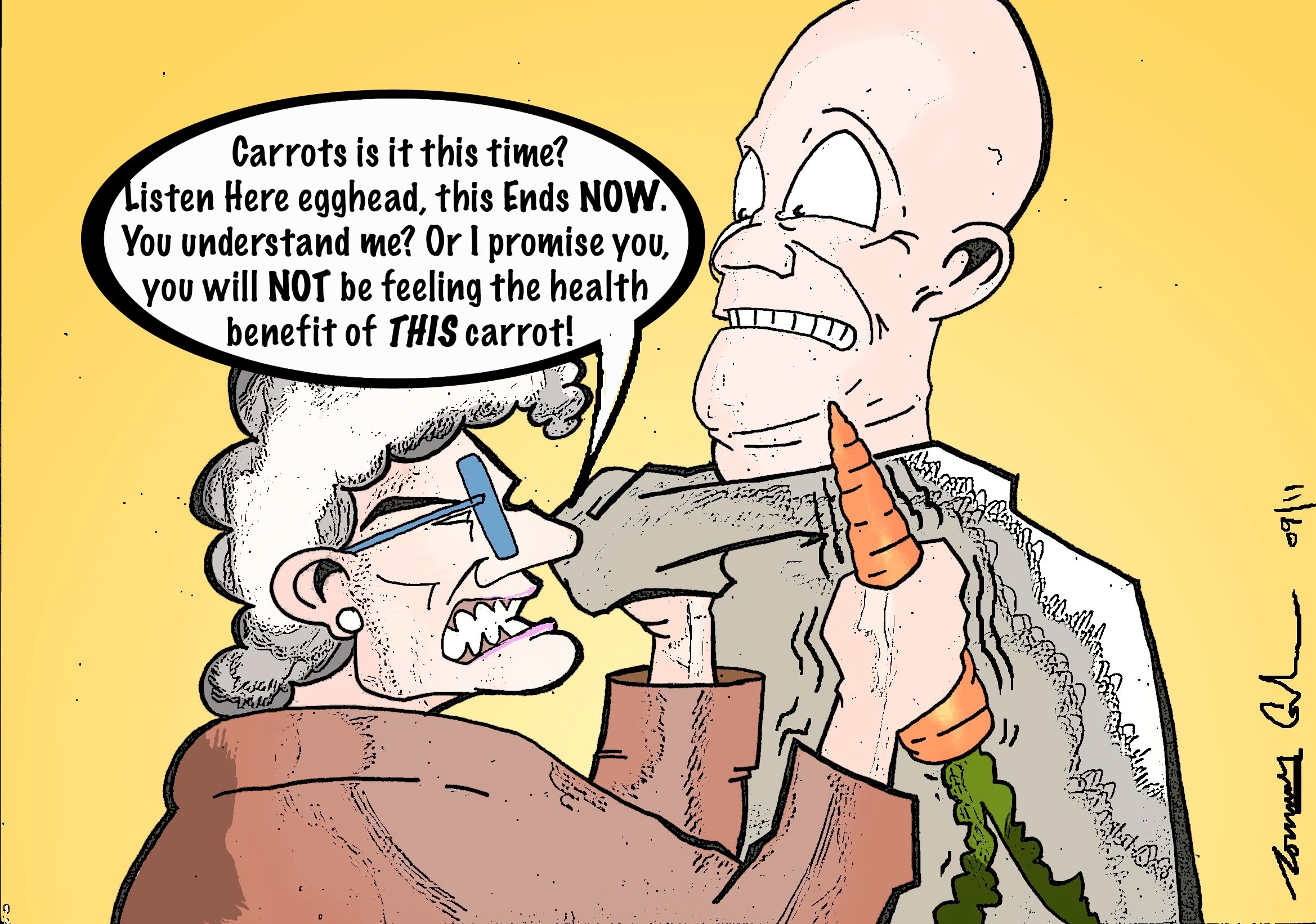
Back in May I wrote about the virtues of carrot juice following some research from Baylor University in Texas – see “Fruitful Research” 4 dated 15th May 2011.

Here is another thing to add to your daily diet, only this time it is whole carrots.  Research at Wageningen University in Holland studied the diets of 20,000 people over ten years.  They found that an increase of 25 grammes a day of orange fruit and vegetables, lowers the risk of heart disease by 26%.  Carrots were associated with a 32% drop (the researchers didn’t mention whether Wageningen is the carrot growing capital of Holland 🙂 .

So now remember on your weekly trip to the supermarket to fill up your trolley with carrots, cowberries, acerola, chokeberries, apples, grapes, blueberries, strawberries, beetroot, oranges, tomatoes, aubergines and don’t forget the red cabbage.

You will make a lot of university researchers and fruit and vegetable farmers very happy but do be careful not to exert yourself too much by pushing that overladen supermarket trolley.  You don’t want to give yourself a heart attack!

Posted in HEALTH | Tagged , | 5 Comments

“Early Dementia Test”

An early diagnostic test for signs of dementia has been developed by Cambridge University, and is currently being trialed in GP’s surgeries.  The test is based on people’s ability to recall lists of items and the location of objects.  A bit like remembering your shopping list or recalling all the objects on the “Generation Game” conveyer belt, if you can remember that far back.

If successful it could be the basis of a national screening programme.  This has to be good news, because it is estimated that 60% of people with dementia never receive a diagnosis and consequently get no help to cope.

Early diagnosis will not be welcome news for the individual concerned but it does mean they can get disease modifying drugs like Aricept which delay the onset of the illness.  It gives sufferers and their relatives time to plan for the future.  It may also buy time for new preventative drugs to be developed.

There are more than 800,000 dementia sufferers in the UK, and this number is expected to double by 2040.  It is essential that diagnosis and early treatment is improved, this is definitely a move in the right direction.

Posted in Dementia | 2 Comments

“A Poem for Early Autumn”

Now is the time of stubble fields,
Grain given up for food.
A brief respite from farming toil,
The ground unploughed before winter.
 
No more upright be-suited harvest,
Time to reflect on a year of growing.
Memories forgotten of drought and flood,
Only the good weather days to look back on.
 
Later age is like that too,
New crops to be harvested in the years to come,
Less effort as the ground is fertile with plenty of practice.
The seeds of the future are already sown.
 
Posted in SMILES | 4 Comments

“Do-it-yourself Healthcare”

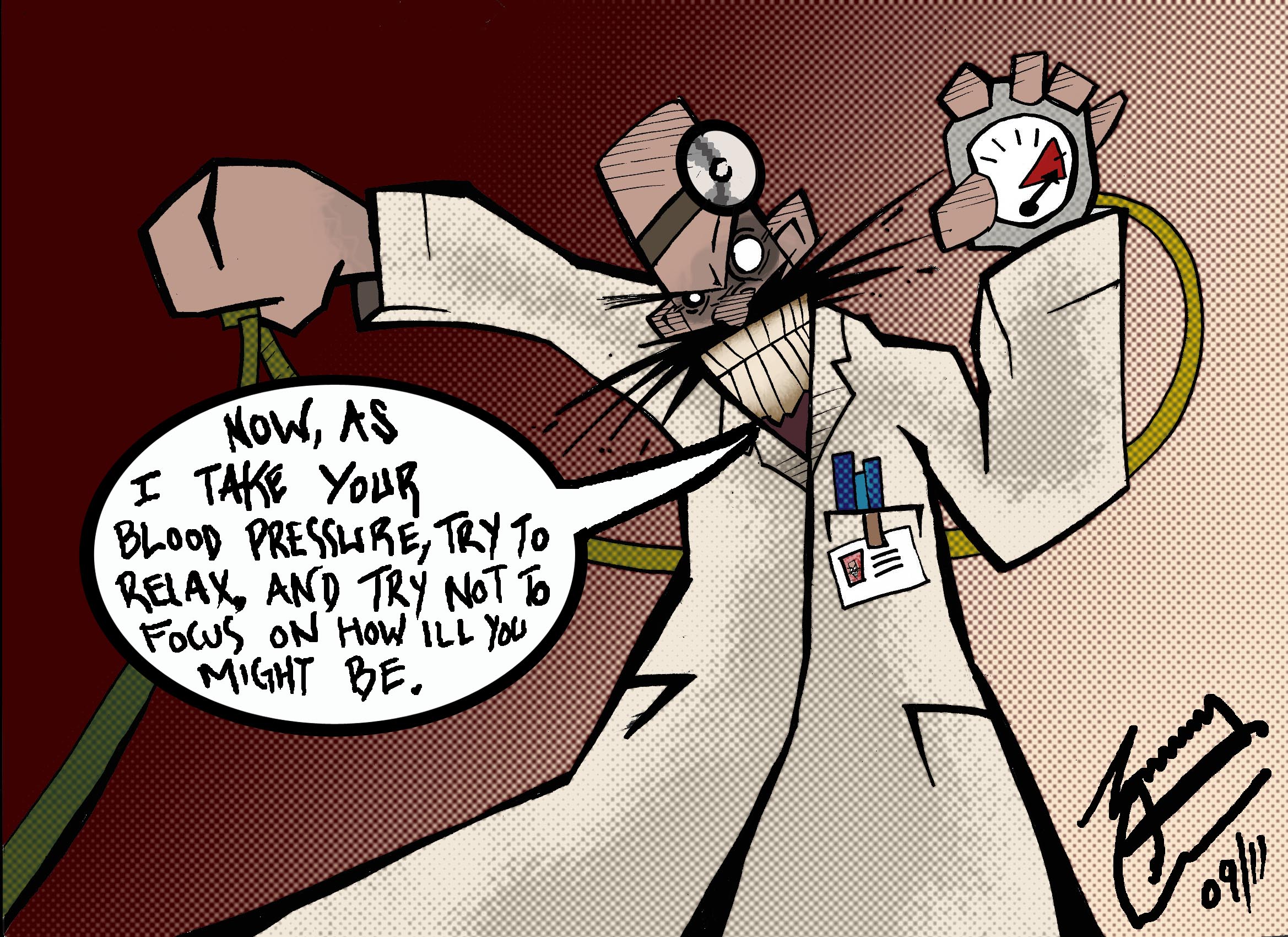
When measuring blood pressure, the “white coat” effect is not a new phenomenon – it’s been known about for almost a century.  When patients go to see their doctor, many are understandably anxious and this raises their blood pressure.  Hence the name “white coat” – although the uniform has now changed to green pyjamas, or jeans and open neck shirts.  The guidance to doctors is to give the patient time to sit down and relax before taking blood pressure (at least 3 minutes), but in these pill-popping,  no-hand-washing,  express delivery days,  time is at a premium.

So it is not a great surprise to now find that up to 3 million people may have been misdiagnosed and are needlessly taking pills for high blood pressure for the rest of their lives.

Don’t stop taking the pills, it could save you from a stroke or a heart attack, but it might be worth having your blood pressure checked again.

The cost to the NHS of hypertension drugs is £1billion a year.  A quarter of patients are known to become anxious when having blood pressure measured, so there is a big saving to be made from getting right.  New guidelines have been proposed which recommend patients take their own blood pressure at home with a machine that monitors them for 24 hours.  This gives much more accurate readings and should lead to fewer errors in diagnosis.

  • In industry, error rates are measured in defects per thousand (or per million in Japan).
  • In the commercial sector customer complaint levels are expected to be no more than 1 or 2 in a hundred.
  • In this part of the NHS Service, it seems that error rates of 1 in 4 have been tolerated for a long time at a huge cost in waste.  It also increases anxiety to patients, who may have been incorrectly treated for many years.

    Now – the solution is do-it-yourself  !

There is certainly a lot of recent evidence to support that view as far as the treatment and care of the elderly is concerned.

So, if this level of error is common in the NHS, why stop with blood pressure ?

  • Go to your local M.o.T. approved garage and have your blood tested.
  • Maybe  get your M.R.I. scan in a photo booth at Asda?
  • How about getting your own X-rays in the Clarks shoe shop.
  • Then you could go to B & Q to get the tools you need to fix-your-own fractures.
  • Call in to Hobby Craft to get some coloured playdoh for your D-I-Y plaster cast .
  • Buy a needle and thread for your sew-it-yourself stitches,    or just drop in to the dress makers, or even the local shoe repair shop.

Posted in HEALTH, SMILES | Tagged | 1 Comment

“Left in the Dark”

In this “World Dementia Month” the Alzheimer’s Society have again highlighted the fact that the majority of people in this country with signs of dementia still go undiagnosed.

Here are their estimated figures for Britain:-

  • 766,000 people thought to have dementia
  • 311,000 with a diagnosis
  • 455,000 with no diagnosis

These people and their families are left to cope with confusion, mood swings and depression in the sufferer.  Furthermore, the carer – frequently an elderly partner -is left with no support, just a feeling of hopelessness.  For many it is a matter of time before they become ill themselves.

The report goes on to criticise GP’s for failing to diagnose the condition earlier.  Whilst this is understandable, it also needs to recognise that early diagnosis is not straightforward.  There are many other health conditions, like depression or infection which have similar symptoms to early stage dementia.  They need to be treated first and that in itself may not be quick and easy.

The next step usually requires a referral to a mental health consultant. This decision will  not be taken lightly by the GP or the patient, because of the stigma attached to any mental illness.  If they do get to that step, there currently is no physical test than can diagnose dementia.  The best guess approach involves a set of simple everyday questions like “what date is it?”, “who is the Prime Minister?” , “who is the Queen of England?”, “what is in the news at the moment?”.  This is called the “mini mental test” but it is far from a scientific way of condemning someone to a lifetime of decline with an incurable illness.

GP’s and consultants are well aware that there is little support available for people in the early stages of dementia, and until recently the drugs that that could be used, like Aricept, were not available on the NHS, because the National Institute for Clinical Excellence deemed them not to be cost-effective!  Fortunately that decision has now been changed (see “A Confused Policy dated 28th July 2010 in the archive).

The other reason for hesitation is the awareness that in the long-term as the disease advances, there is little alternative to a placement in residential care, which is a prospect nobody welcomes.

I say all this, only to explain that a GP’s caution in diagnosing dementia is quite understandable,     but      it is not acceptable to leave the situation like this.

My next week’s dementia blog, ” Early Dementia Test”, points to a more scientific way of predicting early stage dementia.  The sooner that this is used more widely, the sooner patients can be given drugs like Aricept, which at least slows down the progression of the illness and gives sufferers and their families a better quality of life for longer.

More accurate early diagnosis and a prospect of help, at least removes some of the fear for the future.  Much more needs to be done beyond this.

Posted in Dementia, HEALTH | Tagged | 2 Comments

“My Garden Age” 2

It’s a windy apples-off-the-trees blow-away day.  Signs of summer fading fast.  Early autumn breeze wrestling with the browning leaves.

Yet the garden still has much to give in its green old age.  The last flush of the roses as beautiful as the very first.  The fuchsias not so numerous now but still as finely dressed as all through the summer season.  A few sweet peas elegant, delicate and still scented in their final days.  Geraniums and begonias hanging onto their former glory.  Dahlias now at their blooming best, seeking to outdo each other at the autumnal beauty parade.

A harvest festival feast of blackberries in the thorny brambles and apples falling off the trees.  Pies in the making and the sweet smell of baking.  The holly tree berries turning from yellow to red getting ready for their Christmas decoration.

There is much to celebrate and enjoy in the garden right now just as there is joy to look for in the garden of old age.


Posted in SMILES | Tagged | 3 Comments