“Confused Conclusion”

A recent study of elderly people admitted to hospital found that those affected with dementia were suffering because hospital staff have no idea how to treat them.  The study went on to suggest that hospitals should assume that all older people potentially have dementia.

I believe this is a dangerous conclusion to reach without a proper assessment.  It is perfectly natural for people who are ill and whisked into a strange environment to be dis-orientated.  When, as often is the case, they also have to wait around for hours; it is not surprising that some of them become agitated and sometimes unreasonable.  Not all confusion is the result of dementia and if staff treat elderly people automatically as if they are mentally ill, then other more treatable health conditions could be missed.

Yes, of course staff should be properly trained to look out for dementia, but they should assume elderly people are mentally aware, UNTIL they have good evidence to suggest otherwise.

About a third of all residents who are thought to have dementia are treated with anti-psychotic drugs (the chemical COSHH).  This is often for the patients’ safety, but also for the staff’s convenience.  It is restraint by another name.  Patients treated this way often become drowsy and even more confused.  Incontinence and pressure sores are frequent outcomes and the elderly person is often discharged from hospital with even more problems than when they were first admitted.

A diagnosis of dementia should only be made after careful consideration by experts.  Anything less can lead to long-term incorrect treatment and the writing off of a life.  Jumping to conclusions is not a good answer.
For other blogs on Dementia, click on “Dementia” under TOPICS

Posted in Dementia, HEALTH | 2 Comments

“Uneconomic Prediction”

I don’t venture into discussing economics in this blog because it’s not a subject I pretend to understand.  In these heady days of the credit crunch aftermath, the potential melt-down of the European Union and ever-present threat of an ongoing recession in the Western World, it is difficult to avoid the subject altogether.  Especially when it begins to talk about elderly people.

So here is my attempt at understanding an article in the financial pages of The Times on 1st February 2012 written by Andrew Clarke, a young-looking business commentator.

The report refers, in scary terms, to a prediction made by Standard & Poor’s (the most ominously named credit rating agency) that “Britain is facing a downgrade in its credit rating unless we reform the NHS – by 2050”.

The speculation by S & P is that Britain will not be able to afford the rising cost of health care and pensions, but neither will it take steps to reform the situation.  Without dramatic change, they predict Britain’s borrowing would have to increase to FOUR TIMES its current level.  THAT IS BANKRUPTCY ON A GRAND SCALE.

For every economist who thinks one thing, there is always another one who thinks the opposite, and sure enough Andrew Clarke disagrees with S & P, although he doesn’t explain why.  So Mr Clarke’s little cameo on the S & P prediction was interesting but not very enlightening.

As ever, you have to figure it out for yourself, so here is my best guess:-

Firstly, the demographics of an ageing population in the UK are quite clear – we are living significantly longer lives.

Secondly, an older population means much higher health care costs .

Thirdly, it seems inevitable that we will not generate enough new income from growth to cover the cost of state-funded health care and pensions.

S & P describe this as “an economically toxic combination”.

Three options occur to me:-

  1. Reduce pension payouts – which has already been started by extending retirement age and linking pension increases to CPI, not RPI.  Closing public sector final salary schemes is the remaining stumbling block, but inevitably it will happen.  You will also have to simultaneously reduce welfare benefits, otherwise no savings on public expenditure will result.
  2. Cut back on free health care by privatising care of the elderly, which is already happening by denial of access to good care in the NHS thereby is forcing elderly people either to pay for themselves or go without.  The missing piece in this jigsaw is the absence of an insurance product to cover long-term health care.
  3. The Dutch final solution – Euthanasia is slowly creeping through the door under the slightly more acceptable term of assisted suicide.  How long will it be before it becomes common practice to question older people in hospital about their will to live?  Indeed isn’t it already happening and aren’t we conspiring to accelerate the situation by the neglect of older people in hospital and in the community.

The grim reality of our collective head in the sand, is that if we carry on as we are, we will probably end up with all three options playing a significant part in our economic and social future over the next twenty or thirty years.

There is, I believe, a better option if we face up to the changed situation.  We have not generally saved enough in pensions to give ourselves an extended and happy old age, but many older people are home owners, with substantial accumulated equity in their homes.  They need to take control of their own lives by cashing in their wealth to buy themselves a better future.

The economy is faltering. Politicians lack the courage to lead us out of the problem.  Older people need to buy themselves a better future.

Posted in ELDERLY UK POLICY | Tagged | 4 Comments

“Southern Cross Aftermath”

The poker game that was the story of Southern Cross ended up as “pass the parcel”.  A large group of former Southern Cross residents have been handed back to their landlord – NHP, and in turn they have entered a partnership called HC-ONE.  NHP is a near-bankrupt company, which can only be still in existence because it is too difficult to close.

Their new partner is Dr Chi Patel.  He is someone whose path crossed mine for many years, while I was at the ExtraCare Charitable Trust.  I have never met him but I did see him as an influential figure in the nursing home industry.  Although he has a medical background, it was his merchant banking connections that were more significant in the growth of Court Cavendish and then Westminster Health Care.  Both became significant privately funded nursing operators mainly providing for self-funded residents.

Now he is going to require all his skills to reshape the over-leveraged NHP portfolio.  He will need to persuade the financial backers to moderate their vulture capitalist ambitions and at the same time he will have to convince impoverished Local Authorities to pay at least as much to the private sector as they pay to their own staff and to run their own homes.  Neither of these tasks will be easy to achieve, but they are the only way forward for publicly funded residents who need nursing or residential care.   Alternatively Dr Patel will have to abandon state funded residents and gradually shift his marketing efforts exclusively toward privately funded residents, which is the most likely option that he will take.  Which means in the longer term another major provider will be forced to abandon all but the highest paying state-funded residents.

His aspiration is to “provide care for his residents, that he would wish for his own mother”, which is a good place for a fresh start.  He has made this promise to relatives – it is to be hoped he can live up to this lofty ambition.


For earlier posts, click on “Southern Cross” in the TAG CLOUD

Posted in Nursing Homes | Tagged | 1 Comment

“Dementia Unravelled”

Only a few days ago I was writing my last blog on dementia. (look up Dementia under TOPICS)  “Dementia Puzzle” commented on a simple activity programme for sufferers of early stage dementia and I went on to talk about the ExtraCare’s Enriched Opportunities Programme which adopts a similar approach.

When I was recently on holiday in America, I opened a copy of the Daily Mail dated 4th December 2011, and low and behold there is a double page article in the health section.  It covers the experience of Ann Curtis and her daughter Joanne Knowles.  Ann had early stage dementia and Joanne, like many other relatives in similar positions, was trying to find ways to help her mother.  After the usual stumbling around with GP’s unable to effectively diagnose the condition, Ann came across “cognitive stimulation”, which is the fancy name researchers and academics have given to keeping people active mentally and physically with familiar things.

The story goes on to recount how Ann set up a small group of sufferers to meet and share activities.  Like I said previously, it is not rocket science.  What we need is an army of volunteers, like Joanne, to be encouraged to set up small projects all over the country.  We don’t need fancy names or any more academic research.  As a society we just need to get on with it.

It is clear that loneliness and isolation compound the problems of memory loss in later life.  Misdiagnosis and no diagnosis only add to the confusion about confusion.  Simple, structured and regular engagement with older people can lift many of them out of the downward spiral of despair about dementia.  Indeed evidence has shown that many of them do not have dementia at all, but may be suffering from more treatable illnesses such as depression.

Voluntary organisations such as AGE UK, need to be doing much more in this area by offering encouragement, support and opportunity to the thousands of people like Ann and Joanne.  We need as a society to mobilise more passion and compassion about an epidemic which already threatens to overwhelm the NHS and leave the elderly and their relatives stranded and alone.

Posted in Dementia | Tagged | 4 Comments

“Move to a smaller house”

We have just been given an object lesson in “how not to propose a new Government policy”.   Grab half an idea, claim it is an important new initiative, push it out to catch a headline at the start of a new year, then announce it with bold bluster and a cheery smile.

The luckless champion of this new policy is Grant Shapps – the Housing Minister.  His proposal was to encourage older people to move out of their large family houses into smaller homes.  As an approach it has great merit and it is something I have been doing for the last thirty years.  However, the inept way in which this initiative was launched means that it was greeted with howls of derision and scare-mongering headlines.

The consequence of this three steps forward, two steps back accidental strategy is that little is likely to come from it and an opportunity to address a vitally important issue for the elderly and the country as a whole, has been lost.

Let’s go back a few months and look at the clarion call that first revived this issue in the headlines.  In October 2011, a little known and curiously named think tank “The Intergenerational Foundation” published a report crassly entitled “Hoarding of Housing”.  It highlighted some significant figures:-

  • There are 25 million surplus bedrooms in under-occupied houses in England;
  • 33% of all households are under-occupied;
  • Downsizing amongst the over 65’s has stagnated.

Unfortunately, the headline of the report guided shallow minded journalists into focussing on how the elderly could be driven from under-occupying their family homes.  The spiteful thought planted in the full text of the 34 page report was that older people were “hoarding” their houses at the expense of families who desperately need them.  This gross distortion of the situation meant that any prospect of the report being treated seriously was rapidly dismissed by blizzard of newspaper shouts of “shame”.  No housing minister could ever admit to championing this report.  Mr Shapps said “we do not agree that older people should be taxed or bullied out of their homes”.

All was not entirely lost, a spark was kindled and the Government quickly reached for another idea.

Redbridge Local Authority deserves credit for bringing forward this initiative.  It enables elderly owner occupiers to move into more suitable smaller houses without having to sell their home.  The Local Authority will then rent the larger house to a family and pass on the rental income to the elderly person.  In principle it seems like a useful option which may entice a few people to move, although their extra income may well disqualify them from welfare support which owning their own home would not have.

Mr Shapps has thrust this idea into the limelight as an example of how his new strategy for reducing under occupation of housing can work.  However, it feels more like clutching at straws rather than a carefully considered housing strategy.  By concentrating on under-occupation it immediately puts people on the back foot.  The press starts to talk about compulsion and this just engenders fear amongst the elderly.  An almost hysterical full-page article in the Daily Mail by Brenda Almond, a “nutty” Professor of Moral and Social Philosophy at the University of Hull, talks about the prospect of elderly people being:-

  • “urged by municipal meddlers to get out”
  • “properties being commandeered”
  • “homeowners pulling down walls to reduce the number of bedrooms”

What silly nonsense!  But it’s only given a hearing by hastily launched half-baked policies.

There are lots of elderly people who would benefit from a move out of a home that has become too large to maintain, too expensive to heat and too isolated from once familiar neighbours to feel safe and secure.  The drivers for a move are already there, compulsion is neither needed or helpful.

I have been privileged to be involved in building thousands of retirement houses over the years and if they provide independent living of a good standard with a degree of support, they are an attractive option for many elderly people.  The Minister needs to make positive steps not beat people with a stick.

Posted in RETIREMENT HOUSING | 1 Comment

“Coke No Joke”

End of a holiday, sitting by the pool, all books read, no English newspapers, soaking up the last of the sun’s rays before leaving for home.  Using up the last can of coke from the oversized, big enough to keep a polar bear in fridge.

I resort to reading the label on the empty can.  Sad but someone has to do it.  It might as well be me given my life of small print and packaging.  Besides, I have already had to buy a magnifying glass to read the tourist information 🙂

Let’s start with the brand label “Diet Coke”.  So immediately I’m going to lose weight – that’s good for a start.  Always providing I don’t eat too many Fritto Lay Crisps while I am guzzling the coke.  But I guess the Coca Cola Company doesn’t accept responsibility for contingent liabilities or collateral or consequential damage.

Now let’s look at the nutritional facts:-

This can contains – 0 calories; 0 fat; 0 carbohydrate; 0 protein and just 40 grammes of sodium which it says is VERY LOW.  Almost makes you wonder what you’re paying for?  And the sodium probably explains why I am eating all these crisps.  I wonder if the Coca Cola Company owns the Fritto Lay Company, then my weight gain really would be collateral damage and I could sue for misrepresentation.  The nutritional information goes on to say “not a significant source of Fat Cal, Sat Fat, Trans Fat…….”   So what’s all this around my waist line?  Sounds like Coca Cola Inc is saying “nothing to do with me Guv, honest”.  “…….no cholesterol, fibres, sugars, vitamin A, vitamin C, calcium, iron”.  So that confirms it, coke is a swizz.

But why doesn’t it say it contains “no plasma, no pepper, no vitamin x, no steel” and what about “No Whale Meat”, no protected animals, no ivory, nothing sourced from rain forests and no endangered species whatsoever.

Maybe Coca Cola’s secret ingredient does contain some of these things.  What are they trying to hide.  Perhaps at the same time of suing them for misrepresentation about my weight gain, I could also sue them under the freedom of information act and get them to divulge to me their secret formula.

PAUSE HERE FOR A FEW MORE CRISPS

Now I get to look at all the other ingredients which I assume must all add up to zero.

Carbonated water – surprise, surprise, 99% of what I am drinking is water.

Caramel colour – I wonder what colour coke would be without this – probably translucent.

Natural flavours – thank goodness there are no unnatural flavours.

Phosphoric acid – Isn’t that what used to burst into flame when you took it out of water at school?  What’s that going to do to my stomach?

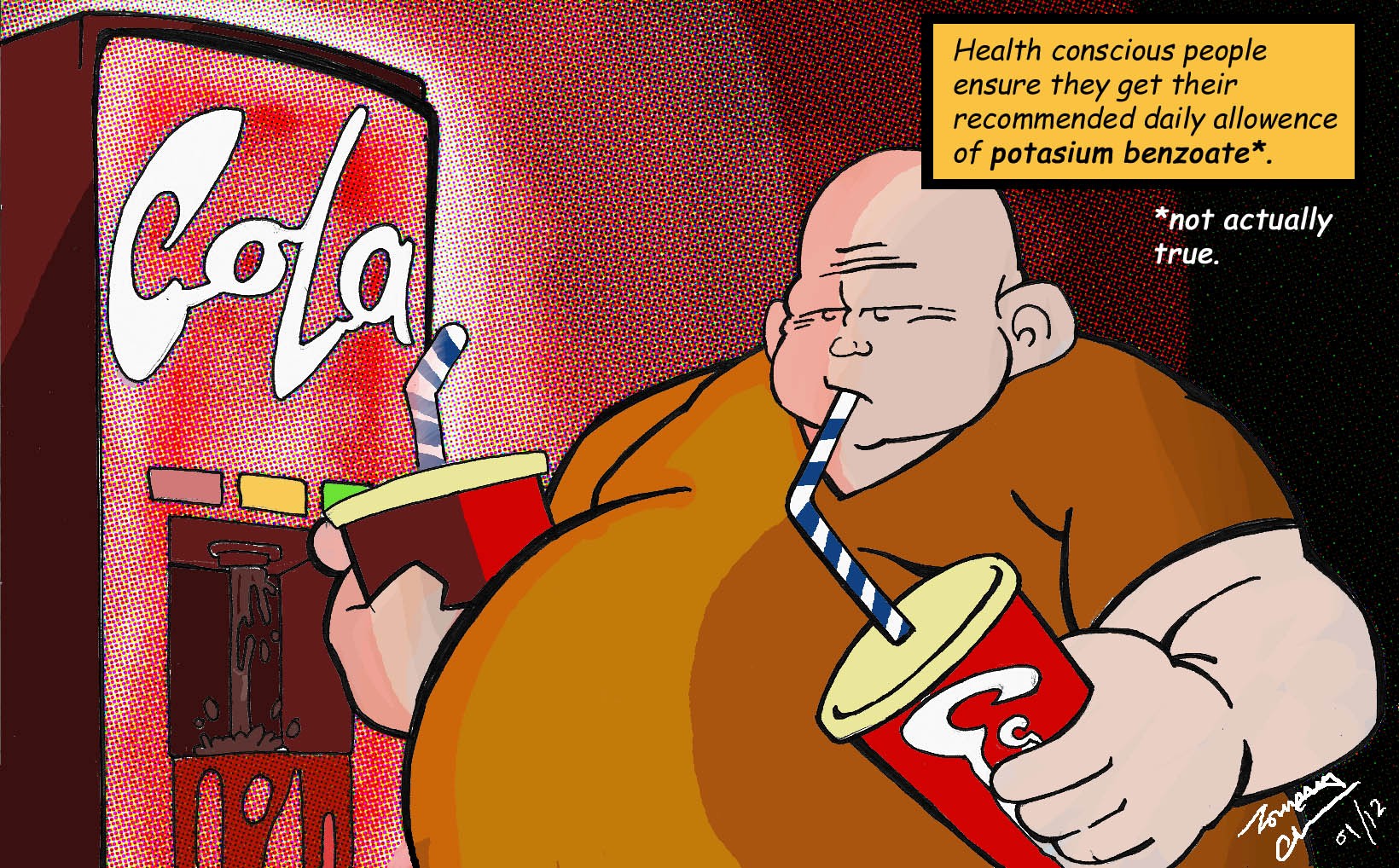
Potassium benzoate – All the kids and me need a chemistry degree to understand this one.  It sounds like you should put in it your car fuel tank!

Sucralose, Acesulfame, Potassium, caffeine, Citric Acid – I give up 😦 who on earth really expects anyone to understand all this.


Posted in SMILES | Tagged , | 2 Comments

“Dementia Puzzle”

How much more research do we need to tell us that the way we currently treat people with dementia is not the right way.  Common sense should tell us that if we marginalise people with dementia and leave them on their own for long periods, the lack of stimulation in their lives will certainly not improve their condition.  Their inability to remember things from the immediate past becomes a barrier to everyday living.

A spouse can often compensate for these memory lapses but eventually it can be at great personal cost.  That is why support for those still living at home is so vitally important and yet currently Social Services are having to withdraw help from people in their own home, in order to prioritise inadequate resources on the most dependant.  This is a nonsensical Government Health strategy, which can only lead to higher costs and poorer care in the long-term.

Nothing can be more debilitating than to take confused people into residential care, put them with lots of other confused people and give them nothing to do all day.  Confusion just leads to more confusion – it is a totally defeatist strategy.

A recently reported piece of research in Bavaria followed the lives of residents with dementia who were given two hours of activity therapy 6 days a week for a year.  The activities included gentle exercise, gardening, preparing meals and puzzles like crosswords and Sudoku.  At the end of the study the residents had declined less than would be expected.  The activity programme was at least as effective as drug treatment in modifying the progression of the illness.

This simple piece of research underlines conclusions already reached in research at the ExtraCare Charitable Trust over a good many years.  This has now be formalised as an “Enriched Opportunities Programme” which is based on the individual lives of the residents.  It is founded on the principal that the more familiar the activities are to residents’ former lives, the more satisfying they are likely to be.

Therapies for dementia are not rocket science, they are common sense, but they depend on society, the Department of Health and Social Services not turning their backs on the problem at an early stage.

Posted in Dementia | 4 Comments

“Cowardly Inaction” 2

Just as I was writing my first blog on the desperate plight of elderly social care at the very beginning of 2012 (see “Cowardly Inaction” dated 15 January 2012 or click on “Slippery Slope” in the TAG CLOUD) a letter appears in the Daily Telegraph – 3rd January 2012, saying much the same thing but in a rather more temperate way.  It was signed by more than 50 leaders in the field of elderly care and calls for the Government and opposition party politicians to implement the recommendations of the Andrew Dilnot report.  I would agree with them, but for the fact that it is not bold enough to radically change things and the politicians have already effectively shelved it as too expensive in the current economic climate.

The letters’ signatories are themselves part of the problem.  They too are looking over their shoulders and trying to recreate state funded solutions and protect elderly people’s accumulated wealth – mainly in the form of their house.  I believe the increase in longevity of the elderly generation, improved medical care and the paucity of most pensions combine to require a major injection of funds into the field of social care.  The only place this can possibly come from is the elderly themselves – which means they must cash in the value of their homes to pay for their own care in later life.  This is the very message that our cowardly politicians baulk from giving honestly to their electorate.

The sooner we tell people this, the earlier the market will respond to provide long-term care insurance products.  Only then will providers have sufficient income to provide a higher standard of residential and domiciliary care.  Dilnot saw this but he didn’t go far enough because he tried to find a compromise for the politicians.

It took a politician of the stature of Lloyd George to introduce the biggest social reform in the welfare of the elderly – the state-funded retirement pension, which was the first level of universal support for older people.  Another great leader – Aneurin Bevan, took the next radical step in championing the foundation of the NHS.  It is difficult now to row back from those solutions, but we have to accept there needs to be an equally dramatic change if we are to offer older people a secure future in later life.

It is a very bold leader that will swim against the tide of public opinion and political expedient.  The good news is that there is nothing to be said for retaining the status quo.

The time is right for change.


Posted in ELDERLY UK POLICY | 2 Comments

“Sheds on Prescription”

A  recent article in the British Medical Journal suggests that doctors may be finally giving up on pills as a solution to all ills.  A study by Professor Alan White of Leeds Metropolitan University, suggests that a peaceful retreat may help lower blood pressure.  He goes on to add that pottering about with odd jobs may have a positive impact on self-esteem.  Actually, I didn’t know I had a problem with my self-esteem but if the good doctor says so, I suppose I must.

It is timely that I saw this article because I am due for a medication review shortly so it gives me the chance to think about the shed I need in the garden – strictly for medical purposes of course!

Nothing too small – as big as a garage at least, and heated – definitely heated.  Plenty of light – a view of the garden and a veranda – but out of sight and hearing of any wifely calls.  I could manage a kettle for my tea or a flask with coffee and brandy in the winter.  There would need to be room service for elevenses and sandwiches for lunch (with the crusts cut off).  Maybe I could have a barrel of beer on tap or brew my own?  I could bring out my collection of Malt Whisky and quietly sample one or two (or three a day).  Even have some other connoisseurs around for an afternoon tipple.  May not be too good for the blood pressure though?

I could also move all my books into the shed – all the ones I have and haven’t read and the ones I want to read again one day.  Then I could leave them lying open all around the shed at interesting pages just in case reading takes my fancy at any moment.   Newspapers – I would need at least two delivered to the shed everyday, and if I didn’t read them, I could stack them in a pile in the corner until I could get around to reading them.

Corners – now there is a thought – corners are always a good place to tidy things away, so as well as the corner for old newspapers, I could have a corner for string, you never know when you might need string – and another corner for bamboo canes, old broom handles and long bits of metal, absolutely essential in any garden shed (and for low blood pressure) (and self-esteem).  A corner for a grow bag for tomatoes near the window, and another corner for a grow bag for hops for my home-brewed beer.  A corner for the plastic Christmas tree and another corner for the illuminated Stetson hatted Santa Claus that my Texan friend, John Tripplehorn, sent me.  In fact, maybe I could use all the Christmas tree lights to light the shed , then I could stay out there on dark nights.  But I would need mince pies and sherry to get into the true spirit of Christmas all year.  So that’s a shed with at least six corners – better have eight because corners seem to fill up quite quickly.

ONE OCTAGONAL SHED PLEASE DOCTOR FOR MY HYPERTENSION

Oh and don’t forget the shelves – you can never have too many shelves.  Obviously I need shelves for the books – strong shelves so they don’t fall down like the ones in the house did.  Then there needs to be shelves for everything else – all the de-cluttering we are going to do in the house:-

  • Shelves for all the gadgets we have bought and never used ;
  • Shelves for all he booze I have bought and never drunk – Plum Brandy from Czechoslovakia, Marsala for the Zabaglone that I never made ;
  • Big wide shelves for all the suitcases that have long since be superseded by other suitcases ;
  • Shelves for all the ornaments dotted all around the house.  Dozens of ornaments which will fill at least three walls and bring me joy every time I look at them ;
  • Shelves for all the empty vases around the house.  The small ones that are too small; the big ones that are too big.  I will leave in the house only the ones that are just right – if I can figure that out ;
  • A shelf with hooks for saucepans that we might need one day ;
  • Several shelves for box files that contain bank statements, bills and letters from the taxman that go back to when I first earned money as a paper boy ;
  • Last, but not least, in my garden shed, shelves for jars and pots.  Jars full of nails, nuts, bolts, labels, can tops, wire, more string and assorted screws that I might use one day.  The pots are left over from the plants I have bought over the last ten years.  It seems such a shame to throw them away.

With the house de-cluttered, we should be able to turn some of the upstairs rooms into extra walk-in wardrobes and my garden shed will feel just like home.


Posted in SMILES | 5 Comments

“Is this Pain Management ?”

There are a great many elderly Americans who move to Florida to retire.  Private health care is big business over there.   Small clinics are springing up all over the place – for back pain, for arthritis, for rehabilitation and for cancer care to mention but a few.

Just as I am about to leave America, an item on the news grabs my attention.  Four doctors in Florida who run a pain management clinic are arrested.  They had to obtain a state licence to run the clinic and were turned down.  But in the ‘Land of the Free’, and of light regulation and private medical insurance, they opened up anyway.

The police suspicions were raised when they saw a flyer being issued to patients telling them not to claim for payment of their drugs on their medical insurance because it would alert the attention of the authorities.  Patients were required  only to pay cash for their pain management treatment.

Apparently the doctors had opened clinics in other areas and been subsequently closed down, so in true entreprenurial spirit, they moved on somewhere else in the State and opened up again.

It doesn’t take a genius to figure out that pain management can mean all sorts of things, but there is one way of guaranteeing there will be no further pain. A quick no-questions-asked lethal injection.

Is this what is meant by “end of life care”?

Only a few days ago I was writing about assisted suicide – click on the “Slippery Slope” in the TAG CLOUD


Posted in Assisted Suicide | Tagged , , | 1 Comment