“Age UK – Agenda for Life 2011”

On Tuesday of this week I went to the Annual Conference of the two organisations that were formerly called “Help the Aged” and “Age Concern”. 

It wasn’t long before I was thinking I had stepped into a parallel universe – the shiny new, new speak world of Age UK.  The world I had just come from only the day before seemed to be an era of neglect of older people and austerity cuts.  In the last few months, there has been so much talk of complaints about NHS care of the elderly, reports by Age UK themselves on malnutrition and 80% Government cuts in Supporting People funding mainly affecting voluntary organisations and charities.  Maybe my expectations were too high, but I had assumed I would see some of the forefathers of Dylan Thomas “raging against the dying of the light and old age burning and raveing at the close of day”. 

When I saw on the agenda that two of the speakers in a panel discussion on “Integrating Health and Social Care” were Jo Webber, the Deputy Director of the NHS Confederation and Dame Jo Williams, Chair of the Care Quality Commission, I at least hoped they would give the politely listening group of older people some rotten tomatoes for audience participation………………..sadly – no such luck.

The opening speech by Tom Wright, the new Chief Executive of Age UK, was all powerpoint and market speak.  The £100 billion grey market is forecast to grow by 81% between 2005 and 2030.   Tom seemed delighted by this, because it will guarantee that everyone in the years ahead is advised by Age UK, to get insured by Age UK, in case they fall out of their Age UK stair lift, on their way down from their Age UK bath and shower, to a breakfast provided by the Age UK sponsor – Sainsbury’s, who just love older people.

The new speak continued throughout the day.  Everything was “embedded” and definitately “sustainable”.  In this belated 1984 world, we are all “equal” and we all have “rights” – “equal rights”.  We are all “engaged” – presumably to each other? – and everything is “counter-intuitive” or it isn’t because it doesn’t make sense.  Oh! and in the Sainsbury’s bit of the world, the staff are all “colleagues” who intend to “shine their light” on their grey colleagues.  We just need a quick chorus of “Shiny Happy People” and all will be bliss.

Almost euphoric after this first session, I was really looking forward to the tomato throwing in the group therapy session on the NHS and Social Care.  Jo Webber came on and reassured that everything was wonderful in the NHS and there was no need to mention malnutrition (indeed nobody did).  It probably never happened and even if it did nobody was to blame, there was not enough money, the staff were too busy and “lessons would be learned”. 

Tom Wright had already told us that 176,000 older people like the NHS so much that they go back into hospital within a month of being discharged.  What better endorsement of the service could a marketeer want than repeat customers!

Dame Jo Williams, the electric Chair of the Care Quality Commission, further reassured us that if anyone at all delivered poor care in future, they would be beaten remorselessly with a big stick.  The audience by this point was so comforted that they forget to throw the tomatoes and politely applauded instead.

The “final solution” in this session came from the new techno age, when Dr Petra Wilson of the American computer software company CISCO Systems told us that help was at hand (or mouse).  It is just a matter of time before all our care needs can be provided by Telecare kettles that report on our health to big brother in the “cloud” every time we have a cup of tea.  In this new world future if we want companionship we can have a digital cuddly toy instead of a pet.  Presumably if you don’t keep talking and stroking it, either you or the pet are dead!   We need never speak to a real person ever again.

Just when it looked like it could not get any better, the Secretary of State for Work and Pensions, Iain Duncan Smith was billed to speak about pensions.  An engineered leak in The Times, The Guardian and on BBC had rumoured that he was going to announce we will all get a £140 pension in future.  He is a very polished speaker which suited this, by now, shiny audience.

Strangely at an Age UK conference for older people, he talked mainly about children and the need to protect their futures in later life.  It was almost as though he was explaining that there wasn’t any money for the current generation of elderly people but that by 2050 everything would be alright.  Then came the crescendo of his speech – the big announcement – when he had raised all hope and expectation this “Quiet Man” lived up to his reputation and said………………. NOTHING!
 

Posted in ELDERLY UK POLICY | Tagged | 2 Comments

“Commission on Funding of Care & Support” 4

HALF-TERM REPORT

Some of the early indications from the Dilnot Commission would suggest that they intend to fully embrace some of the age old problems in the funding of long term care.  Certainly it will be very welcome if there is a resolution of the tension between the partly-funded social care system and the free services currently classified as NHS Continuing Care, this has been a longstanding grey area which has been interpreted in a multitude of ways by different PCT’s.  It will also be good to see an unequivocal statement on free and means-tested entitlements set on a national basis so that elderly people and their relatives can have a common understanding of what they can expect from both Social Services and the NHS in terms of quality and funding support.

It is already clear that there is going to be far greater sharing of costs, but the split between the State and the individual will heavily depend on just how much extra public funding is forthcoming.  As the demographic pressures increase in the years ahead I would be surprised if the State is able to fund much more than the critical/substantial means-tested cases that are currently funded. 

 I also strongly agree with the suggestion that today’s system must be improved before anything else.  Otherwise it’s difficult to imagine why elderly people would wish to pay more for the current abismally poor standards of care.

As always the devil will be in the detail but the fundamental question of where the additional funds are to come from has yet to be faced by both Andrew Dilnot’s team and then later the politicians.  I believe this can only be achieved by a radical restructuring of the provision of long term care away from the NHS and towards a higher quality of social care provision, both in the community and the residential home sector.

This follows on from my submission to the Dilnot Commission dated 6 February 2011 and my follow up blogs dated 27 February 2011 and 3 March 2011.


Posted in ELDERLY UK POLICY | Tagged , | Leave a comment

“Commission on Funding of Care & Support” 3

One of the fundamental themes of my submission to the Dilnot Commission  (see Commission on Funding of Care & Support dated 6 February 2011), is that in the years ahead, most older people will have to pay for their care by using their house as an asset. This is not a welcome prospect because as a society we have come to expect that health care is free.  Alongside that idea, the inflation of house values over the last 30 years has led the elderly and their relatives to believe they will leave a significant legacy when they die.

I believe these two related myths are holding back the elderly from securing a better future for themselves. In this new area of austerity, is a bubble that needs to burst but no political leader wants to be the first to break the bad news. In the financial press recently were some guesstimates that illustrate the scale of the issue:-

 People over 65 own £763 billion of un-mortgaged property;

 In 10 years this will have risen to £1 trillion;

 800,000 people will reach 65 next year;

 On average they will live for 23 more years.

So what are the barriers to this happening? Insecurity is the key issue.  In later life few people want to step into the unknown, and yet lifespan and health are two unanswerable questions. The fear of not knowing how much you will need to look after yourself is what leads many people to hoard what they do have. This is reinforced by the justifiable view people have, that long term care is not only very expensive but often very poor quality.

For the Government to unblock this situation they need to remove the barriers that they can influence:-

 Make equity release a more reasonably priced option so that people can more easily access the hidden savings they have in their homes;

 Stimulate the retirement housing market to encourage people to move and downsize their homes;

 Offer long term care insurance to give people more certainty over future health care costs;

 Dramatically improve the quality of health care for older people by restructuring NHS provision.

These moves will hopefully be captured in the recommendation of Andrew Dilnot’s report. A trillion pounds would go a long way to reviving our ailing economy and would enable older people to secure for themselves a brighter vision of later life.


Posted in ELDERLY UK POLICY | Tagged , , | Leave a comment

“Neglect Shames Britain” 4

ST DAVID’S DAY REFLECTION

February 2011 was quite a momentus month of news about the elderly.  I don’t think I can remember a month with so many front page headlines and numerous graphic accounts of neglect of the elderly.  Not just in the press but also on television and radio. 

It was all prompted by a report by the Ombudsman on complaints about the way elderly people are treated in the NHS.  At the beginning of the month it looked like the issue, which was first flagged up in December 2010, by the Patient’s Association Campaign championed by the Daily Mail.  At long last it seemed like it might finally take off.

Then came the announcement of a Royal Wedding; the turmoil of political change in North Africa and the earthquake in Christchurch, New Zealand. 

WHOOSH !!!!      Rather like a Formula 1 car race, it was headlines one minute and history the next.  All the attention goes to the car in the front and it wasn’t the elderly for long. 

The problem is old people die everyday.  They are expected to.  It is not a nice experience and tragedies sometimes happen.  We can do nothing to stop it so maybe it’s just better to forget it.  Put it in the back of our collective minds and move on to the next headline.  Bereavement is not a happy subject nor one where there are any quick-pill solutions.  It’s like global warming – an inconvenient truth.

Let’s change the prospective for a minute:-

What if it was not the elderly we were talking about, what if it was children?

What if thousands of children were dying in our hospitals from starvation/dehydration/everyday infections and all without pain control?

It’s not even possible to imagine that hospital staff could walk past children in this situation as if they didn’t exist.  Their compassion and concerned relatives would be at the forefront of ensuring that the best possible care and attention was made available.

Young children don’t deserve to die.

Have we, as a society, come to believe old people do?

At the end of the month, the newspaper headlines have moved on but the TV Documentary channels were just taking up the issue of elderly neglect.  On the same night, just one hour apart on the 29th February, they portrayed two very contrasting views.  One on the “Dispatches” programme on Channel 4 – almost too difficult to watch – was an investigative “fly on the wall” film about end of life care in the NHS.  All of it reflected the awful experiences of patients and their relatives.  A chilling portrayal of the headlines from the beginning of the month.  At the end of the programme, the all too familiar apologies from the NHS and Social Services.  Followed by the less than credible promises that “lessons will be learned”.

Not so long as society believes the elderly deserve to die, they won’t!

In our collective grief about this neglect, it is natural to want to lash out at someone or something, and the NHS and Social Services are the first in the firing line.  I believe that most people who work in these services are decent caring staff who want to do a good job.  They succeed superbly well in looking after children, so why does it all change when it comes to older people.  Could it be that our expectations of later life are so low that life is not worth living.  Have we, as a society, not yet come to terms with the fact that most people are going to live much longer.  More health care will be needed for some people but the majority will lead healthy and active lives. 

There is a vision of later life which could be the salvation of our society if older people are encouraged to use their wealth of experience, skills and financial resources, to find a new way of living in older age.  The second TV programme was on BBC2 in a short series called “When Teenage Meets Old Age”.  It is an inspiring example of what generations working together can give to each other.

Out of a Winter of neglect, surely we can on this first day of Spring, find a new vision of older and younger people working together for a better life.


Posted in ELDERLY UK POLICY | Tagged , , , | 2 Comments

“Commission on Funding of Care & Support” 2

Age UK, in an interesting blog by Stephen Lowe entitled “Changing the Social Care Landscape”, has recently commented on the potential tension between the Dilnot Commission Report and the Law Commission Review of Adult Social Care Law.  Both are due to report later this year.

I agree completely that the current social care system, as it applies to most older people, is a disaster.  I am not as confident as Stephen Lowe at Age UK seems to be that the two Commissions looking into adult social care will reach an harmonious conclusion.  I believe Andrew Dilnot will come up with some fairly radical proposals for the funding of care because as an economist he will clearly see that anything less will mean that the cost of care funding by the state will be unsustainable.  Sadly I feel the Law Commission Review is far less likely to simplify the evermore complicated web of human rights and age discrimination legislation.  The application of tighter and tighter regulation, however well intended, will not solve the problem of failing systems.

Stephen Lowe rightly says that the fundamental difficulty is to do with trust and I agree with that completely.  So long as the quality of health and social service care for older people remains as bad as it is, there can be no straightforward solution to the issues.  What the Department of Health needs to do is help build a new vision of health care for the elderly.  I have already expanded on this in my submission to the Dilnot Commission which is included in my blog dated 6th February 2011.  I believe that the NHS and Social Services need to step back from providing anything other than acute care for older people but the price of this is that the majority of older people will need to fully fund their own care in the future

Posted in ELDERLY UK POLICY | Tagged , | 1 Comment

“Move to the Country” 2

Back on the 28 May 2010, I wrote about the virtues of moving to the country on your 76th Birthday which was supported by recently published demographic statistics about living longer.

On the 9th February I went to a Government sponsored conference about the future of sheltered housing. After hours of speeches it seemed like most of the presenters and much of the audience were looking for hope rather than being able to offer a constructive way forward.  This is understandable when you realise that many of them were Civil Servants, Local Authority staff and leaders of voluntary projects. All of their words were heavily loaded with talk of austerity and cut backs in spending. Their work of previous years was being shredded as they spoke. Indeed many of them were uncertain about their own future, and the funding of their departments and projects.

Excellent projects like Care and Repair services plus information and advice projects have gained vast experience over the years.  They have provided invaluable support to thousands of older people to help them remain independent in the community. Many of these projects operate on the margins of Central and Local Government Departments joining up the often silo-mentality services of health, social services and housing. They are providing the holistic, preventative and cost effective services that the Coalition Government applauds, yet they are under threat from the blunt axe of cut backs.

Meanwhile they are being replaced by the vacuous aspirations of “Localism”, “Personalisation” and the “Big Society”. The conference speakers all tried to relate their talks to these new concepts but vainly and unconvincingly. It felt as though they had been cast adrift and were clutching at the straws of a “new speak” language that they could not understand.

Coincidently as I was writing this blog I was listening to a Sunday morning TV discussion on the “Big Society”. Individuals whose jobs were being threatened were blaming the bankers on one side.  An MP was extolling the value of voluntary involvement on the other. In the middle charities were affirming the virtue of their cause, and church leaders were seeking to draw people under the umbrella of their faith.

Both the conference and the TV debate seemed to be moving towards the same hopeless conclusion – that the “Big Society” idea is just a smokescreen for cut backs.

Against this background, my conference visit appeared to be drawing to an equally disappointing end. Only to be saved by the final speaker – Lynden Jackson – who talked about the issue of ageing from the perspective of a small village community – Debenham in Suffolk. Their common interest started from a concern about dementia in their small community and later widened to also include physical frailty. Over the last two years, they have been befriending people in their own homes and providing support for carers, exactly what families and good neighbours should do for each other. At the same time they formed a group to develop a bigger vision for the future, who started to talk to all the Health and Social Services Teams operating in their area. Their story is told much better on their website www.the-debenham-project.org.uk. They now have a vision for the future which hopes to build a new but small project of housing with care which includes provision for respite care, rehabilitation and specialist dementia help.

It is a hugely ambitious task for such a small group but if it were accomplished it could provide a housing and care model which could be replicated across the country for rural communities.

What the Debenham Project has is strong leadership and a clear vision which needs nurturing and encouraging with a very light touch. They could benefit from much of the expertise in the conference room and they will need money and resources to fulfil their ambition but by their deeds they completely describe what “Big Society”, “Localism” and “Personalisation” are all about.

Posted in ELDERLY UK POLICY | Tagged | Leave a comment

Breakfast Exercise “3”

Breakfast is supposed to set you up for the day but not always in the way you intend.  See my earlier posts on Breakfast Exercise and you will see what I mean (Breakfast Exercise – 6.9.10 and Breakfast Exercise “2” – 21.11.10)

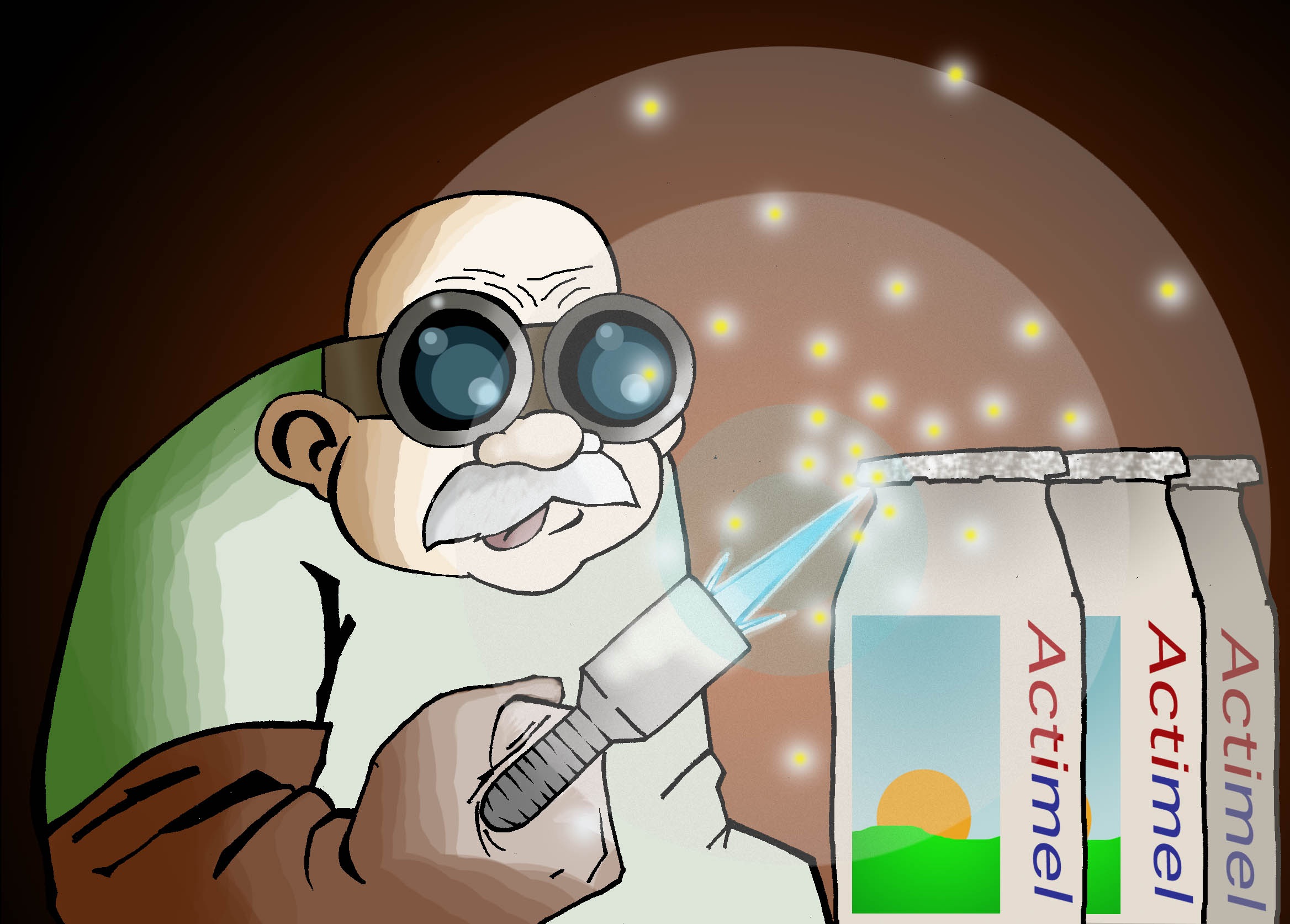
Today I have something new to try – Actimel – a liquid yoghurt made by Danone.  Even better for my New Year’s return to fitness, I could win one of “50,000 Winter Days Out” – skating, skiing and more.  Wow what a start to the year!

By this time next year, I could be the next Torvill and Dean – or at least one of them?  Mind you, at 60 plus, those double solkers and triple axles could be a bit of a challenge, especially when I have never been skating before.

Maybe I am getting a bit carried away here, I first have to face my more usual twin challenge of packaging and small print.  The individual yoghurt pots come locked together in an ingenious pack of 8.  Only problem is you have to be equally ingenious to unlock them.  So after much pushing and pulling and then some ripping and tearing – and b****y swearing, I now have my one pot daily amount in my hand and 7 more on the floor.  Fortunately not broken, 6 just scattered about and 1 under the washing machine.  Still, all the bending and stretching will help me later with my triple toe loops.

The foil cover on the plastic container is the same as all other yoghurt pots – difficult to open in one go.  They must be especially designed for messy openings and sticky-licky fingers.  Still the liquid yoghurt is nice enough, I am just one swig away from my TV appearance with Jayne and Chris on “Dancing on Ice”.

All I have to do is reassemble the jigsaw of a ripped up cardboard package so that I can read the instructions on the back.  Nothing is going to stop me now, I am already prepared with my magnifying glass for the small print challenge.  I can see straight away that as they say on the box, this is “my chance to get the most out of winter”.  I just need to enter my unique code on the Actimel website to know “instantly if I have won.  My unique 16 digit code – no chance of a mistake there then?

I am almost beginning to imagine myself hoisting Jayne Torvill over my head in an aeroplane spin when my magnifying glass reveals in even smaller print the lawyers Terms and Conditions – only 19 of them!  Hold on Jayne I’ll be back in a minute:-

1.      Live in GB and over 18

2.      Closing date end of February

Not much time for practice then!

3.      Pay your own travel costs

Just hope it’s not in Helsinki!

4.      If you have health problems

If?  Now I have to pay for a medical.  Still think of the glory and Jayne!

5.      Prizes subject to alteration

I hope I don’t get climbing Everest instead!

6.      Must enter your personal details

Junk mail to follow!

7.      Applications before 24.1.2011

That’s sneaky – even less time to practice!

8.      Enter your unique code again

Good job it is only 16 digits!

9.      Retain your till receipt

What?  I’ll have to go to the rubbish tip!

10.    Prizes can’t be transferred

Might be stuck with Jayne.  Oh Well!

11.    Prizes randomly allocated

I might get Chris!

12.    Only one entry per day

Just when I had mastered that 16 digit code!

13.    Subject to verification

A lie detector test perhaps?

14.    Must participate in publicity

Me and Jayne on the winners’ podium!

15.    Winner’s name published

Crowds outside the door then!

16.    Promoter can offer alternative prizes

No thanks, I have set my mind on Jayne!

17.    Except for death, promoter accepts no liability

I didn’t realise it was that dangerous!

18.    Enter and you accept these terms

Bring your own lawyer!

19.    Send S.A.E. for winners list

Maybe we could form a club!

20.    Promoter’s decision is final

No audience phone-in vote then?


Posted in GRUMBLES | Tagged , | 4 Comments

“When I’m 64”

Written by Paul McCartney in 1966 when he was only 16 – just how prophetic were these lyrics?

“When I get older losing my hair many years from now,”
Sad to say my hair was falling out in my 30’s and by the time I was 40, I was able to qualify as a Trappist Monk!
“Will you still be sending me a Valentine,”
No mystery senders now, but a treasured expression of lifetime love.
“Birthday greetings,”
Not so many now since I’ve stopped counting
“Bottle of wine”
Yes! A bottle of red and a bottle of Port and a book from true friends
“If I’d been out till a quarter to three, would you lock the door,”
The cat is more likely to be out at this time than I am
“Will you still need me, will you still feed me when I’m 64”
Not if I go into hospital you won’t!
“I could be handy mending a fuse when your lights have gone,”
No need for fuses with circuit breakers, but I can shine a torch so you can see in these energy saving lightbulb days
“You can knit a sweater by the fireside,”
Knitting is a lost art and firesides have almost all disappeared too
“Sunday mornings go for a ride”
Less joy in the traffic and no more lunchtime drink in a country pub
“Every summer we can rent a cottage in the Isle of Wight, if it’s not too dear”
It’s probably cheaper to go to the Costa del Sol on Easyjet
“We shall scrimp and save”
That certainly came true for lots of people
“Grandchildren on your knee, Vera, Chuck and Dave”
More likely to be called Fifi-Trixibelle, Dweezil and Romeo
“Doing the garden, digging the weeds”
An everlasting passtime
“Who could ask for more”
Everyone whose name is Oliver and most elderly people
“Send me a postcard”
E-mails are more likely and less fun than seaside cartoons
“Drop me a line”
A whole different meaning these days
“Stating point of view”
A pity politicians don’t leave out the spin and speak from the heart
“Yours sincerely, wasting away”
I wish! Putting on weight is more the current problem
 
“Will you still need me, will you still feed me”
Hopefully I’ve earned my corn in the last 63 years
“When I’m 64”
TODAY!
Posted in SMILES | 3 Comments

Commission on Funding of Care and Support

Submission by John Graham OBE – 26 January 2011

My proposals are two-fold, and are based on both improving the quality of care for older people and also releasing the billions of pounds required to meet the dramatic growth in the frail elderly population in the years ahead.

Transforming the NHS Care of the Elderly

The proposal in terms of the NHS is consistent with the recent move to GP commissioning.  It also seeks to refocus the NHS on the area it does best – acute care.  The NHS, in becoming more specialised, has moved itself away from dealing with the complex but relatively low level interventions of geriatric care.  Equally, the current nursing profession, with its move toward a more technical degree based approach, is less well suited to provide the “tender loving care” more often required by the elderly.  The consequent problems with care of the elderly in NHS hospitals are regularly reported on e.g. Age UK’s report on nutrition; Patient’s Association report on rising complaint levels; the recent reports on poor surgical outcomes for older people, rising levels of infections on wards and the inadequacy of pain control. 

Your report illustrates the significant imbalance in funding in favour of NHS care over social care.  My proposition is to shift away from treating older people in hospital except for short term acute clinical intervention.   My experience suggests that most medical needs can be met in nursing and residential care settings or even in people’s own homes in the community.  This is wholly consistent with the Coalition Government’s move to GP commissioning.

There would need to be skill set changes to support this move.  Many nurses have been lured away from vocational training in pursuit of better salaries and degrees.  Whilst this move in the direction of increased technology and clinical specialism may be appropriate across the whole spectrum of the NHS, it is not so relevant when nurses need to take the lead in providing dignity and holistic care to elderly people who have multiple low level conditions.  They need to treat the person, not the illness and to do this I would suggest the development of a new arm of the nursing profession operating in nursing homes and the community.   Second level nurses for the elderly are already separately accredited in Holland and elsewhere and would go a long way to improving medical care in residential homes.

Put together, I believe these two proposals would significantly improve value for money, given that the overall unit cost of nursing and residential care is significantly lower than the basic cost of nursing in the NHS.  By redirecting millions of pounds from the NHS, it will allow many more people to be provided for in nursing homes and the community, controlled by the more localised social care sector.   Rather than transferring funds out of the NHS, I would specifically provide “top up grants” to nursing / residential homes from the NHS budget for those people who have complex health needs.    I would, at the same time, remove the anomaly of free “continuing care” funding by the NHS.

Unlocking Housing Assets

My second change would be to make a series of amended taxation measures designed to make it easier for elderly people to use the assets tied up in their homes (the so called “death tax” is one option, but I believe all political parties grossly understated the cost of their proposals).  My key proposal would be to promote the use of reverse mortgages (used in Australia) as a way of enabling older people to release equity in their own homes.  I would do this by offering mortgage interest relief on the condition that the released resources were used exclusively to secure health and social care support through a registered agency.  This should avoid the pitfall of more open ended and less regulated equity release schemes.  It would provide a major avenue enabling older people to remain in their own homes and still fund the domiciliary care they need in later life to maintain their independence.  Tax free eligibility levels could be tied to Local Authority domiciliary care costs.

As a second level of cover, I would extend tax free eligibility to long term care insurance which could be used to fund people as a “stop loss” if they were eventually unable to remain in their own homes for life. 

By essentially getting asset rich residents to fund their own care with this tax free benefit, it will leave public funds to stay focused on those people with critical and substantial health care needs who have no significant financial resources or assets.  This should significantly relieve pressure on Social Services and reduce the demands on the NHS.

Improved Regulation

Both of my proposals would need a change in regulation, although I believe this could be done through existing channels.  Firstly, the CQC role should be defined more clearly to support quality outcomes rather than focusing on compliance with input procedures. Secondly, the FSA would need to exercise control over the issue and purpose of tax free reverse mortgages, and also of any extension to health care insurance.  Again I believe this is only an enhancement of their current role. 

Conclusion

I appreciate that none of these proposals are straightforward and they have significant ramifications, but I think that there needs to be a significant transformation of the elderly care system in terms of both quality and cost.  Nonetheless I believe these propositions are sufficiently close to the current direction of travel of all party policy to be accepted.  I believe they address old peoples’ concerns about the inadequacy of care in the NHS and ease their ability to fund planned care elsewhere with their own resources.

This represents a profound change which will claw back the unearned assets people have accumulated in their housing.  To an extent it is what is already happening by default for an increasing number of families, and without supportive measures it provokes a great deal of resentment.  I believe the provision of a tax incentive will make the measures more readily accepted by elderly residents and their relatives.  It holds out the prospect of a new vision of care and support in later life for those who need it most, whilst enabling the majority of elderly people to continue to live independently with some additional support.

Posted in ELDERLY UK POLICY | Tagged , , | 2 Comments

“My Paper Chase”

I had a frustrating day yesterday – making phone calls to no-one who was in, just b****y voice mail!; typing an e-mail which then I accidentally deleted before I could send it!!  Finally, when I wanted to print a report, I ran out of paper half way through!!!

Still, an easy day today, looking forward to an enjoyable afternoon of wood-turning.  Started the day doing my Tai Chi outside in the garden to get me all relaxed and ready.

Just need to pop in to stationers, should not take long – it’s almost on my way.  Staples surely won’t tie me down for long.  As I walk through the door, I enter a bureaucrat’s emporium – a warehouse full of paper – my goodness the Amazon Forest has come to Northampton.  The impulse buy near the entrance is envelopes on “special offer”.   I must need some of them but here’s the first problem:-

  • Do I need gummed ones, self-seal ones or peel and seal ones – does self seal mean you have to seal them yourself?
  • What size do I need – C4 / C5 / C6
  • What does “C” stand for and why isn’t it “E” for envelope
  • What happened to “A” and “B”
  • Now I’ve found “DL – what?????

A few more choices:-

  • With a window or without a window?
  • Pack of 25 / 50 / 100 or a whole box of unknown number?
  • Basket weave – whatever that is – it must be on the wrong shelf

 I eventually decide not to bother!

The impulse seems to have disappeared

Now onto the paper I came for.  Oh dear! Bit of a choice here about a mile of shelving stacked so high you would need a telescope to see what is on the top shelves – providing it’s not a cloudy day that is.  I know exactly what I want – just a pack of A4 copier paper but life is not that simple in the Staples Emporium – I need to pass an “A” level in stationery first:-

  • What is bigger – 500 sheets or a ream?

Whatever happened to diaries with all that useless information inside?  And anyway you can never find your diary when you need it !

  • Do I need 80 gram, 90 gram, 135 gram?

Who says size doesn’t matter, certainly not Mr Staples?

  • Now the big question, what type of paper do I need?
    • Sample paper – presumably you can bring it back later
    • Office paper – where else would you use it?
    • Multi-use paper – perhaps you can use this for fish & chips
    • “All in one paper” – maybe there is a giant sheet inside with enough space for everything you would ever want to write about
  • Now the final and most important exam question of all.  How to save the world in the midst of this fallen Amazonian Forest.  What Eco paper do I buy?
    • Ecologically friendly – as opposed to paper that tell you off when you use it
    • Recycled paper – I guest this comes with words already typed on it – maybe you write between the lines
    • Eco-logical “Give a tree a name” – presumably before you cut it down

Hopelessly failing my “A” level in paper, I buy the cheapest and leave.


Posted in GRUMBLES | Tagged | 3 Comments