“Plastic Fantastic”

A recent article in the Daily Mail on the 15th August 2011, reported on an 83-year-old lady in America who caused quite a stir in the medical establishment when she decided to have breast implants.

This really had me in a quandary, because generally, most people and I include myself,  tend to frown on the idea of plastic surgery purely for cosmetic sake. 

 Isn’t it just the domain of the rich, the famous and the vain?

As our population ages, more and more women are opting to improve their appearance through cosmetic surgery.  In America it is a growth industry – 84,000 such procedures were performed last year – on face lifts,  eyelids  and breast operations.

The medical profession is divided about the ethics and clinical wisdom of such operations on the elderly.

  Meanwhile, Mrs Kolstad, who still works full-time at the age of 83, just wants to be noticed.  I’m sure she has been made aware of the risks of an operation like this at her time of life and as she lives in America she will definitely be paying for the privilege.  She sounds very much like a lady who is more than capable of making up her own mind. 

 Bigger boobs is certainly one way of combating ageism and turning grumbles 😦 into smiles 🙂

Good on you Mrs Kolstad !

Posted in ELDERLY MARKET, SMILES | 1 Comment

“Grumbling American Style”

I was surfing around blog sites relevant to older people last night looking for someone with interesting insights into ageing.  As usual most of the things I found were excessively academic articles on gerontology which speak of everyday issues in such highfalutin terms that I quickly lose interest in what they’re trying to say.  The other blogs on ageing, all seem to have a commercial edge and are full of adverts promoting everything from:-

  • wrinkle cream to cosmetic surgery through to dating for seniors;
  • mobility aids to recliner chairs to stair lifts;
  • home delivery ready meals to retirement homes;
  • health cures from the credible to the incredible;
  • pension plans to funeral plans;

Finally I did come across a blog which I think you might find interesting.  “The problem with young people today” is a blog by Don Mills which you can find at http://crabbyoldfart.wordpress.com   which is an incredibly humorous grumbling site.  Many of the issues Don comments on, are probably just as applicable to the UK and fit perfectly into the grumbling image of old people – but with a big smile.

Posted in GRUMBLES | 1 Comment

“Water, Water Everywhere”

Over the last ten years it has become more and more common to hear people tell you to drink more and more water – eight glasses a day / two and a half pints a day / 1.2 litres a day and even 2 litres a day !

Supermarket shelves are loaded down with spring water from the Highlands of Scotland / the Limestone Springs of Derbyshire / The Health Springs of Malvern / The Volcanic Springs of Central France / The Alpine Glacial Streams of Northern Italy.   These days everywhere water springs up, someone is there to bottle it.  Then we can have it still  or sparkling or carbonated or distilled or filtered through charcoal or flavoured with every possible variety of fruit.  No doubt there are many more options I’ve yet to come across.

The message is reinforced by sportsmen and women everywhere taking care to hold the label so you can see the brand name on the bottle.  At Wimbledon several swigs are required between each change of ends – whatever happened to Robinson’s Lemon Barley Water?  At Golf Tournaments a drink of water is necessary on the tee at each hole and between each shot when walking down the fairway.  Watch Leicester Tigers play at Welford Road and you see a pitch invasion of water carriers on and off the pitch at every opportunity.  In my day playing rugby you were lucky to get a small orange segment at half time !

In the London Marathon every kilometre has a market stall of bottled water, although most of the runners seem ungratefully to pour the water over their heads.  Next year “Head and Shoulders Shampoo” are sponsoring the race and they will be adding their product to the water.  In the 2012 Olympic Stadium, there will be water pipes strung above the race track and the Athletes will be attached to “Pellagrino Move-Along Drinking Straws” that will follow the runners throughout the race.  In the Steeplechase, the Athletes will be credited with an extra 10 seconds on every lap to give them time to stop and drink at the “Evian water jump”.

A report in the British Medical Journal casts doubt on this obsession with drinking so much water.  It suggests that Government guidelines on drinking so much water are “worse than nonsense” and that the virtues of water guzzling are exaggerated by bottle water brands. 


Posted in SMILES | 4 Comments

“Dangerous Road” 2

A couple of months ago on the 20th June 2011, I wrote about assisting early death and the apparently more liberal attitudes to euthanasia in Holland, albeit with some safeguards.

A graphic illustration of the issues is shown in a recently reported case at a General Medical Council tribunal, where a Shropshire GP is facing a misconduct hearing for allegedly hastening the death of a 65-year-old man, terminally ill with lung cancer.  The patient had been given a large dose of pain relief drugs in the knowledge that this may hasten his death.  The family were informed and a specialist was also in attendance.  The man had recently been discharged from hospital, presumably to allow him to die in his own home.  The doctor had visited regularly and on his fourth visit in 24 hours, he administered the final drugs.  Over the years this must have happened quietly in the night to many other people, where a caring doctor has eased the painful end to a life.

Now in these more judgemental days, that’s not the end of the story or the distress.  A worried nurse reported this incident as a “serious deviation from end-of-life care standards”.  Thereafter the due process of retrospective assessment takes over, the police become involved followed by the lawyers, then there is no turning back.  What may well have started out as a compassionate and caring act, becomes a potentially criminal act.

It is not my intention to judge the rights and wrongs of this case, merely to highlight the difficulties:-

  • If the patient had been kept in hospital, no doubt the hospital doctor would have had more support at hand but it is the desire of most people to die at home.
  • If the GP and the nurse were able to discuss the options more openly between each other and with the family, they may have reached a consensus decision and the death would have been accepted by all involved.  But it is not easy to have these conversations, especially with relatives, in such stressful situations.
  • If the patient had made a living will expressing his wishes in such circumstances, the decision might have been easier – although not necessarily legal.  However, few people like to think ahead to their death and cancer can arrive with great speed.
  • If there were a more substantial range of home care for the terminally ill, such as “hospice at home”.  This situation may have been resolved differently.  Specialist services like McMillan Nurses have a great reputation in this field.
  • In the year and a half following the patients’ death, the relatives will have found it a very difficult bereavement; the police will have spent time investigating whether they have another Harold Shipman case to deal with; and the GP will have endured the anguish of not knowing if he will be struck off and maybe prosecuted.

These examples and others like it will be repeated many times in the years to come.  If a climate of fear and blame is created, it can only result in doctors trying to keep patients alive at all costs.  More patients will be sent back to hospital to end their lives in a prolonged period of ill-health and pain before they are allowed to die.

Posted in Assisted Suicide, ELDERLY UK POLICY | Tagged | 1 Comment

“Musical Interlude”

A little while ago I read a negative article about a hospital patient being given a tambourine to summon a nurse.  I recently re-read the report more carefully and it set me thinking —– this no doubt well-intended, if thoughtless idea, could be turned from a grumble  😦  into a smile   🙂

Music always lifts the spirit and significantly the hospital where this happened was the Cardiff Royal Infirmary, in the heart of the musical nation!  You could almost guarantee that every patient can play an instrument.  So why not give each patient a different instrument and then the nurses would know who was calling for attention:-

Mrs Jones could have a violin – delicate, polite but to the point;

Mrs Thomas a trumpet – she was always the shrillest voice in the street;

Mrs Davies a xylophone – very sophisticated, Mrs Davies is;

Mr Williams could have the drums in the day room because it is apparently further away and he makes lots of noise;

Mrs Evans a wind instrument – a flute, an oboe maybe, even a trombone but not a tuba – that’s too big – she’s never been short of wind, Mrs Evans;

No tambourines, triangles or small bells here, this is a Welsh hospital and there’s lots of “raging against the dying of the light” to do.

music2 3

At 10 o’clock each day, except Sundays, instead of doctors rounds, the local Brass Band leader could come in and conduct the patients and help them play in harmony.  This could be the only hour of the day when the nurses get a break and a chance to sit down.

The impromptu orchestra could learn different tunes to play for each of their daily needs – “a drink”, “a dressing”, “the toilet”, “my tablets”, “my pillows plumped up”, “a drink again”, “the toilet again”.

Wouldn’t all this be fun?  I’ll bet it would speed up recovery and hasten hospital discharge, as well as keeping the nurses on their toes.  “No time for paperwork, I can hear Mrs Davies playing Handel’s Water Music again”


Posted in SMILES | Tagged | 3 Comments

“Active Ageing”

Britain’s chief medical officers issued new guidance on exercise this month.  It was a straight forward and encouraging report because it emphasised that moderate exercise was good for you.  No need to be working up a sweat in the gym :-), providing you do it frequently – short 10 minute walks, ironing, housework, shopping and even just standing up can all help.

The report underlines the fact that “older people should try to be active every day” and goes on to say “being active has enormous health and well-being benefits.  It protects against many of the biggest causes of early death like heart disease and strokes, and can promote good mental health”.

In the ExtraCare Charitable Trust retirement housing projects, there are many ways of keeping active:-

– The obvious – exercise classes,  armchair aerobics,  tai chi,  swimming;

– The vigorous – work out in the gym to a fitness programme on exercise machines;

– The leisurely – walking,  dancing,  gardening,  fishing,  archery,  bowls;

– The adventurous – the annual ‘Brolly Walk’, cycling from Land’s End to John O’Groats (in the gym);

– The occasionally spectacular – walking with wolves, completing the three peaks challenge, swimming with dolphins in Mexico and walking the Great Wall of China;

Meanwhile, the same Department of Health that issued these new guidelines is also responsible for funding thousands of older people in residential care, who are left sitting in chairs all day and never go outside at all.  Its appointed regulator, the Care Quality Commission, happlessly watches on, blissfully ignorant of any need to promote active lifestyles for older people.

Posted in HEALTH, Residential Care | Tagged , , | 7 Comments

“Cast Adrift 2”

End of July 2011 and I have just returned from a cruise up the West Coast of Norway on board the latest ship in the Cunard fleet – the new Queen Elizabeth.  A massive ship – 10 decks high – taller by far than all the buildings and all the ships in all the ports she visits.  So you have an inbuilt sense of superiority wherever you arrive.

It must have been much the same experience for the adventurous sailors of centuries past, whose ships were bigger and stranger than anything the people of far off lands had ever seen.

The Queen Elizabeth has echoes of the past by being beautifully decorated throughout in the 1930’s Art Deco style.  An era reminiscent of luxury and Hollywood films for the rich and famous.

Leaving Southampton to cruise across the North Sea with a shipful of retired ramblers relaxing in the lap of luxury.  A floating cacooned community of sixty, seventy and eighty year-olds sailing on their solitary seas.  Cut off from their youth and momentarily comfortably cradled in their wealth.

A year ago I wrote about a trip across the Atlantic – see “Cast Adrift” dated 29th July 2010.  That time all we saw was the sea, which led me to question the value of endless days at sea.  I have certainly no desire to be a lone sailor.  I am no Frances Chichester or Ellen McArthur.

The cruising life is different, it’s an opportunity for total self-indulgence.  A chance to do what you like, when you like.  Time is your own.  Read when you like.  Stare out of the window when you like – there is nothing to see but sea – so all you see is a reflection of your own thoughts.  Puzzle yourself with crosswords, quizzes, Sudoku or jigsaws as you please.  Grab a scrap of paper and capture a thought.

Eating is an essential part of the cruising lifestyle.  Anytime is meal time.  Eat in one or all of the many restaurants; eat for breakfast,  lunch,  high tea and dinner; eat in the bar,  eat in the all-day buffet,  eat canapes at the reception parties and when you get back to your cabin order room service and eat all over again.  It is as if we haven’t ever eaten before or never will again.

One of the other things to do is to meet great new people.  Every one says “hello” to everyone.  The staff are obviously trained to do it, but every stranger you pass on the corridor, in the lift and on deck does it too.  It is a habit we have lost in the rush hours of a busy working week, but here on board it is a habit regained that lifts the day.

If we learned from this we could probably transform our hospitals into happier places.  Customer care and politeness costs nothing but a smile.

In one brief encounter, I met a lovely lady from Louisiana.  It was her Southern Belle accent that first caught my attention.  She looked well into her eighties and was travelling alone – bright as a button.  She told me that since her husband died several years ago, she had decided to travel some.  She had started by driving herself all around the United States visiting all the national parks.  Her longest driving trip was to Alaska and took 31 days!  She said that her son had worried about her safety, especially when she wanted to go to Mexico but she told him “what the heck, at my age I need to do it now”.  Now she was doing Europe starting with this cruise to Norway.

What a lady, what a lesson.  You’re never too old for an adventure.  She is certainly not adrift, she knows exactly where she is going and what she is doing.  So too are all the other senior sailors.  They are having the time of their later lives in this retirement village at sea.

Posted in SMILES | 2 Comments

“Short Sighted Cuts”

Visual impairment affects more than half of older people and I am not talking about the many people who need glasses to improve their eyesight.  I am talking about the point where deteriorating vision begins to limit your daily life.  In annual surveys I used to do of older residents in retirement housing, around 50% of people said they had problems with their sight which led to everyday difficulties with getting around, reading, watching television.  Even more limiting are issues like preparing food; or not being able to read labels when shopping; and of course driving.

Visual impairement, along with hearing impairment, are the relatively simple medical conditions which, left unattended, can lead to loneliness and isolation.  Then further down the ageing slippery slope to depression and pills, or falls and fractures.

That is why the findings of a recent report by the Royal National Institute for the Blind, are so worrying.  The study of cataract surgery carried out in the NHS found that over half the Primary Care Trusts were restricting access to simple eye surgery because of their need to save money.

It is issues like this which so graphically demonstrate the NHS’s blatant disregard for the quality of life for older people.  Preventative health care takes a back seat as soon as money is required to be saved.  Yet by saving less than £1,000 on cataract correction on one eye, the same NHS acute hospital may later on have no option but to spend much more on a fractured hip of the same elderly person who has fallen as a result of their poor sight.

Cataract surgery is the most common operation carried out in the NHS with 400,000 being done each year.  The RNIB study found that 53% of PCT’s are cutting back on these procedures.

Posted in HEALTH | Tagged | 5 Comments

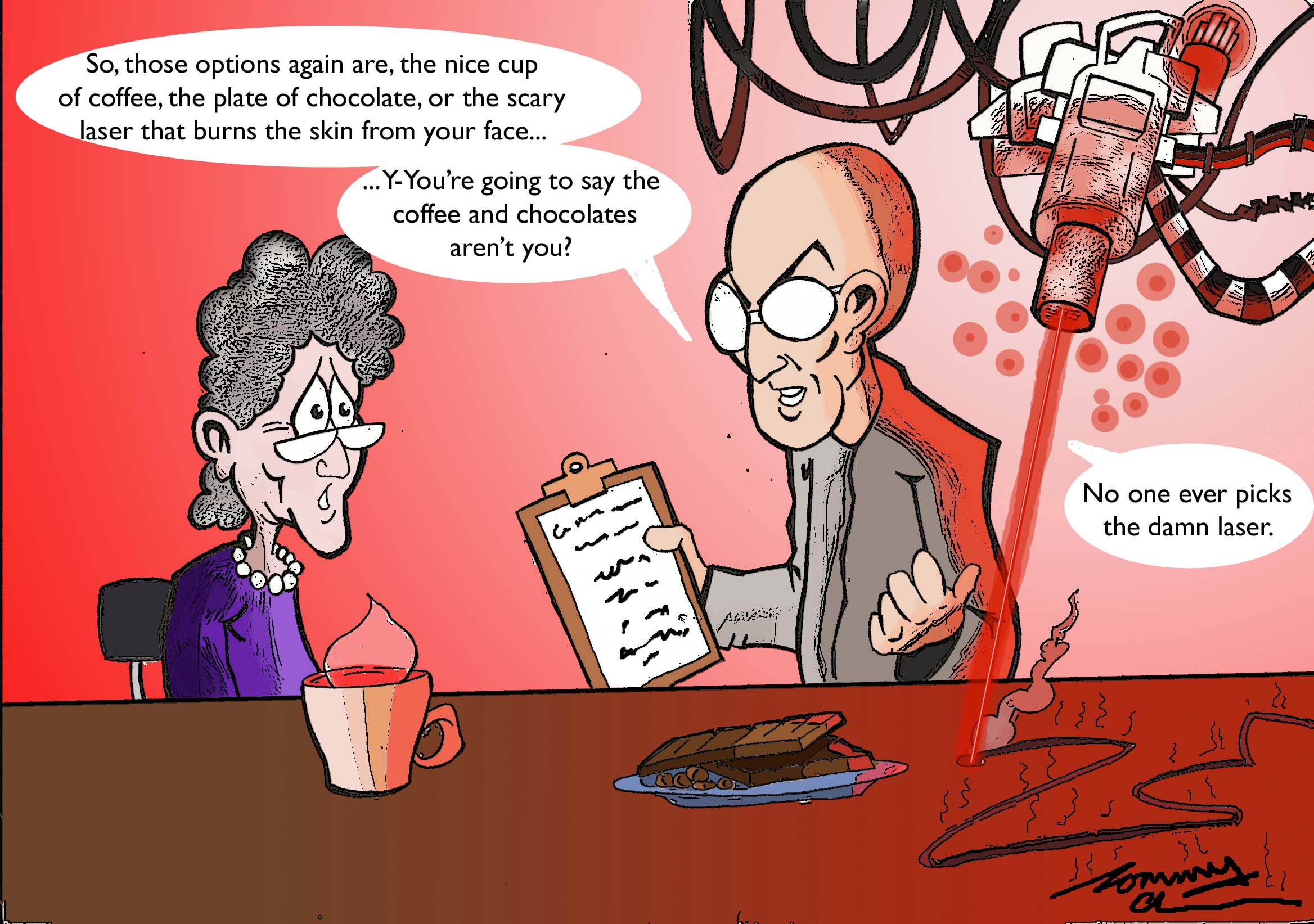
“Coffee cures wrinkles”

Ever in the search to stay looking young, older women are always willing to try new ways to banish wrinkles!

Way back in May 2010, I first wrote about rather scary laser treatment which burns the skin off your face!  The blog was called “Wrinkly Smiles”.  Then rather more happily, I blogged about research that seemed to suggest that eating chocolates were the answer.  This was on the 29 May 2011 called “Dream Chocolates”.

Now a new caffeine based product from America is laying claim to getting rid of wrinkles and puffiness under the eyes by using an”Eye Roller”, whatever that is!  When first launched on the Boots website, it sold out in 2 hours!


Posted in SMILES | Tagged , | 1 Comment

“Southern Cross Cards Collapse”

Since the last hand of cards were played in this most callous of games (click on Southern Cross in the TAG CLOUD to see previous posts on this subject), the players have all been re-assessing their hands before placing their bets and playing their next cards.

In the last round, Southern Cross Management played their only card and bid to reduce rents by 30%.  The bankers and landlords reluctantly failed to agree.  Then in the next round of betting, SCM had no more chips to play and were forced to throw in their cards.

250 homes will be taken back and managed by their owners (Four Seasons and Bondcare Group being two of them).  No doubt they will have to swallow the 30% loss of revenue income to do this.

The residents in the remaining 500 homes will still be left dangling in the air, while their landlords desperately search for new operators.  The bankers and vulture capitalists inevitably had to accept lower rents, they just did not want to come to terms with the changed situation and they were and still are prepared to sacrifice residents’ feelings of insecurity while they deliberate on what to do next.

Meanwhile the two other players, CQC and the Government, are still in the game, whether they like it or not.

CQC act like a ghost in the background as if they have no responsibility for the situation, in spite of the fact that firstly they have a duty to assess the financial viability of care home operators and secondly by their own admission they have major concerns about the quality of care being delivered in many Southern Cross homes.  It’s high time they stood up and acted in the residents’ interests!

The Government (Department of Health) is sitting with most chips to play but is still playing a blind hand with no idea of the outcome of the game.  They started the game many years ago by encouraging the residential care sector to expand rapidly to meet the increasing number of frail older people who needed care.  Then, after the market responded in the guise of Southern Cross and many others, the Government didn’t like the overall cost and commenced squeezing the Local Authorities to keep fees down.  This process started long before the recent credit crunch but was certainly made much worse by the banks and vulture capitalists seeing the elderly care market as a gravy train.

It is time for the Government to stop playing a blind bet with old people’s lives.  They need to declare their hand by getting into the game and taking control of an effectively bankrupt Southern Cross.  The issue goes much wider than this, there are many other residential care operators equally perilously positioned, and Local Authorities social care bugets  and  elderly peoples’ Health Services are no betterplaced in both financial and quality terms.

It’s time for a radical reform of health and care services for older people.  It’s not a card game, it’s a life and death issue for the 31,000 residents in Southern Cross homes, for the hundreds of thousands more in residential care and the millions of older people in the UK who worry about their future as their health declines.


Posted in Care Funding, Residential Care | Tagged | 2 Comments