“Stress linked to dementia”

A long-term piece of research of a group of women in Gothenberg, Sweden, recently concluded that repeated periods of stress in middle-age can significantly increase the risk of developing dementia in later life.  There are several problems with making sense of this conclusion:-

Firstly, the good news is that the majority of women were not stressed;

Secondly, even amongst those who did say they were stressed, most did not develop dementia;

Thirdly, for those who were overstressed, it’s a little too late to tell them not to get stressed twenty years ago.

The only useful conclusion for the researchers seemed to be that a lot more research needs to be carried out.

Posted in HEALTH | Leave a comment

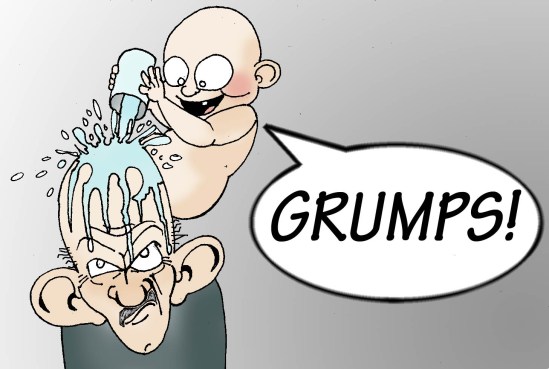
“Christening Granddad”

According to Saga magazine, the baby boomers no longer wish to become “grannies” and “granddads” as they reach their third generation.  Apparently they don’t like the implication that they are getting old.

So rather than becoming proud grandparents and responding to names like Gran, Nan, Nanny or Grandad, Grandpa, all of which are terms of affection and respect in my mind, – they are encouraging grandchildren to call them sugar, buzzy, lala, papeo, foxy and g-dog ?????  I doubt this will kid anyone that they are any younger, least of all their perplexed grandchildren.

What badge would you wear with pride ?

Posted in SMILES | Tagged , | 7 Comments

“Residential Care Dilemma”

How do we greet the news in a recent press release that the Care Quality Commission plans to get tougher with the regulation of care homes?  A few years ago, I would have said “about time”, but now standing back from the problem I am not so sure this is the right way forward.

Older people and their relatives almost everywhere would confirm that residential care is very much seen as a choice of last resort.  Their own eyes and noses are the only quality assessment tool they need to know that most residential care is not up to a standard they would choose if there were a better and more importantly, affordable alternative.  For the lucky few there are some exceptionally good residential care homes with high standards of accommodation and qualified staff but this usually comes at premium fee rates.  New models of provision, such as extracare housing, are still relatively new and not available in most areas nor to the majority of people.

So we are left with most residential care homes acting as warehouses for older people – they keep people warm and fed but have no aspiration to give people any kind of quality of life.  Not surprisingly, even very frail older people are not keen to move in but nonetheless there are still queues at the door.  This is driven by the weight of demographics and the inability of individuals, their relatives and Social Services to cope with people at home, especially those with dementia.

So why don’t things change for the better, given that the customers certainly want better quality, the staff much prefer to work in a positive environment and Social Services and the Regulators want to see improvement?

At the heart of the problems is the fact that the financial model of residential care is flawed and the social care model is based on dependency.

In financial terms, since 1991 when the rules were changed and means tested assessment was introduced, Central Government has progressively starved Social Services of funding for social care.  Having been handed this poison chalice, Social Services have used their near monopoly purchasing power to dictate low fee levels, while simultaneously pushing up the care levels.  In fairness to them they have little alternative.

Small homes became less able to spend money on property upgrading or staff training and have been progressively squeezed out of the market.

In the meantime, corporate providers using the economies of scale, provided larger homes and grew rapidly in the decades between 1985 and 2005.  They were funded by bank borrowing “secured” by the promise of Government revenue and an endless supply of customers.  They also had impossible-to-achieve revenue returns, as debt was leveraged up to build more and more homes.

Now, many of the big residential care companies are on the verge of insolvency due to the combination of high gearing and artificially low fee income.  It is probably only the current low interest rates that keep them afloat.  Quite what the emergency rescue package would be for a large residential care provider going bust – nobody knows.  Hopefully the CQC have a contingency plan for this possibility.  I suppose theoretically they would be refinanced by further extending their debt.  This has already happened in several cases where “forced” mergers/acquisitions have taken place, but this cannot go on indefinitely.

It is this background of inadequate (but unlikely to improve) Government funding and a highly leveraged, financially precarious residential care provision that no doubt stays the hand of tougher regulation.  To close over 70 residential homes in the last 12 months sounds dramatic and indeed may well lead to an early death for many of the 700 residents who have been forced to move as a consequence.  However, closure of 0.3% of the 24,000 residential care homes will make very little impact on the quality of life of the hundreds of thousands of older people living in residential care.

I am not against tougher regulation nor arguing these few homes should not have been closed.  It is just that it fails to address the real issue which is the appalling quality of life which is offered to most elderly people living in residential care.  If CQC wish to have a substantial, strategic and long term impact on quality outcomes, it can’t be through increased regulation and more home closures.  Tighter regulation in itself only puts homes on the defensive and sets experienced regulatory staff on the opposite side of the quality debate to hard working and generally well intentioned care staff.  CQC in its own press release acknowledges that the final sanction of home closure inevitably hastens the deaths of many of the residents who are forced to move out.

So the Care Quality Commission sits on the horns of a great dilemma – in one open hand it has the aspiration to improve quality of life, and the other hand is a closed fist which holds the hammer of regulation.

The Department of Health needs to acknowledge that regulation has done very little to improve residential care in the last thirty years.  I was told by the Head of Regulation some years ago that their role was about compliance – well the evidence suggests that, that blinkered view hasn’t worked.  The brief of the Care Quality Commission needs to be re-focused.

The way ahead lies in the opposite direction to tougher regulation.  The CQC should champion good practice and facilitate learning and skills improvement throughout the residential and domiciliary care sector.  This approach is about preventative health care and support to encourage an active later life.  There is no shortage of residents, relatives and staff who would wish to travel this route.  The alternative only leads to dissatisfaction and distress.

If we do nothing, the tougher regulation road can only lead to crisis.  So enable the CQC turn around and walk the other way – take the high road of aspiration.

Don’t you agree inspiration is better than regulation?

Posted in Residential Care | Tagged | 3 Comments

“Retirement Age Rage”

This is a discussion which will rumble on for ages.  It is one of the biggest social policy issues of our time and one where I have a clear sense of direction, but am not yet sure what outcome I think there should be.  So this is a blog to open a debate.  It poses questions but waits for your answers before forming a clearer view.  Here are a few headings to consider:-

Default Retirement Age

This is the age that it was assumed you would retire and start to pick up your state pension.  It was 60 for women and 65 for men.  I don’t know where this age difference came from?  It doesn’t square with the fact that women live longer than men – so why should they enjoy more time in retirement.  Currently this inequality is being phased out, and leveled up to 65, albeit over a very long period of time.

The equality issue has now been overtaken by age discrimination considerations and on that basis the default retirement age looks likely to be swept away by October 2011.  This must be correct.  It cannot be right to force people to leave work purely on the basis of age and many employers have already waived compulsory retirement.

The Cost of Retirement

There is an underlying economic argument in favour of later retirement driven by the suggestion that we can’t afford to let people retire.  Certainly it’s true that most people don’t save enough for their retirement.  This is largely because pension schemes did not anticipate increased longevity and are now significantly under-funded.  Worse still, Central Government did not save anything at all for public employee pensions and will increasingly be severely embarrassed by the need to cover the costs of final salary pensions.  I am not at all sure this argument stands up if the economy is not growing and people who don’t retire displace younger people who can’t get a job and claim unemployment benefit.

Nonetheless, these two drivers of human rights and economic necessity seem to have enabled Government to move very quickly to declaring the default retirement age dead.  What’s more it has been accepted without much debate, which suggests it is an acknowledged fact that we need to retire later.  Rather ironic when I have just retired myself.   Perhaps I better get back to work again – there are certainly a lot of un-thought out consequences to scrapping a fixed retirement age but generally the Government getting out of the way and letting people make their own decisions is an approach I agree with. 

Health Care Costs

The bigger issue which is only marginally addressed by removing a fixed date to retire is – how is old is age to be funded in the future?  This is not a debate about pensions – inadequate as they may be – it is really an issue of how health care for the elderly should be provided?  And how it should be funded?  It is a matter which is central to the future of western society and will call into question all our values and beliefs.

So before I venture forth with any proposals I would welcome your comments on your own experience of retirement and your views on how retirement can be funded in the years ahead ?

Posted in ELDERLY UK POLICY | 4 Comments

“Fog of Confusion Lifts”

At long last, the inappropriate named N.I.C.E. – National Institute of Clinical Excellence – has agreed to reverse its decision on the early use of Aricept and other similar drugs which have been shown to slow down the onset of Alzheimer’s Disease.  Their original ruling to stop doctors prescribing the drugs was based on their view that they were not cost effective at £2.50 per patient per day.  That was met at the time with a hail of protest which fell on deaf ears.

Since then there has been a relentless three year long campaign conducted by the Alzheimer’s Society with the aid of The Daily Mail, challenging the decision both legally, which they lost, and in the press, which won.  The public announcement by the author Terry Pratchett that he had the disease, undoubtedly helped raise the profile of the campaign.

Eventually N.I.C.E. reworked its financial calculations and accepted that the cost benefit of the long term savings in hospital and residential care admissions could more than justify the initial cost of the early use of the drug.  Quite why it took three years and much distress to figure this out, remains a mystery.  At least we have a Government sponsored Quango that corrected its mistake even if it didn’t go so far as to admit it.

Nearly three quarters of a million people in the UK suffer from Alzheimer’s Disease and yet less than 50,000 people are prescribed these drugs.  What is now needed is another massive campaign to encourage a big increase in take up, although sadly it may be too late for many sufferers whose condition is too far advanced to benefit.

The broader significance of this decision goes beyond dementia.  It potentially heralds a positive switch in the direction of preventative health care.

Posted in Dementia, HEALTH | Tagged | Leave a comment

“Memories in the making”

This is the name of a really creative activity programme for people with dementia.  It is based at the Kemp Center for the Arts in Texas and is being piloted by the Alzheimer’s Association.

The project encourages people with varying degrees of dementia to paint images from their memory.  Apart from the obvious therapeutic value of creating an artwork, it is tapping into a side of the brain which may not be so affected by the illness.

This would be an idea which should be followed up in the UK.


Posted in HEALTH | 3 Comments

“Signs of the Times”

Two full page advertisements in The Times today aimed at older people can’t be cheap.  The fact that they are there at all is an indication of the growing importance of the elderly market.  Less surprisingly they are promoting three products which seem to define the stereotypical view of the elderly market – mobility scooters, stairlifts and walk-in showers.  This imagery all reinforces the view that as you get old you’re going to end up frail and immobile unless you purchase these essential but very expensive pieces of equipment.

The first advert is for Quingo Mobility Scooters; a very comprehensive illustration of the chair and all its features and variations.  Just two slight worry areas.  Firstly, there is no mention of the cost of the scooter, but it is obviously not cheap, since they are offering “free gifts” worth around £600 when you purchase one during October – no pressure?  Secondly, there is a small print footnote to say you cannot buy these scooters in mobility showrooms or on-line, which probably means you’re going to get a home visit from a company sales person.  No pressure??  These may well be great products but if they are, why the reticent sales information?

The second advertisement is prominently branded “Age UK”, “Age Concern” and “Help the Aged” which I am sure gives great credibility to the products for anyone considering a purchase.  Again there is no indication of the cost involved.  Understandably a survey will need to be carried out – which will guarantee you a home visit – but not from the charities whose name is plastered all over the advertisement.  Again, in the small print you find the products are provided by the Minivator Group.  Also in the small print, there is carefully worded reference to the profits being shared with Age UK.  That’s “up to” 50% of the “NETT” profits generated by “THIS ADD”.  Full details of the profit sharing arrangement can be obtained by making a written application.  I doubt many people do that – but I will and I will let you know what it says.

Given the excellent reputations of the Charity Organisations involved, I am sure this is a sincere promotion.   It would be good therefore to see a clearer view of the costs and the actual profits shared.  Surely if it’s a good fundraiser for Age UK, they would be proud to talk about it?

I am going to follow up both these advertisements and will report back on the responses I get.

Posted in ELDERLY MARKET | Tagged | 4 Comments

“Clutching at Hope”

It would be a strange world if we lived our lives from news headlines to news headlines.  The Swine Flu pandemic mobilised action all around the world and then disappeared in a sneeze rather than becoming the next Black Plague.

So what are we to make of the Daily Mail’s 9th September claim – “10p pill to beat Alzheimer’s”.  Firstly, if it turns out to be true it will be good news for millions of people, not just the sufferers and their carers but also many more older people whose first memory lapse raises the prospect of a much worse fate awaiting them in their years ahead.  Behind the headline is a research study from Oxford University which suggests that high doses of Vitamin B may significantly slow down the development of Alzheimer’s Disease.  The researchers are quite rightly saying that more studies are required and it could be five years before firm conclusions can be reached.  This caution is also echoed by Alzheimer’s organisations.

The problem with sensational news headlines is that they may raise false hopes for all the worried elderly people with slight memory loss who may not have Alzheimer’s at all.  It would indeed be a miracle if dementia can be cured or at least dramatically slowed down by a 10p vitamin pill.

Only a few weeks ago I was reading about strawberries being a potential cure for memory loss (see Fruitful Research dated 10 April 2011) and earlier reports suggested walking, brain training and even eating walnuts may help.  Such is the desperation of so many people who are worried about their future that they may try any or all of these.  I doubt much harm will come to you through getting more exercise nor by eating more fruit.  What might do more harm is over-simplified headlines which do a disservice to serious researchers and leave sufferers and their relatives clutching at hope.

Posted in Dementia | Tagged | 1 Comment

“Conker Memories”

I got up early this morning and discovered a beautiful sun-shining autumn day; perfect for a walk in the Northamptonshire countryside. A no excuses to stay in bed day.

So walking shoes – dusted off. A lightweight jacket in case of showers; check pockets filled with hankie and inhaler; apples for me and any horses I might encounter; notepad and pen to capture any passing thoughts – otherwise long forgotten by the time I get back home; and my trusty ordnance survey map to keep me on the public footpaths. Finally – the these days indispensable mobile phone to call in the rescue helicopter if I get lost.

As I am about to step out of the door my wife throws me a challenge – “if you see any conkers bring some back to put around the house, an old wives tale says they scare away spiders and it worked last year”.

It doesn’t take long to drive away from the hustle and bustle of modern life. TV and traffic noise quickly banished. I return to a rural idyll I stumbled across a few weeks ago. A country estate four miles from the nearest major road. The main house once a hall of Lordship grandeur – no civil war revolutions here – brought down to earth by the grim reaper and the taxman’s death duties. It’s now a luxury country house hotel exclusively available to guests with only a weekend-long interest in rural life. No oak trees planted by these passers by.

Still I am left to enjoy the peace and quiet and the legacy of trees planted two centuries ago – Oak, Ash, Beech, Sycamore, Walnut and Chestnut all proudly standing a hundred feet high still dressed up in their summer coats of leaves not yet yielding to autumn.

Farmers with their tractors and ploughs dance around their base but these statuesque specimens are too noble to be brought down by the ravages of more economic farming.

These are the trees of my youth. I grew up in Abergavenny with my bedroom window looking over Bailey Park, and not-so-distant views of the Brecon Beacons. Right outside the house was a giant Horse Chestnut tree, which in spring was decorated, like a belated Christmas tree, with white flower candles. Quietly throughout my childhood summers, the flowers turned to spiky fruit high up in the unreachable branches of the tree. Then the first windy day of September began a flurry of sporting activity. Who could find the biggest and best conkers? Initially fallen from the most ripe fruit. Then later, more reluctant and harder conkers had to be encouraged by an army of little boys throwing sticks into the trees; the occasional reprimand from parents when sticks fell back on cars or pedestrians. Even worse the park-keeper complete with blue uniform and whistle would chase us away and threaten us with being “reported” – to who I don’t know. By strange coincidence, given my mission today, we called him spider – though never to his face.

“Spider” went off duty at six o’clock and locked the park gates for the night. Leave it half an hour and we could climb over the railings and return to our task of filling our pockets with conkers.

The following day in the school playground your best conkers were already laced up and ready to go (no shoe laces these days!) Your spare conkers could be swapped for the cards out of packets of tea. Some of the more cunning and more experienced boys may have soaked their conkers in vinegar for days or baked them in the oven, but this was “illegal” and so nobody talked about it. These days it would probably be grounds for a no-win, no-fee court case for fraud.

The playground jousting lasted for a few weeks. Some peoples’ hopes were dashed in the very first game with bits of broken conker flying everywhere. A field day for health and safety officers who, no doubt, would ban this dangerous past-time and probably prosecute teachers and parents. Meanwhile we were too innocent to know the danger we were in so we just had fun. If you won your conker became a twoer, a threer, a fourer, a fiver and so on. If you got to ten you achieved real status in the whole school. By the end of the fortnight if you were the last man standing you became the school champion until next year. A position much more important in the playground than academic achievement.

So returning from my walk pockets full of conkers had brought back many happy memories and “old wives tales” being true will frighten spiders away for another year.


Posted in SMILES | 4 Comments

“What’s a Photo Biologist”

By now we are all well aware that being outside in too much sun causes wrinkles.  Slap on at least factor 30 sunscreen before you read any further!  Apparently some photo biologist researchers in France have shown that the sun’s rays, even through glass, can double the increase in skin ageing.  They found that office workers who sat next to windows had significantly more wrinkles on the side of their face closest to the window.  All you need to get an even tan would be a swivel chair and a second desk. 

The researchers also studied car drivers and found that they had more signs of skin damage on one side of their faces.  Perhaps the French should have two cars – one left-hand drive and one right-hand drive – then they can get an even tan.

Alternatively, at a time when the French have been contemplating banning the Burka, perhaps they should be requiring all French drivers and window-hugging office workers to wear Burka’s on grounds of health and safety.

Not to be outshone in the UK, some researchers at Lancaster University found that even on autumn days UVA radiation can lead to premature ageing of the skin.  An eminent Professor or Photobiology said 90% of visible signs of ageing are due to the sun’s rays.  It must have taken years of study in expensive beach locations in the Maldives and the Caribbean to figure that one out!  Still it makes up for a good chat up line – “excuse me, do you mind if I stare at you in your bikini, I am a Photo Biologist?”

P.s. this research is published by Boots who happen to be introducing a new line in sun protection.

2 Comments