“Sugaring the Pill”

When I was a child and not very well, my mother used to give me a spoonful of jam to get me to swallow any tablets or take any nasty medicine.  Most children have an inborn dislike of pills and potions.  It seems that by the time we get to sixty plus, we have all learned to love them, if we go by the amount of medication consumed by older people.

See my early blogs:-

  • “Pill, Kill or Cure – 17th July 2011
  • “Pilly Galore” – 19th December 2010
  • “A Pill for Everything” – 7th September 2010

or just look in the TAG CLOUD under PILLS

I wonder how this pill popping dependency came about?  Judging by a recent report in the ‘Mail on Sunday’, it appears that the drug companies have found a way of sweetening the pill by using the same approach as my mum, but in a rather more extravagant way.  It appears that in the name of “educational and scientific meetings”, NHS staff are being taken to exotic locations and luxury hotels to learn about new drugs and medical treatments.  Obviously doctors and senior NHS managers need to get away to far off places before they can think clearly. Evidently, far away places which are Centres of Learning, like Mauritius, Las Vegas and Sydney, are natural destinations.  The Health Trusts involved assure us that there is no possibility of their staff being influenced by their all expenses paid trips.  Absolutely no chance at all!

Furthermore, there are other safeguards to avoid corruption – the drug companies have very strict rules about providing hospitality(presumably that means they HAVE to provide it) and the NHS has a clear division of responsibility between the prescribers of drugs and the staff who agree to purchase contracts (I assume the prescribers go first class to the far off destinations and the purchasers only get to go to a caravan site in Bognor Regis).

Posted in HEALTH | Tagged , | 1 Comment

“Dangerous Road” 3

Three articles on successive pages of The Times last week (5th September 2011) made for an uncomfortable juxtaposition.  They were entitled “prosecutors clear the way for assisted suicides“, “MPs given poll warning on abortion” and “jails to help ageing prisoners die with dignity“.  They were unrelated issues written by separate journalists but there is a thread which joins them and leads in an ominous direction.

The first article continues the theme of assisted suicide which I have been writing about for the last year.  See my earlier blogs:

  • Dangerous Road 2 – 24 August 2011
  • Dangerous Road – 20 July 2011

It marks another step down a very slippery slope.  At least 30 people suspected of helping a friend or relative to commit suicide have been referred to the Crown Prosecution Service, but none have been prosecuted.   This has all happened in the last eighteen months, since new guidelines were issued which suggested no prosecution should take place where the act is taken out of compassion by a relative.  This follows on from the Debbie Purdy case which I commented on in my blog “Lucy Died Today” dated 22 March 2010.  The Director of Public Prosecutions issued 8 pages of guidance aimed at clarifying the position on prosecution whilst continuing to affirm that assisted suicide is still illegal.  I doubt many people will read the 8 pages in their contemplation .

The second article about abortion is maybe a history lesson in how the law can be gradually changed by a series of reasonable steps which eventually lead to a point a very long way from the start of the journey.  Fifty years ago, abortion was a taboo subject and illegal in the eyes of the law.  That led to “back street abortions” and unforgiving attitudes.  The sexual revolution of the 1960’s opened the door to a more tolerant attitude to abortion and “medical grounds” became the new criteria of acceptability.  In turn those definitions have been widened further to the point of “abortion on demand”.  200,000 abortions were performed in the UK last year and the debate has moved to who should provide counseling.  The law as a barrier to abortion, would seem to have disappeared completely.

I am not saying that the early loosening of the law was wrong, just that when laws become guidelines, the boundaries of acceptability become very blurred.  Ultimately the law is effectively changed by default, rather than by clear decision.  In the intervening years, there is a great deal of anxiety, and case-law is made up as we go along.

You have to wonder whether this is the road we are about to travel with end of life care in relation to “assisted death”.

The third article is about the treatment of the increasing number of older prisoners, who end their lives in jail.  It argues for better provision for inmates to cope with increased frailty, poor mobility and memory loss as they grow old.  Given that the state is in an inescapable position of responsibility, steps will have to be taken to ensure the Government doesn’t get sued for poor treatment of pensioner prisoners.  Let’s hope they are cared for rather better than poor pensioners on the outside who are incarcerated in their own homes or neglected in residential homes and NHS hospitals.

Faced with these three different scenarios, you have to worry in the years ahead how long it will be before a hard pressed Home Secretary joins all the stories together and weaves a very dangerous thread 😦 .

Posted in Assisted Suicide, ELDERLY UK POLICY | 2 Comments

“Granola Wars” 2

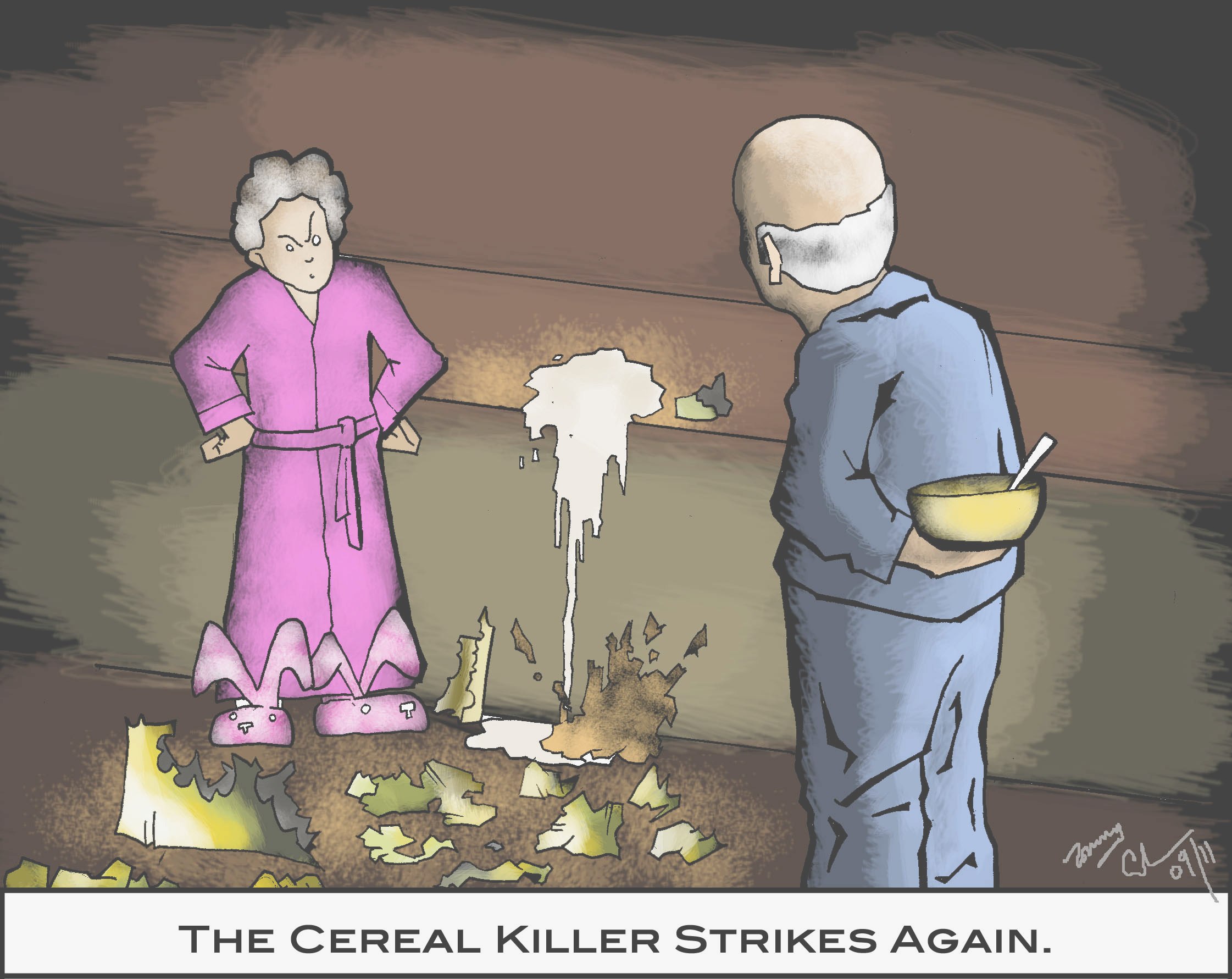
My struggle with packaging and in particular breakfast cereals, continues.  (See my earlier blogs in the “archive” on Breakfast Exercise dated 6th September 2011, 27th March 2011 and 20th February 2011 and Granola Wars dated 19th June 2011).

This morning it was all the fault of that well respected high street brand Sainsbury’s.  It was a lovely morning – I woke up refreshed and ready for a new day – I wasn’t looking for a fight.  Then I picked up a brand new packet of Fruit Muesli.  Sainsbury’s have obviously been watching the TV Programme “Dragons Den” and seen Theo Paphitis dismiss new entrepreneurs whose products he can tear apart with his bare hands.  Sainsbury’s are made of sterner staff – they must have resolved that nobody is going to ever open their products.  How about a new slogan “everlasting muesli – best before 2061!”  50 years is about the time it will take you to open this product.

Before going any further and having learned from my previous encounters with cereal packets, I first read all the writing on the outside of the bag, with the aid of my magnifying glass, which I now always carry around with me in my pyjamas to deal with early morning small print.  On the packet was the usual helpful information:-

  • A breakdown per 50 gramme serving of all the nutrients to the nearest tenth of a gramme – do I really need this first thing in the morning?
  • The ingredients contain sultanas, raisins, dates, bananas, apricots, apple and SULPHUR DIOXIDESounds like it will be good for clearing the drains!
  • As a “footnote”:-) on the packet I am told that Sainsbury’s recommend at least 30 minutes of brisk walking every day – they clearly haven’t factored in the energy you have to use in opening the packet, otherwise they would know you have none left for walking!
  • The one thing I was in need of was some simple hints on HOW TO OPEN THE PACKETIt would not surprise me if it is written in invisible ink.  Just a little “tear here” or a “cut along the dotted line there” or best of all a “pull the tab to open”.  But oh no that would be too easy – Sainsbury’s like to give you a challenge in the morning.

I know I could cut it open with a pair of scissors but that can’t be right – how would I re-seal it?  Surely 30 servings are meant to last for at least a month.  So I guess I have to resort to the usual tug of war – me versus the packet.  I’ve been there before but this packet is like trying to tear a telephone directory in half.

E     V       E           N            T            U              A                L                  L                   Y

I win – the packet breaks and I manage to spill 1 kilogram of muesli all over the kitchen floor!

Posted in SMILES | Tagged | 6 Comments

“DON’T FORGET SEPTEMBER “

September is  World Alzheimers Month,  although I would not have known, if I had not been reading my copy of the Trinidad and Tobago Newsday newspaper.   Sadly I was not lying on a beach in the Caribbean at the time 🙂   I guess not too many people read this paper, so I wonder how many of the worlds’ population know about ” WORLD ALZHEIMERS MONTH ”  ?

They should do, because millions of people around the world suffer from the disease —  35,000,000 is the best estimate I can find.   Furthermore, the numbers are increasing drammatically as the global population ages and currently, there is still no cure in sight.  This is truly a pandemic of epic proportions, which could engulf our ageing societies, particularly in the west and in Japan. It will put enormous pressure on health services and an unbearable burden on relatives all around the world.

Dementia is the very first thing I blogged about way back in February 2010, under the heading “Lest We Forget”.   { All my earlier posts on this subject can be found by clicking on ‘dementia’  in the TOPICS list. }   For this month I will write an additional blog each week on the subject and see if I can find some positive examples on the web of significant  progress in treating this most challenging of illnesses.

Posted in Dementia, HEALTH | 3 Comments

“Welcome Research – Cheers ” 2

Almost a year ago, I wrote about research in Norway which suggested that moderate drinking of wine every day  (oops! I might have added “every day” myself)  can improve thinking skills and may even prevent dementia   🙂 .

BUT    not for men    😦  .

Ever since,  I have been trying to prove this appalling dishcrimination againsht men wrong.    So far, so good,  it has been working,  I haven’t ffforgotten once to have a drink and I remember lots of fhings.

Now the good news.  Researchers at Loyola University in Chicago have done a study of studies on the effect of drinking among 365,000 people.  They concluded that moderate drinking can protect against dementia,  possibly as a result of better blood flow to the brain.    They claim that moderate drinkers were 23% less likely to suffer mental decline.

Interestingly, their definition of “moderate drinking” was 1 or 2 glasses a day.

Sooh,    I am obvioushly     not drinking     enuf

P.S.   Another review by “The International Scientific Forum on Alcohol” which is sponsored by the drinks industry in America concluded the schame FHING!    And they can’t possably be influenced by drink can they !

Posted in Dementia | 2 Comments

“Plastic Fantastic”

A recent article in the Daily Mail on the 15th August 2011, reported on an 83-year-old lady in America who caused quite a stir in the medical establishment when she decided to have breast implants.

This really had me in a quandary, because generally, most people and I include myself,  tend to frown on the idea of plastic surgery purely for cosmetic sake. 

 Isn’t it just the domain of the rich, the famous and the vain?

As our population ages, more and more women are opting to improve their appearance through cosmetic surgery.  In America it is a growth industry – 84,000 such procedures were performed last year – on face lifts,  eyelids  and breast operations.

The medical profession is divided about the ethics and clinical wisdom of such operations on the elderly.

  Meanwhile, Mrs Kolstad, who still works full-time at the age of 83, just wants to be noticed.  I’m sure she has been made aware of the risks of an operation like this at her time of life and as she lives in America she will definitely be paying for the privilege.  She sounds very much like a lady who is more than capable of making up her own mind. 

 Bigger boobs is certainly one way of combating ageism and turning grumbles 😦 into smiles 🙂

Good on you Mrs Kolstad !

Posted in ELDERLY MARKET, SMILES | 1 Comment

“Grumbling American Style”

I was surfing around blog sites relevant to older people last night looking for someone with interesting insights into ageing.  As usual most of the things I found were excessively academic articles on gerontology which speak of everyday issues in such highfalutin terms that I quickly lose interest in what they’re trying to say.  The other blogs on ageing, all seem to have a commercial edge and are full of adverts promoting everything from:-

  • wrinkle cream to cosmetic surgery through to dating for seniors;
  • mobility aids to recliner chairs to stair lifts;
  • home delivery ready meals to retirement homes;
  • health cures from the credible to the incredible;
  • pension plans to funeral plans;

Finally I did come across a blog which I think you might find interesting.  “The problem with young people today” is a blog by Don Mills which you can find at http://crabbyoldfart.wordpress.com   which is an incredibly humorous grumbling site.  Many of the issues Don comments on, are probably just as applicable to the UK and fit perfectly into the grumbling image of old people – but with a big smile.

Posted in GRUMBLES | 1 Comment

“Water, Water Everywhere”

Over the last ten years it has become more and more common to hear people tell you to drink more and more water – eight glasses a day / two and a half pints a day / 1.2 litres a day and even 2 litres a day !

Supermarket shelves are loaded down with spring water from the Highlands of Scotland / the Limestone Springs of Derbyshire / The Health Springs of Malvern / The Volcanic Springs of Central France / The Alpine Glacial Streams of Northern Italy.   These days everywhere water springs up, someone is there to bottle it.  Then we can have it still  or sparkling or carbonated or distilled or filtered through charcoal or flavoured with every possible variety of fruit.  No doubt there are many more options I’ve yet to come across.

The message is reinforced by sportsmen and women everywhere taking care to hold the label so you can see the brand name on the bottle.  At Wimbledon several swigs are required between each change of ends – whatever happened to Robinson’s Lemon Barley Water?  At Golf Tournaments a drink of water is necessary on the tee at each hole and between each shot when walking down the fairway.  Watch Leicester Tigers play at Welford Road and you see a pitch invasion of water carriers on and off the pitch at every opportunity.  In my day playing rugby you were lucky to get a small orange segment at half time !

In the London Marathon every kilometre has a market stall of bottled water, although most of the runners seem ungratefully to pour the water over their heads.  Next year “Head and Shoulders Shampoo” are sponsoring the race and they will be adding their product to the water.  In the 2012 Olympic Stadium, there will be water pipes strung above the race track and the Athletes will be attached to “Pellagrino Move-Along Drinking Straws” that will follow the runners throughout the race.  In the Steeplechase, the Athletes will be credited with an extra 10 seconds on every lap to give them time to stop and drink at the “Evian water jump”.

A report in the British Medical Journal casts doubt on this obsession with drinking so much water.  It suggests that Government guidelines on drinking so much water are “worse than nonsense” and that the virtues of water guzzling are exaggerated by bottle water brands. 


Posted in SMILES | 4 Comments

“Dangerous Road” 2

A couple of months ago on the 20th June 2011, I wrote about assisting early death and the apparently more liberal attitudes to euthanasia in Holland, albeit with some safeguards.

A graphic illustration of the issues is shown in a recently reported case at a General Medical Council tribunal, where a Shropshire GP is facing a misconduct hearing for allegedly hastening the death of a 65-year-old man, terminally ill with lung cancer.  The patient had been given a large dose of pain relief drugs in the knowledge that this may hasten his death.  The family were informed and a specialist was also in attendance.  The man had recently been discharged from hospital, presumably to allow him to die in his own home.  The doctor had visited regularly and on his fourth visit in 24 hours, he administered the final drugs.  Over the years this must have happened quietly in the night to many other people, where a caring doctor has eased the painful end to a life.

Now in these more judgemental days, that’s not the end of the story or the distress.  A worried nurse reported this incident as a “serious deviation from end-of-life care standards”.  Thereafter the due process of retrospective assessment takes over, the police become involved followed by the lawyers, then there is no turning back.  What may well have started out as a compassionate and caring act, becomes a potentially criminal act.

It is not my intention to judge the rights and wrongs of this case, merely to highlight the difficulties:-

  • If the patient had been kept in hospital, no doubt the hospital doctor would have had more support at hand but it is the desire of most people to die at home.
  • If the GP and the nurse were able to discuss the options more openly between each other and with the family, they may have reached a consensus decision and the death would have been accepted by all involved.  But it is not easy to have these conversations, especially with relatives, in such stressful situations.
  • If the patient had made a living will expressing his wishes in such circumstances, the decision might have been easier – although not necessarily legal.  However, few people like to think ahead to their death and cancer can arrive with great speed.
  • If there were a more substantial range of home care for the terminally ill, such as “hospice at home”.  This situation may have been resolved differently.  Specialist services like McMillan Nurses have a great reputation in this field.
  • In the year and a half following the patients’ death, the relatives will have found it a very difficult bereavement; the police will have spent time investigating whether they have another Harold Shipman case to deal with; and the GP will have endured the anguish of not knowing if he will be struck off and maybe prosecuted.

These examples and others like it will be repeated many times in the years to come.  If a climate of fear and blame is created, it can only result in doctors trying to keep patients alive at all costs.  More patients will be sent back to hospital to end their lives in a prolonged period of ill-health and pain before they are allowed to die.

Posted in Assisted Suicide, ELDERLY UK POLICY | Tagged | 1 Comment

“Musical Interlude”

A little while ago I read a negative article about a hospital patient being given a tambourine to summon a nurse.  I recently re-read the report more carefully and it set me thinking —– this no doubt well-intended, if thoughtless idea, could be turned from a grumble  😦  into a smile   🙂

Music always lifts the spirit and significantly the hospital where this happened was the Cardiff Royal Infirmary, in the heart of the musical nation!  You could almost guarantee that every patient can play an instrument.  So why not give each patient a different instrument and then the nurses would know who was calling for attention:-

Mrs Jones could have a violin – delicate, polite but to the point;

Mrs Thomas a trumpet – she was always the shrillest voice in the street;

Mrs Davies a xylophone – very sophisticated, Mrs Davies is;

Mr Williams could have the drums in the day room because it is apparently further away and he makes lots of noise;

Mrs Evans a wind instrument – a flute, an oboe maybe, even a trombone but not a tuba – that’s too big – she’s never been short of wind, Mrs Evans;

No tambourines, triangles or small bells here, this is a Welsh hospital and there’s lots of “raging against the dying of the light” to do.

music2 3

At 10 o’clock each day, except Sundays, instead of doctors rounds, the local Brass Band leader could come in and conduct the patients and help them play in harmony.  This could be the only hour of the day when the nurses get a break and a chance to sit down.

The impromptu orchestra could learn different tunes to play for each of their daily needs – “a drink”, “a dressing”, “the toilet”, “my tablets”, “my pillows plumped up”, “a drink again”, “the toilet again”.

Wouldn’t all this be fun?  I’ll bet it would speed up recovery and hasten hospital discharge, as well as keeping the nurses on their toes.  “No time for paperwork, I can hear Mrs Davies playing Handel’s Water Music again”


Posted in SMILES | Tagged | 3 Comments