“Investing in old age”

You know that the age of old age has arrived when investors start investing in it.  It is not my intention on this website to give advice on where to put your money.  In my mind it’s just another form of gambling and although I have no objection to it in principle, I don’t believe in wasting my hard-earned money on risks I can’t assess.

So it was interesting to see in the financial press recently that several heavyweight financial institutions – Swiss Banks – are launching investment funds which focus on The Ageing Population and how they will spend their money in the years ahead.

The funds interests seem well thought out, if rather predictable – enjoying life, health and savings.

Everything from:-

Artificial Limbs………………………………to……………………….antiques
Botox …………………………………………..to………………………. bandages
Cruises………………………………………… to………………………..continence pads
Dominoes ……………………………………..to………………………..
Electric wheelchairs……………………….to……………………….. energy drinks
Fractured femurs…………………………..to………………………..face creams
Glasses………………………………………… to……………………….. gardening
Hip operations……………………………… to……………………….. hearing aids
Investment……………………………………to………………………..Incontinence pads
J
K
L
Magnifying glasses …………………….to ………………………memory clinics
N
O
Prosthetic limbs …………………….to………………………………pick me up tonics
Quorn…………………………………………..to………………………..quiz books
R
Stair Lifts …………………………………….to………………………spectacle wipes
Television……………………………………..to…………………………..TV dinners
U
Vitamin supplements…………………….. to……………………….. Viagra
Wrinkle creams……………………………….to…………
X
Y
Zimmer frames……………………………to …………………..zip fasteners
 

Posted in ELDERLY MARKET | Tagged | 3 Comments

“Don’t let them eat cake”

Recent research in America has re-affirmed that being overweight increases your risk of getting diabetes by 60%!  Perhaps more importantly a high fat diet can also lead to damaged brain cells, which play a major role in loss of memory.

According to the Alzheimer’s Society, “People who are overweight at 60 are twice as likely to develop dementia at 75.”

I guess Marie Antoinette did not do her subjects any favours by encouraging them to eat cake.

The same piece of research from North Western University in Chicago also concluded that pear shaped women were likely to suffer from higher levels of memory loss.  It puts a whole new significance into the answer to the question – “Does my bum look big in this ?

At first glance this research seems at odds with my own experience.  I would say the majority of sufferers with dementia in residential care are more likely to be underweight than obese.

Is this to do with them losing weight after they develop the illness ?

Is it a physical symptom of the disease ?

Or more to do with lack of encouragement and assistance to eat ?

Posted in HEALTH | Tagged | 3 Comments

“A Die-Lemma”

Dying is not a subject most people want to contemplate.  It engenders sad emotions and fearful prospects.  Nonetheless, it is a subject which we will all have to face more frequently as our population ages.

What prompted me to write this blog was a short three paragraph piece in The Daily Telegraph on the 19 April – just a page filler – not a big news story.  The report covered the fact that a Primary Care Trust in North Essex had suggested to care homes that they should not dial 999 when an elderly person was dying, providing they held a “do not resuscitate” form from a resident, their family or a doctor.  The suggestion was that care homes were ignoring such requests and dialing the emergency services anyway.

I am sure this policy is well intended.  It is certainly true that most people would prefer to die at home.  Whereas currently the majority of people die in hospital, all too often in desperate circumstances.  Therefore you can sympathise with GPs / PCTs who are trying to enable more people to die in their own homes.

The problem as ever is in the detail:-

Who decides when someone is dying ?

  • An unqualified care assistant on duty alone in the middle of the night ?
  • An about-to-be-bereaved relative in a late night phone call ?
  • A local doctor covering the night shift who has never met the resident before ?

Who waits in the wings to pass judgement ?

  • The care home owners rightly fearful of ending up in a court action over negligent care ?
  • The Care Quality Commission every ready to be holier than thou with the benefit of hindsight ?
  • The coroner at an inquest weighing the opinions of all the people who weren’t there ?
  • The no-win-no-fee lawyers ever eager for the next lucrative case which can be made to drag on for months / years ?

With these witnesses and prosecutors behind you, it is a very bold person who can make a compassionate decision on life or death.

The medical profession is more and more able to prolong life at all costs, while the legal profession is increasingly geared to assigning blame at great expense.  An unholy alliance accidentally designed to ensure elderly people do not die with dignity in their own homes.


Posted in Assisted Suicide | Tagged | 4 Comments

“Southern Cross Card Play”

In the weeks following my blog “Southern Cross Poker Game” (see 5 April 2011), there have been a few cards played but no winning moves just yet.

Southern Cross Management – made the first move when their Chairman resigned and was replaced by another financier from the existing boardnot exactly indicating a will to change their approach

At the same time the Executive Directors were “strengthened” with a new Operations Directorwith a limited background in nursing care

and a Publications Directorwhich sounds like a sticking plaster solution if ever there was one.

All this misses the point of why the Southern Cross Homes are failing.  Firstly because of avaricious financial agreements which promise to pay disastrously high racked up rental agreementsagreements made by the same financial wizards.

Secondly, standards of care are not maintained to high enough levels, which is why the Care Quality Commission are closing so many homes to new admissions (40 at the latest count)this first play of the cards hardly inspires confidence.  It rather more suggests panic – deck chairs and titanic comes to mind.

Bankers and vulture capitalists (the landlords) – these money men do not move quickly and they are known for keeping their card close to their treasure chests.  They had their first card snatched from their hand by Southern Cross Management when they unilaterally decided to stop paying rent for a month.  The landlords retrospectively agreed not to take action to foreclose for a monthnot that they had too much option, except to spit feathers.

Meanwhile they flag up their interest in finding another operatora bluff if ever there was one.  This is a business they badly misread when they got into it – and now it is not easy to get out.

The Care Quality Commission, the inexperienced player – the butterfly in the game – continues to close admissions to more homes but has no strong card to play without Government approval.  In the meantime, it is working to offload the problem by asking Local Authorities what they will do if Southern Cross goes bustit’s called contingency planning or buck passing.  The S..T and the fan have not met yet.

The Department of Health – Still sits tight holding the strongest hand – an agreement to use beds for NHS patientsbut first there needs to be significant concessions by the money men and no hand can be played by Government until after the May elections.  Even after that a radical change like this is not one to be countenanced quickly.

So Southern Cross residents are left as chips in a phony war of bluff and counter bluff.


Posted in Residential Care | Tagged , , | 1 Comment

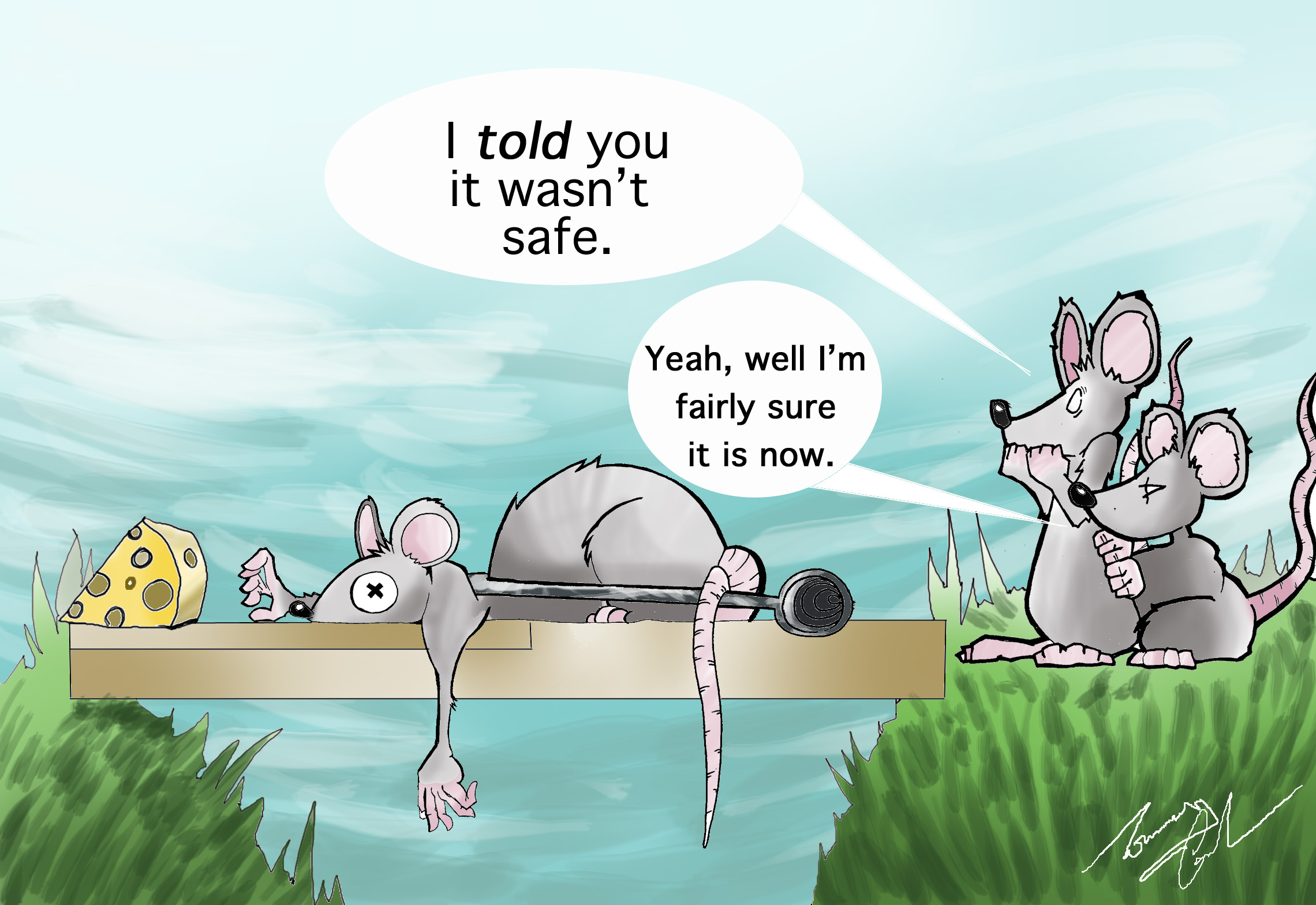
“Mouse Traps become bridges”

The older generation grew up in an era when mouse traps were an every day piece of household equipment.  Mice were a pest and the top cat was the best “mouser”.  It is little wonder that people get grumpy about change when it appears that in spite of these times of austerity, mice now have rights too.

A recent planning permission for a housing development in Somerset required the developer, Taylor Woodrow, to set aside £500,000 to build a “special bridge” for the safe passage of doormice.  As Tom from Disney’s cartoon used to say “I hate them mices to pieces!”

In my many years of building retirement housing, I have experienced significant delays to projects required by planning authorities, who seem to have little regard for cost.  Here are some examples – a colony of swifts were given time to nest and delayed a £30m project at a cost of hundreds of thousands of pounds in increased construction costs; lucky newts were humanely caught and moved to a new habitat whilst elderly people waited another 12 months before their new homes could be built; and finally bats were searched for in vain and never found but at least the environmental consultants racked up significant fees.  I am in favour of protection of wildlife but isn’t this all being taken too far.  Has common sense gone out of the window.

Have we gone completely mad – don’t you think that the money wasted in delays could have built many more social houses for people in need?

Posted in GRUMBLES | 1 Comment

“Memory Plays Tricks”

I have always thought I have a very good memory for things that are important to me, particularly in business and especially with figures, I can recall things from months and even years ago.  But this will be a surprise to anyone who knows me, because I am renowned for leaving things behind, and forgetting everyday things that I have agreed to do one minute and have completely forgotten the next.

At last I have an authorative diagnosis (excuse?) thanks to Scottish researchers carrying out studies into our ever busier lifestyles.  It appears that I might well have BLS – Busy Lifestyle Syndrome.  Oh dear! oh dear!  This could well be why I have been forgetting things for so many years.

This must be a serious piece of work because it is linked to drug companies who are hoping to bring out a new line of pills to combat memory loss.  What a coincidence?  Pilly Galore will be happy if she reads this (see Pilly Galore blog dated 19 December 2010).  Surely this can’t be an example of a drugs company inventing a disease, so that they can create a new money-spinning pill to cure it.

Then again maybe I haven’t got BLS after all.  A Finnish research study found that perfectly healthy people forget upto 30 things a day.  So that’s ok then.

It seems I am not alone – the lost property offices on London’s Rail Network reported 33,000 more items left behind in the years between 2005 and 2008.  Even I could not have left that many things on British Rail so there must be a lot of BLS sufferers, all dropping things on the circle line.

Posted in HEALTH | Tagged | 4 Comments

“Walk for Life” 2

Although they have not yet won the London marathon,  it seems like the Americans are catching up with us.

Back in November last year, I wrote about some research from Bangor University extoling the virtues of 30 minute sessions of outdoor exercise (see “Walk for Life” 14 November 2o10).   Needless to say I haven’t exactly followed this advice enough – the cold weather has been my excuse.   At least I have kept up with my Tai Chi in the garden most days.  Now it looks as though I might not be doing the right thing.   The American researchers reporting to the National Academy of Sciences, showed that a programme of aerobic exercise (walking) over a year, can increase the size of your brain by around 2%.   Whereas stretching exercises like Tai Chi only increased your brain power by 1.5%.

This was a study of 120 people who had not previously exercised regularly.   Being American and loving to do things bigger and better, the study was carried out at four universities at Pittsburgh, Illinois, Rice University and Ohio State (that’s an awful lot of researchers) and for good measure they made their exercise sessions last even longer  — 40 minutes, 3 times a week.

What’s more they did their exercise on a “track” so having failed to win the marathon, they are obviously preparing for the 2012 London Olympics.

Posted in SMILES | Tagged , , | 3 Comments

“A Questionable Bonus”

Generally, as I have commented on in my “Submission to the Dilnot Commission” dated 6 February 2011, I am strongly in favour of a radical change in NHS care of the elderly.  I am less sure about the changeover from PCT’s to GP Commissioning.  In principle, it seems sensible to put clinicians in control, particularly if they are closer to the customer which GP’s are.  However, the changeover is very rapid and GP’s are not best known for their management skills, nor are they immune to the influences of drug companies and the private health care sector.

Controlling the multi-billion pound budget will be a massive challenge for GP’s but the Government has a crude answer to this.  The Health Minister, Paul Burstow, is considering incentivising GP’s to “spend NHS funds effectively” by linking their salary to a “quality premium”. 

I have never been keen on bonus pay, I believe people should be paid the right rate for the job and then motivated to deliver good quality.  Even the best targeted bonus systems can lead to people becoming overly competitive and inclined to take short-cuts to secure higher pay.  Often at the expense of teamwork and resulting in distorted outcomes.

The key questions are who defines “spending effectively” – this could be just code for keeping within budget; and what is meant by a “quality premium” – this should surely be about outcomes, but that might lead to GP’s being selective about the patients they take on their list.  In both cases GP’s might be inclined to avoid  elderly people  who will certainly have higher drug costs and more frequent and longer  hospital admissions.

There is already concern from the British Medical Association that this system might mean GP’s deny treatments in order to maximise their salaries.  This is a justifiable fear since past experience shows that NHS managers had to do this all the time.

Carrot and stick pay structures like this have no surgical precision and potentiallycould lead to very unhealthy outcomes.


Posted in ELDERLY UK POLICY | Tagged , | 6 Comments

“Residential Care Dilemma” 4

I have already forecast that we are heading for a financial meltdown in the residential care market – see “Residential Care Dilemma” dated 12 October 2010 and “Houses Built on Sand” dated 16 January 2011 (both can be found by clicking on the   TOPIC        ‘Residential Care’)

I have never been keen on residential care as a model for looking after older people in later life.  Like everyone else, I would not move into a residential home if I had an alternative.

Almost 30 years ago, it was the next step up from sheltered housing.   Not a step you willingly took because the image was one of old ladies sitting around the edge of a lounge all day, with the TV on to comfort the staff into thinking that the residents had something to do.   Beyond the image was the smell   😦  😦        – never talked about – stale urine told you all you needed to know about the attractiveness of getting old.

There were other things you gave up too  –  your mobility first .  There were few electric wheelchairs and no scooters – they were prohibitely expensive and in most places there were steps and narrow corridors which rendered them useless.  So sitting in a chair all day and rarely going outside becomes the norm.  It’s an existance but not a life  😦

Nor did you have the privacy of your own toilet and shower – you shared with about 10 new-found friends.   The communal bathroom was down the corridor, or maybe you needed the plastic commode in your room.   Little dignity left after this everyday experience 😦

Even more intrusive was the fact that many people had to share a bedroom with a stranger.   A right often justified by owners because “people like company”   😦    A lot has changed for the better in the last 30 years – though not everywhere.

I am still uncomfortable with the residential care model because it builds on dependency rather than promoting independence.  There is a place for companionship and interaction, particularly amongst the frailest and  mentally-impaired residents, who benefit from the stimulation of people around them.  But that does not mean that these most vulnerable of residents should have to suffer the indignities of residential care.

It is these issues that make it so important that we re-think the future role of residential care. 

 Sadly all the current discussion is focussed on the imperative of financial viability.  Qualityhas taken a back seat.  The two issues are inextricably linked.   Neither can be or will be resolved without the other.   It is a classic catch 22 situation.   Without more money you will not improve quality but without better quality you will not get more money !

                                         SO WHO WILL TAKE THE FIRST STEP ?

                                   WE NEED TO TURN GRUMBLES INTO SMILES.

Posted in Residential Care | 3 Comments

“Reflection on Blogging”

Q1  Why am I blogging?

  • I have something to say about all things “elderly”
  • Writing can be therapeutic
    •  
      • Fun when it flows easily – a topic that fires my imagination
      • Frustrating when on an important issue – the simple concepts won’t come to mind
  • It’s an opportunity to work with Tom (son) and to capture his irreverent sense of humour and his talented artistic expression which needs and deserves an outlet.
  • It’s a new career which I could still be pursuing in a bathchair in my garden in my 90’s.

Q2  What should I be blogging about?

  • Social policy is where I started but it is a complex subject riddled with interactions.  There are no black and white issues.  Shades of grey and nuance are not for twittering. 
    •  
      • I am looking for more of a discussion than to be building definitive statements.  Assertion is my most natural style, but in blogging I am more aiming to provoke thought in others and influence outcomes.  
      • So far my “subscriber comments” have been few and far between.  Although their views have added real colour and valuable insight.  One regular and frequent commentator has become my “expert at large”.
  • The second group of issues I stumbled upon are the everyday issues of getting old – pills, print and packaging.  Fun topics with serious marketing implications.  
    •  
      • The market is not age-friendly and marketeers are blind to the lost opportunities before them.
  • Finally, as I am doing right now, the time-out chance to listen, read, observe and reflect on anything and everything but still with a view to finding the elusive wisdom and poetry of ageing.

Q3  Where do I want the blog to go in the long-term?  i.e. what is the vision?

  • Longer term I would like the blog to be a place to go to, to find a valued opinion on all things elderly
  • I don’t know whether this is a 3-year or 30-year project, but there is no business plan so the journey should be exciting – like exploration and discovery.
  • Essential to have a strong element of older people involvement and leadership.
Posted in ABOUT GRUMBLESMILES, SMILES | 4 Comments