“Deaths up = Taxes up”

We have just this week heard the 2016 Budget announcement from the Chancellor —  George Osbourne.   Pensioners have once again been ‘protected’?   No cuts to benefits for older people  — not even to Winter Fuel Allowance.   However the Chancellor keeps reminding us he has a ‘long term plan’, so beware.

Buried in the myriad of supporting paperwork that goes behind the headlines there is a forecast about Inheritance Tax.    It was only paid by 4.8% of people who died in 2013/14, but, because of the increase in the ageing population and rising property values, this proportion will increase to 9.9% of people who die by 2018/19.

This is great news for the Chancellor because, without doing anything, his Inheritance Tax take will more than double.    The even better news  from last year was that thanks to a relatively ineffective flue vaccine, we had the highest number of deaths since 1999.

The total Inheritance Tax take this year is expected to be a coffin full of  £4.6 Billion.   Let’s hope they don’t cremate it!

So, in tax terms the older population can expect to well treated, at least while they are alive and voting.  Although disappointingly there was no mention of additional money for domicilliary care inspite of the big increase in the older elderly population.   However, don’t expect the Chancellor to spend more money on improving elderly care in Social Services or the NHS.    Keeping people alive longer will be more expensive than killing them off and collecting more tax.   God save us from the Taxman !

Fingers crossed for warm winters and Winter Fuel Allowances in the years to come.

Posted in Pensions | 4 Comments

“Age UK” – The Last Straw

Just as I predicted a few weeks ago in my blogs about Age UK’s commercial deals (see “Age UK” in the TAG CLOUD for the previous posts). The Charity Commission have been provoked into action.

The recent negative publicity about Age UK’s energy deal with EON has embarrassed the regulator into taking action to require all charities to “review their commercial arrangements” and to “ensure their commercial contracts reflect the values of the charity”.

This follows concerns about pressurised fundraising methods adopted by several large charities – accosting people in the street (chugging) or bombarding them with unsolicited junk mail and harassing them with unwanted phone calls.    All marketing techniques widely used in the commercial sector, but less acceptable when used by a charity.

Over recent years, with the dramatic reduction in Government grants, many charities have sought to maximise their income elsewhere.  There is nothing wrong with that, providing they don’t forget their charitable purpose or lose the trust of their donors.   However, their charitable integrity should remain paramount and unquestionable.   If this is lost, all is lost.

The tax relief given to charities could be withdrawn if they are seen to be abusing the situation.    Charities are a much softer target for the tax inspector to take on  than Google, Amazon and Starbucks.

Age UK made more than £100 million in commercial income last year, but by doing so in a questionable and non-transparent way they may have done more damage to themselves and to other charities than they realise!

Posted in Pensions | Tagged | 3 Comments

“Age UK – Not So Cheap !”

Just as I predicted, Age UK is back in the news again with more bad news. (This follows on from the three previous blogs which you can see by clicking on “Age UK ” in the Tag Cloud).

After the Daily Mail questioning the value for money of their energy deal with EON, Money Mail has now done an investigation into more of their services.  This time they have focussed on insurance policies promoted in partnership with Ageas :-

  • Car insurance was found to be three times more expensive, £673 compared to £224 with LV=.
  • Home and contents insurance was double for a semi-detached house in Bristol, £161 compared to £88 offered by Halifax.
  • Travel insurance for a couples 8 day trip to Italy cost almost double, at£78 when compared to £45 with Saga.

These examples are all taken from an article written by James Burton.

As happened with the previous example, Age UK’s reaction was predictably defensive which is never very convincing.

If they are not a correct representation of Age UK’s product offers, Age UK should sue the Daily Mail for misrepresentation.   On the other hand if the criticisms are accurate and the scale of the differences in quotations is significant, then Age UK has inadvertently committed a major breach of trust with their elderly customers.

Age UK’s response was ‘Age UK will always offer good value products but cannot promise to be the cheapest for every customer’.

Age UK is in deep water with this issue and responses like the one above will just not do !   If they do not deal with it in a less defensive way they will find themselves being investigated by the Regulators or by an even more high profile Parliamentary Select Committee.

They sold 482,000 Ageas policies last year, worth £21.9 million.

ageuk3

All sorts of companies sell products to older people – everything from double glazing to anti-ageing cosmetics to glasses and hearing aids.  Many of them use questionable sales techniques which fall within the law, but only just.  Sacks of junk mail, endless unsolicited phone calls are all designed to get a high pressure salesman’s foot through the door.  Many older people finding it difficult to cope with this.

Sadly these days you come to expect sharp practices from commercial companies, particularly when selling to older people, but Age UK is trading on it charitable reputation. It is close to abuse of vulnerable people to be taking advantage of their trust in this way.

ManSmilew-BIGboard Cropped 178


Posted in Grey Products | Tagged | 1 Comment

“Age UK – Cheap Products ?”

Almost five years ago I attended the Age UK Annual Conference and below I am publishing the blog I wrote after than meeting.  It’s relevant to the blog I posted on the 14th February 2016 about the Age UK brand.  You can see in the fourth paragraph the remarks made by the new Chief Executive – Tom Wright, setting out the direction in which he was intending to take Age UK.  He has the skills and experience to develop a more commercial and entrepreneurial side to this new charity for older people.  At a time when Government funding for social care was being dramatically reduced and fundraising donations were being restricted by the austere times, who could argue with that approach? 

Brand reputations are not easily built but can easily be damaged.  Trust takes a long time to develop, but Age UK was building on the foundations of its predecessors – Age Concern and Help the Aged which gave Age UK a strong footing at the outset.  Stepping in the direction of more commercial ventures was potentially rewarding but also carried some new risks.  So below is the blog I wrote after that conference five years ago.

“Age UK – Agenda for Later Life 2011” – reprinted from 10th March 2011

On Tuesday of this week I went to the Annual Conference of the two organisations that were formerly called “Help the Aged” and “Age Concern”.

It wasn’t long before I was thinking I had stepped into a parallel universe – the shiny new, new speak world of Age UK.  The world I had just come from only the day before seemed to be an era of neglect of older people and austerity cuts.  In the last few months, there has been so much talk of complaints about NHS care of the elderly, reports by Age UK themselves on malnutrition and 80% Government cuts in Supporting People funding mainly affecting voluntary organisations and charities.  Maybe my expectations were too high, but I had assumed I would see some of the forefathers of Dylan Thomas “raging against the dying of the light and old age burning and raving at the close of day”.

When I saw on the agenda that two of the speakers in a panel discussion on “Integrating Health and Social Care” were Jo Webber, the Deputy Director of the NHS Confederation and Dame Jo Williams, Chair of the Care Quality Commission, I at least hoped they would give the politely listening group of older people some rotten tomatoes for audience participation………………..sadly – no such luck.

The opening speech by Tom Wright, the new Chief Executive of Age UK, was all powerpoint and market speak.  The £100 billion grey market is forecast to grow by 81% between 2005 and 2030.   Tom seemed delighted by this, because it will guarantee that everyone in the years ahead is advised by Age UK, to get insured by Age UK, in case they fall out of their Age UK stair lift, on their way down from their Age UK bath and shower, to a breakfast provided by the Age UK sponsor – Sainsbury’s, who just love older people.

The new speak continued throughout the day.  Everything was “embedded” and definitely “sustainable”.  In this belated 1984 world, we are all “equal” and we all have “rights” – “equal rights”.  We are all “engaged” – presumably to each other? – and everything is “counter-intuitive” or it isn’t because it doesn’t make sense.  Oh! and in the Sainsbury’s bit of the world, the staff are all “colleagues” who intend to “shine their light” on their grey colleagues.  We just need a quick chorus of “Shiny Happy People” and all will be bliss.

Almost euphoric after this first session, I was really looking forward to the tomato throwing in the group therapy session on the NHS and Social Care.  Jo Webber came on and reassured that everything was wonderful in the NHS and there was no need to mention malnutrition (indeed nobody did).  It probably never happened and even if it did nobody was to blame, there was not enough money, the staff were too busy and “lessons would be learned”.

Tom Wright had already told us that 176,000 older people like the NHS so much that they go back into hospital within a month of being discharged.  What better endorsement of the service could a marketeer want than repeat customers!

Dame Jo Williams, the electric Chair of the Care Quality Commission, further reassured us that if anyone at all delivered poor care in future, they would be beaten remorselessly with a big stick.  The audience by this point was so comforted that they forget to throw the tomatoes and politely applauded instead.

The “final solution” in this session came from the new techno age, when Dr Petra Wilson of the American computer software company CISCO Systems told us that help was at hand (or mouse).  It is just a matter of time before all our care needs can be provided by Telecare kettles that report on our health to big brother in the “cloud” every time we have a cup of tea.  In this new world future if we want companionship we can have a digital cuddly toy instead of a pet.  Presumably if you don’t keep talking and stroking it, either you or the pet are dead!   We need never speak to a real person ever again.

Just when it looked like it could not get any better, the Secretary of State for Work and Pensions, Iain Duncan Smith was billed to speak about pensions.  An engineered leak in The Times, The Guardian and on BBC had rumoured that he was going to announce we will all get a £140 pension in future.  He is a very polished speaker which suited this, by now, shiny audience.

Strangely at an Age UK conference for older people, he talked mainly about children and the need to protect their futures in later life.  It was almost as though he was explaining that there wasn’t any money for the current generation of elderly people but that by 2050 everything would be alright.  Then came the crescendo of his speech – the big announcement – when he had raised all hope and expectation this “Quiet Man” lived up to his reputation and said………………. NOTHING!


There was lots of hope and aspiration in the 2011 conference but the recent adverse publicity I referred to in my blog two weeks ago, about Age UK’s recommended energy contracts with EON, illustrates how quickly a good brand reputation can be damaged.  Although the criticism may not have been entirely fair, the undesirable publicity will have done much to take the shine off Age UK’s new brand image.

Age UK Enterprises have also promoted many other suppliers and services and they should look carefully now to ensure there are no pitfalls in their offers, or more damage will be done.  It is only a matter of time before these are investigated.  It would be even more damaging if they are found to offer poor value.

I want to end on a positive note because I feel Age UK have done much over recent years to improve the reputation of the elderly sector.  They just need to be ultra careful in dealing with the sometimes “shady” area of services to older people. 

ageuk2

I am looking forward to seeing Age UK kettles and cuddly toys for older people which still have to be brought to market.   I’m also still waiting for Ian Duncan Smith’s £140 pension for ALL pensioners to materialise, but that’s another story.

Posted in Grey Products | Tagged | 2 Comments

“GPs under pressure”

The BMA is the professional body that represents  the 40,000 GPs in the UK.    However it is increasingly acting like a militant trade union.

Their latest proposition to their members is a handbook of advice with a list of 17 services that GPs should not do.   These are services like:- wound care management, nursing leg ulcers, following up hospital discharges, minor injury surgery services, etc.   All services that are critical to enabling older people to remain living in the community and to return home again after a stay in hospital.   They claim they are ‘inappropriate’ and should be done by someone else.

What this is really about is the growing pressure on the NHS from the rapidly increasing number of older people.    The failure of any recent Government to face up to this, just leads to endless cost shunting around the NHS, between hospitals, GPs and Social Services.   In the meantime expensive hospital beds are occupied by older people, who would much rather return home and be looked after in the community at less expense.

The  British Medical Association which represents all doctors should be more concerned about the interests of their patients.

doctors19 02 16

Instead of looking at things through the eyes of the doctors’ trade union, maybe we make a radical shift to put the power in the hands of the customer.  The Health Secretary, Jeremy Hunt, always argues that the money should follow the patient and this way you would get a service which more reflects individual patients’ needs.  So what if we were to give an allocation of funds to older people to spend as they wished on their health.  This would enable them to select a doctor of their choice and to decide what and how the health services they need should be provided.

This would probably shift the priorities of health care in the direction of preventative health and support in the community rather than concentrating more and more on health services in a few large teaching hospitals.  It would also play to GP’s more customer focused skills.

We are all supposed to be grateful for what we receive from the health service, but it is often forgotten that we are all paying for it through our taxes.  So the health service is not there for the benefit of doctors, it should always be there for the benefit of patients.

The key word, which is not often used in relation to the health service, is customer.

Posted in HEALTH, N.H.S. | Tagged | 4 Comments

“Age UK – A Caution Unheeded”

My previous blog focused on the difficulties that Age UK had got itself into by promoting commercial products and receiving commissions for their introduction.  Essentially, I think this is a good thing to do because it, not only brings income into the charity, but should also facilitate elderly people making good choices in an environment when often they need advice.  Age UK has a very good and trusted reputation and therefore their recommendation is very valuable to suppliers, which is why Age UK are able to secure commissions for the introductions they make.  There is however a danger in this process if the financial arrangements are not entirely transparent. It’s also important that the trust placed in Age UK is mirrored by the terms and conditions of the suppliers’ offer.  Where this doesn’t happen, trust can easily be lost.

Below I have reprinted a blog I wrote in September 2010 which is entitled “Signs of the Times”.  Although this blog was about mobility scooters, my penultimate paragraph underlines the importance of transparency in contract arrangements.  It’s a sad fact that many suppliers of services and products to older people often wrap their product offer in a welter of small print and caveats.  Elderly people need to trust Age UK to look after the customer’s interest in making such transactions and to do it for a modest and transparent price.

I have highlighted the danger signs in the penultimate paragraph in bold type!

“Signs of the Times” – reprinted from 30th September 2010.

Two full page advertisements in The Times today aimed at older people can’t be cheap.  The fact that they are there at all is an indication of the growing importance of the elderly market.  Less surprisingly they are promoting three products which seem to define the stereotypical view of the elderly market – mobility scooters, stairlifts and walk-in showers.  This imagery all reinforces the view that as you get old you’re going to end up frail and immobile unless you purchase these essential but very expensive pieces of equipment.

The first advert is for Quingo Mobility Scooters; a very comprehensive illustration of the chair and all its features and variations.  Just two slight worry areas.  Firstly, there is no mention of the cost of the scooter, but it is obviously not cheap, since they are offering “free gifts” worth around £600 when you purchase one during October – no pressure?  Secondly, there is a small print footnote to say you cannot buy these scooters in mobility showrooms or on-line, which probably means you’re going to get a home visit from a company sales person.  No pressure??  These may well be great products but if they are, why the reticent sales information?

The second advertisement is prominently branded “Age UK”, “Age Concern” and “Help the Aged” which I am sure gives great credibility to the products for anyone considering a purchase.  Again there is no indication of the cost involved.  Understandably a survey will need to be carried out – which will guarantee you a home visit – but not from the charities whose name is plastered all over the advertisement.  Again, in the small print you find the products are provided by the Minivator Group.  Also in the small print, there is carefully worded reference to the profits being shared with Age UK.  That’s “up to” 50% of the “NETT” profits generated by “THIS ADD”.  Full details of the profit sharing arrangement can be obtained by making a written application.  I doubt many people do that – but I will and I will let you know what it says.

Given the excellent reputations of the Charity Organisations involved, I am sure this is a sincere promotion.   It would be good therefore to see a clearer view of the costs and the actual profits shared.  Surely if it’s a good fundraiser for Age UK, they would be proud to talk about it?

I am going to follow up both these advertisements and will report back on the responses I get.

Posted in Grey Products | Tagged | 1 Comment

“Brand Age UK”

Not too many years ago the two leading brands related to age in the UK were all about old age, frailty and people “in need”.   Help The Aged was the main campaigning voice for the sector and Age Concern provided support and advice in local branches all over the UK.    Both organisations did sterling work, but we’re held back by limited resources and terrible brand names.   The emphasis on  ‘help’ and ‘concern’  portrayed  older people as old, past-it and helpfulness.

Then in 2009 in a long overdue move, the two charity’s merged into a new organisation called “Age UK” .   Their new chief executive – Tom Wright – was recruited from outside the charity/voluntary sector and came with stronger commercial experience  having previously run the tourist organisation “Visit Britain” .      He set about building  a much more positive image of ageing and a much sounder financial base for the new brand.

Age UK annual income is around £90 million  and has a broad financial base of charitable donations, grants, retail income from shops and commercial activity.   It is this latter source of funds that has brought them to the attention of the national press and other news media in the last two weeks.

At the beginning of February Age UK found itself in the shining headlines of The Sun newspaper, as a result of an investigation carried out into a commission deal with EON to promote ‘low energy costs’.  The accusation was that Age UK  were making £6million by promoting a far from good value energy supply to older people.    OOPS !

Shortly to be followed by  the host of catch-up  copy cat media, publicity seeking politicians and ever belatedly but always wise after the event regulators.  In no time at all Age UK got more publicity than they could ever wish for !    They immediately went on the defensive and denied any wrong doing, but that just provoked more investigation.   Examples of poor value for money were quoted, which within days lead to the deal being withdrawn.    Now other services recommended by Age UK including car, travel and home contents insurance are being questioned.   Wait until they look at equity release, mobility scooters and burial insurance.    The subsequent evaluations will check the value for money and the commission Age UK receives, which run into millions of pounds.

There is no question that Age UK went into these arrangements with the best of intentions, nor can one doubt the need for  a trusted referral service in an area where there can be a minefield of small print for elderly people to comprehend.     Sadly all the publicity will have done considerable damage to Age UK’s reputation.   To recover from it all they will need to be much more transparent about their commission arrangements in future and much more vigilant in ensuring that their services remain competitive.

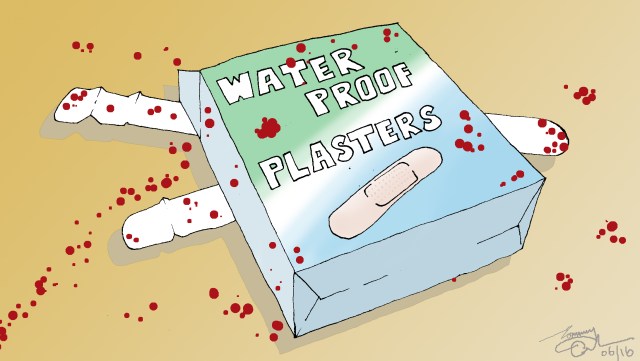
Brand Age UK needs a bandage !

Posted in ELDERLY UK POLICY | Tagged | 4 Comments

“Bloggers Cramp”

There must be something called “Blogger’s Cramp” and I must have had it for a while.   Ideas pop in and out of my mind, but nothing provokes me into writing anything.

I must go to the doctor and see if he has a pill for it.   Then again perhaps not, after all, GP’s are so busy at the moment complaining about how busy they are.   They won’t have time for rare uncommunicable diseases.

Perhaps I could go to the local hospital, but I think the junior doctors are on strike about having to work weekends, so I would have to go as an emergency.    I don’t think  “Blogger’s Cramp” quite qualifies as an emergency.

Maybe I will call in at the local chemist and see what they have on their copious shelves of cures for absolutely everything.   Although I read recently that many of the small chemists are having to close down, due to all the cuts in Government subsidies.

There seems to be no refuge for someone with ” Blogger’s Cramp”.    I will just have to soldier on.

Posted in SMILES | 9 Comments

Pension Follies


The Conservative Party has never been the greatest of friends with the BBC and has long held the view that it is over paid, over staffed and all together to big for it’s boots.    In among his budget cuts last year was a not too subtle shift of responsibility for paying for free TV licences  from the Government to the BBC.    Although it is phased across several years, in the long run it amounts to a cut to the BBC of  £700 million a year, equal to ten percent of it total butget.     Ouch !

In response the Beeb has come up with a great idea for a new comedy series.    Modelled on the very successful charity fund-raiser  “Children in need” .  Each week an audience of wealthy pensioners  who are over 75 years old will be asked,   begged, shamed   or cajoled into paying their £145.50 annual licence fee instead of getting it for free.

Sir Michael Parkinson, a former Older People’s Tsar, has been asked to headline the first show because of his recent expertise at selling funeral plans to pensioners.

It is hoped that Episode two may feature Rod Stewart, Mick Jagger, Cliff Richard and Dame Shirley Bassey, providing the BBC can persuade them to come back to this country from their tax havens.   Of course they don’t have to pay the licence fee themselves as they are tax exiles.    They have been asked to sing a spirited rendition of “Money, money, money” .

Negotiations are rumoured to be taking place with the ever popular Ken Dodd, because of his extensive experience of the British tax system, but the stumbling block may be he reluctance to give up his own free TV licence.

The whole series is still in the planning stage at present, but a BBC spokesman said they are hoping to raise many millions of pounds this way, otherwise they have to reduce some of the huge fees they pay to their star acts .

Post Script :-

Inspired by the BBCs response the Chancellor is now thinking of passing responsibility for the Winter Fuel Allowance to the energy companies.

2 Comments

Pensioners votes taken forgranted.

The Conservative Party has long seen itself as a champion of older people.    It prides and preens itself  as a supporter of British values.  This has kept it in power through the last two general elections, propped up by the votes of the majority of elderly people, who tend to vote and vote conservatively.

One of the central policies related to older people, has been the ” triple lock” on the state pension and the enticing pot of gold elusively placed at the end of the rainbow  —  The new £155 pension.

                                So far we have only seen the rain !

The storey of this unbelievably big rise in pensions has carried the Conservatives through two General Elections on a wave of hope and anticipation.   I first started blogging about it in 2010.  ( see all my earlier posts by clicking on pensions in the Topics list )

I always knew it was too good to be true and through the rainstorm of austerity in the last five years, the rainbow has started to disappear.    It is vanishing with each step into every puddle of bad news :-

  • First of all, although announced in 2010, the commencement date of this wonderful bounty was put back to 2015, then 2016 .
  • As the detail became clearer, it was obvious that it would only apply to NEW pensioners, leaving those who were already retired and those who would be before April 2016, to be left out in the rain.
  • Next came an even deeper puddle.   You needed an extended 36 years of contributions to qualify for the full pension.   This short-changes many people approaching retirement – especially women who have had career breaks to bring up families.
  • The unrelenting rain got heavier still as savings rates plunged almost to nothing.
  • To make matters worse, by the time you finally got your pension pot of gold, annuity rates have reduced by almost 50 percent since the recession started.

When the new pension begins in April this year relatively few pensioners will benefit from it and a two tier system will have been set up  which will enshrine inequality for years to come.  Many grey voters may no longer feel Conservatives can be trusted, but do they have an alternative.

I venture we will hear a lot more about pensions in the year ahead.

Posted in Pensions | Tagged , | 5 Comments